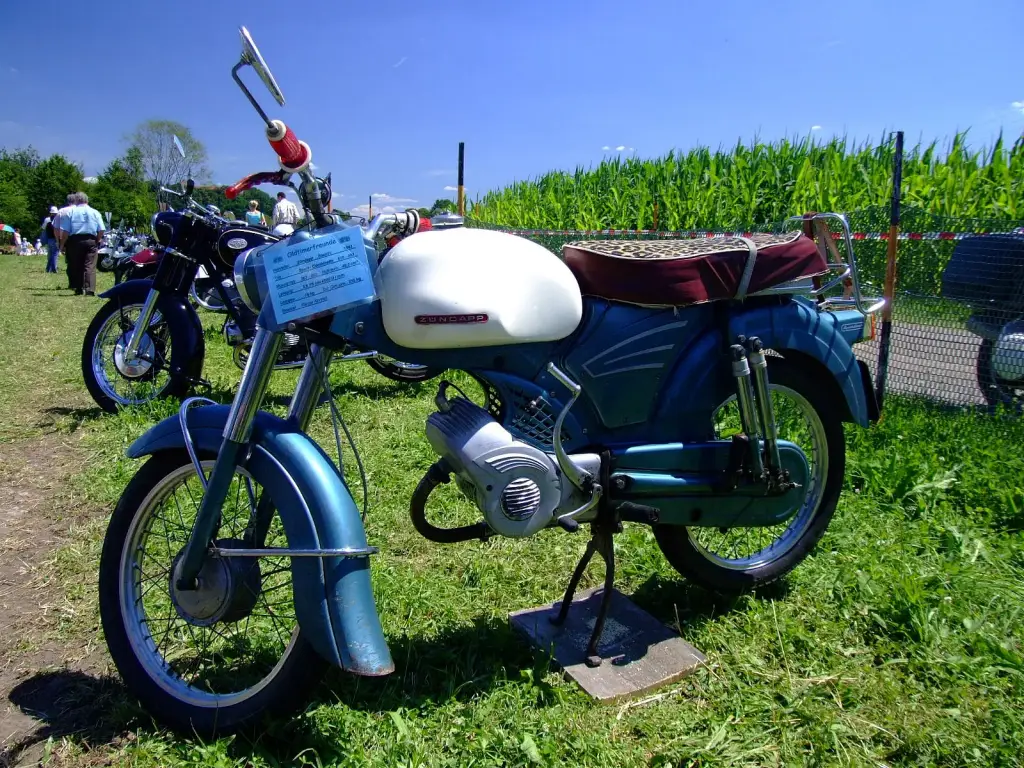
The Zündapp Sport Combinette was a 50 cc mokick that the Zündapp works in Munich built from 1961 to 1967 in the series 510, 515 and 517. Limited by law to 40 km/h, it belonged to the new licence class created in 1960 for small motorcycles without pedals.
Zündapp Sport Combinette at a glance
| Maker | Zündapp-Werke, Munich |
|---|---|
| Production | 1961–1967 |
| Series | 510, 515, 517 |
| Engine | single-cylinder two-stroke, 39 × 41.8 mm |
| Cooling | airflow or fan |
| Carburettor | 16 mm Bing |
| Fuel mix | 1:25 two-stroke mixture |
| Gearbox | three-speed |
| Top speed | 40 km/h |
| Brakes | 120 mm drums, cable front, rod rear |
| Tyres | 2.75 × 21 inch |
| Price | 1,177 DM |
The Sport Combinette is described only on the German Wikipedia; this page is based on that article and the English article on the manufacturer.
History of the Zündapp Sport Combinette
The Sport Combinette was Zündapp’s small mokick of the 1960s, a two-seater from the 515 series onwards. The series 510 was superseded by the 515, which in turn gave way in 1967 to the 517, renamed C 50 Sport in 1968. All of them used the tubular frame with a cast light-alloy tail that was usual at Zündapp at the time. Unlike the 510 with its short swing arm, the 515 had a telescopic fork at the front, and all models ran on 2.75 tyres on 21 inch rims.
The most distinctive feature was the rear suspension of the 510: a swing arm with four spring units, two of which could be brought into play when carrying a passenger. In 1962 the switchability was dropped; the springing was taken over by one spring strut on each side, and two shock absorbers were added so that the four-spring look remained while the arrangement underneath was completely different, with four mounting points on the swing arm instead of two. The same layout carried over to the early 515 before it was replaced by single combined spring-and-damper units, as used on the 517 from the start. The 517 also had a new, lower frame, with a redesigned main stand and mount, new rider footrests and a fully detachable chain guard.
The engine was the robust single-cylinder two-stroke from the 510 series, either airstream- or fan-cooled, with a 39 mm bore and a 41.8 mm stroke, fed by a 16 mm Bing carburettor on a 1:25 petrol-oil mixture. A three-speed gearbox passed the drive to the rear wheel by chain. The drum brakes measured 120 mm, cable-operated at the front and rod-operated at the rear. The 40 km/h top speed matched the new class 5 driving licence introduced on 1 August 1960: a mokick had no pedals but a kick starter.
At 1,177 DM the Sport Combinette cost almost three average monthly wages – the average monthly wage in 1964 was 418 DM. It became famous through Armando Rodrigues de Sá, the millionth guest worker to arrive in West Germany, who was given one of these machines when he reached Cologne-Deutz station in September 1964. The original is now kept in the Haus der Geschichte in Bonn.
Design and features
- Four-strut rear suspension: the 510’s swing arm could call on two extra spring units for two-up riding.
- Cast alloy tail: a tubular frame with a cast light-alloy rear section, typical of Zündapp mokicks.
- Legal 40 km/h: tuned to the class 5 mokick licence introduced in 1960.
- Simple engine: a 16 mm Bing carburettor, three speeds and chain drive.
Zündapp Sport Combinette versions
- Series 510 (1961–): short swing arm, telescopic fork on later machines, switchable four-strut rear suspension.
- Series 515: two-seat mokick with telescopic fork; early machines kept the four-strut look.
- Series 517 (1967): lower frame, combined spring/damper units, detachable chain guard; renamed C 50 Sport in 1968.
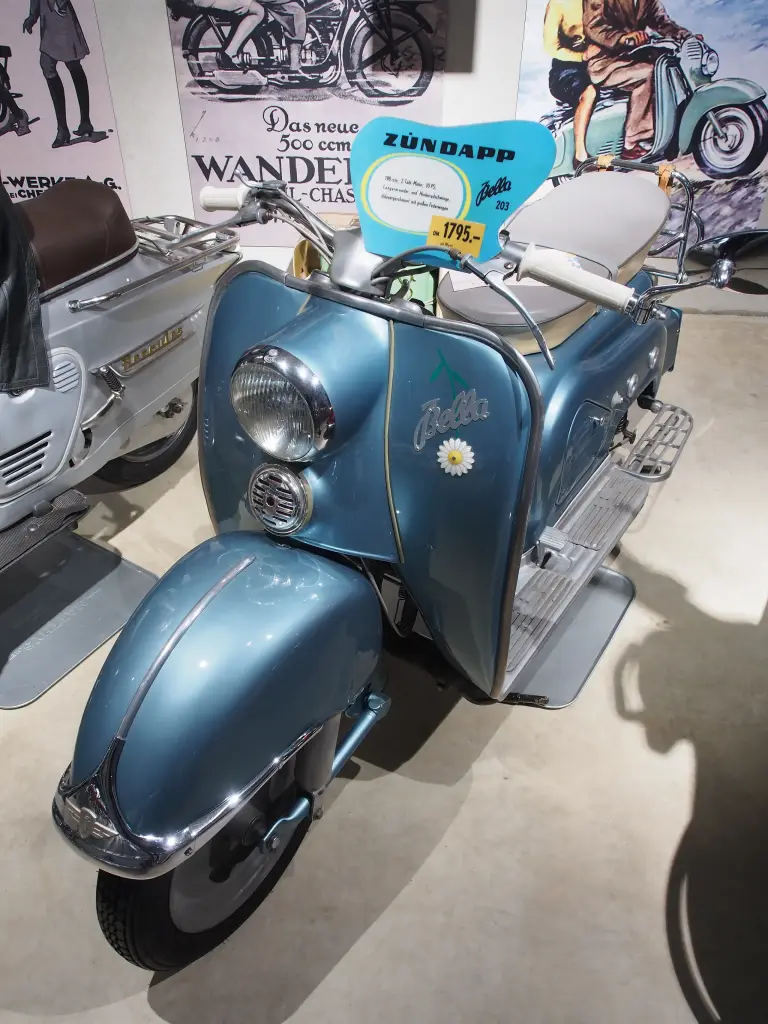
The Sport Combinette belongs to the small-capacity side of the Zündapp range, alongside the Bella scooter. The company’s larger machines are covered by the KS 601 and the DB 200. More models are in the Zündapp collection.
Sources
- Zündapp Sport Combinette, German Wikipedia: series, suspension, engine, price, history
- Zündapp, English Wikipedia: company background and the 50 cc market