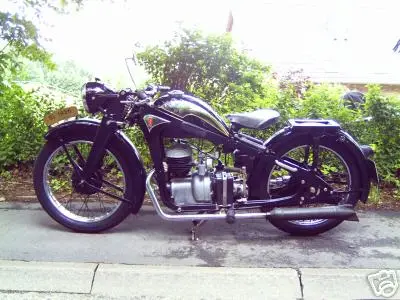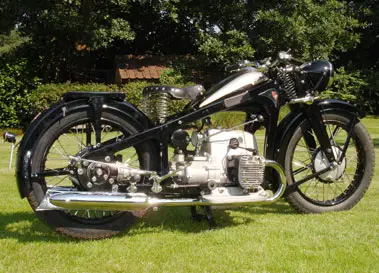
The Zündapp K 800 is a four-cylinder boxer motorcycle that Zündapp of Nuremberg built between 1933 and 1938. It was the largest of the K-series, which in five years lifted the company’s share of the German motorcycle market from 5 to 18 per cent.
Zündapp K 800 at a glance
| Maker | Zündapp-Werke, Nuremberg |
|---|---|
| Production | 1933–1938 |
| Engine | four-cylinder four-stroke flat engine, side valves |
| Carburettor | British Amal |
| Power | 20 hp (1933–1934), 22 hp (1935–1938) |
| Gearbox | four-speed chain gearbox, hand lever on the right |
| Final drive | shaft |
| Frame | pressed-steel K frame |
| Front suspension | trapezoid fork with two springs |
| Rear suspension | rigid, sprung saddle only |
| Tank | 15 litres, over 200 km range |
| Tyres | 3.50 or 4.00 × 19 inch |
| Built | about 2,600 civilian and 4,962 military |
The K 800 has no article of its own on the English Wikipedia; this page is based on the German article together with the English article on the manufacturer.
History of the Zündapp K 800
The K 800 appeared in 1933 and stayed in production until 1938. Its engine was a side-valve four-cylinder flat unit fed by a British Amal carburettor, with a 6 V direct-current generator and battery ignition through a distributor with a centrifugal advance. Power was 20 hp in the first two model years and 22 hp afterwards.
A dry three-plate clutch passed the drive to a four-speed chain gearbox, a design by Richard Küchen that was shifted by a long hand lever on the right side – the ball-change arrangement typical of large Zündapps. From the gearbox a shaft took the drive to the rear wheel. The front wheel hung on a trapezoid fork with two compression springs and friction dampers, replaced by an oil damper from frame number F 140184; at the rear the frame was rigid and only the saddle was sprung. The 15-litre tank gave a range of more than 200 km at a consumption of roughly 6.5 litres per 100 km.
“K” stood for Kastenrahmen, the pressed-steel box frame used by the whole K-series and also by the KS models: K 400, K 500, K 600, KS 500, KS 600 and K 800. The smaller KK frame, Kleiner Kastenrahmen, served the models from the K 200 to the KKS 500. Only the wartime KS 750 was given a frame of oval steel tubes, to stand up to military use. The K 800 was closely related to the K 600, which shared everything but its smaller engine and produced 15 hp and 100 km/h; only 26 K 600s were built in 1933 and 1934, with frame numbers 139 001 to 139 026.
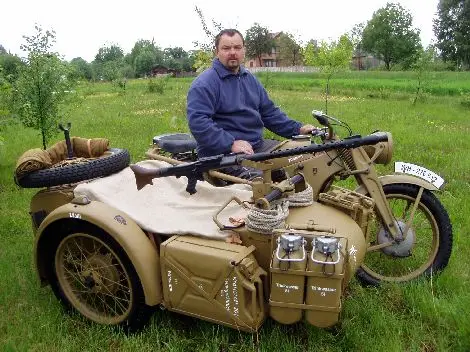
In military service the K 800 was the only four-cylinder machine used by the German armed forces in the Second World War. Alongside roughly 2,600 machines for civilian and other users, 4,962 were built for the army. In the last production year a variant with a small Noris headlamp was made from frame 195 594 to 196 963. The line was continued after 1938 by the KS 600, which used a new overhead-valve flat twin.
Design and features
- Flat-four engine: side valves, an Amal carburettor and a six-volt generator with battery ignition.
- Shaft drive: a cardan shaft behind the four-speed Küchen chain gearbox, shifted by hand.
- Pressed-steel frame: the K frame gave the series its name and its characteristic appearance.
- Military version: the only four-cylinder motorcycle used by the German armed forces in the war.
Zündapp K 800 versions
- K 800 (1933–1934): 20 hp version.
- K 800 (1935–1938): 22 hp version with oil-damped fork from F 140184.
- Late K 800: frame numbers 195 594 to 196 963 with a small Noris headlamp.
- K 600 (1933–1934): the same motorcycle with a smaller engine, 15 hp, 26 built.
The K-series was followed by the KS 601, the last shaft-drive Zündapp, while the smaller DB 200 brought the marque to a far wider public. More models are in the Zündapp collection.
Sources
- Zündapp K 800, German Wikipedia: production years, technical details, frame numbers, quantities
- Zündapp, English Wikipedia: K-series, market share, wartime use