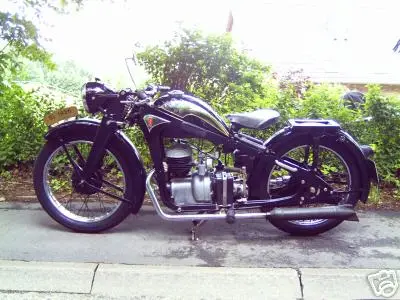
The Zündapp DB 200 is a 200 cc two-stroke motorcycle that Zündapp built in Nuremberg from 1935 to 1940 and again from 1947 to 1951, alongside the more expensive DBK 200 with a box frame. With 96,499 built and a low price, it did much to put Germany on two wheels.
Zündapp DB 200 at a glance
| Maker | Zündapp-Werke GmbH, Nuremberg |
|---|---|
| Production | 1935–1940 and 1947–1951 |
| DBK 200 | 1936–1940 |
| Built | 96,499 |
| Engine | single-cylinder two-stroke, twin exhaust |
| Frame | tubular (DB), box frame (DBK) |
| Price before the war | 540 RM (DB 200), 695 RM (DBK) |
| Nickname | Bauernmotorrad, the farmer’s motorcycle |
| Military version | DB 200 W |
| Postwar production restarted | 12 August 1947 |
The DB 200 has no article of its own on the English Wikipedia; this page is based on the German article together with the English article on the manufacturer.
History of the Zündapp DB 200
The DB 200 grew out of the 175 cc Derby, which Zündapp sold off from July 1933 as the new 200 cc Derby model came in. The engine was a two-stroke single with a flat piston instead of the earlier domed one, and because Auto Union held the sole licence for Schnürle loop scavenging in fast two-strokes, Zündapp developed the more elaborate three-port “Dreistromspülung”, which rivals mockingly called the patent scavenge. The flywheel, normally outside the engine, was moved inside the clutch housing.
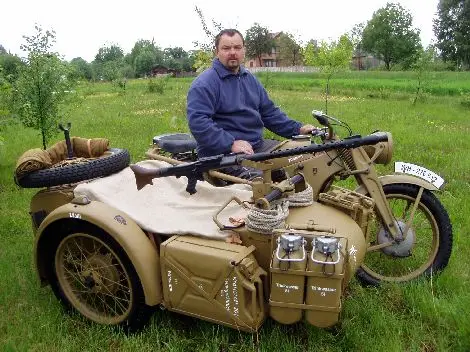
Demand outstripped supply almost at once. Even before the war some parts were painted black instead of chromed. A DB 200 cost 540 Reichsmark and a DBK 200, with its box frame, 695 RM. The motorcycles were robust enough that the army took the DB 200 into service as one of its few light machines, under the designation DB 200 W, with two panniers, blackout lighting and no chrome at all.
Production stopped in 1940 and resumed in 1947, when Zündapp received a manufacturing licence after the wrecked plant had been rebuilt and the Allied limits on capacity and engine size were lifted. The first machine of the type left the factory on 12 August 1947. The three-port scavenging could no longer be used: a court found that it infringed Schnürle’s patent and Zündapp had to pay substantial compensation. In its place came the even more complex four-port system designed by the Berlin engineer Paul Schauer, whose piston had five windows and whose cylinder eleven. Once the Schnürle patent expired the company, like most others, moved its two-stroke programme over to loop scavenging.
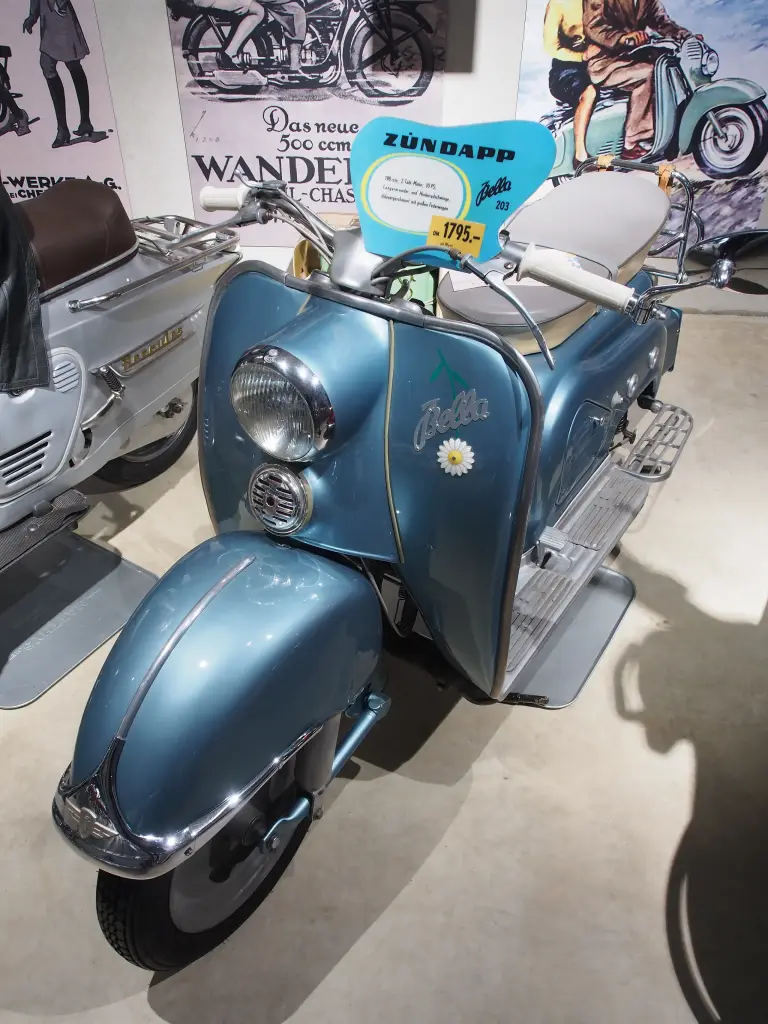
At the currency reform of 21 June 1948 the DB 200, then Zündapp’s only model, cost about 1,000 DM. Model suffixes in the DB range usually marked small equipment differences: a DBT 200, for instance, had a tachometer. The line was steadily developed towards more comfort, safety and performance, and the 200 cc engine family lived on into the 1950s in the DB 201, DB 203 and DB 205, and in the Bella scooter, whose engine was closely related to the DB 204 motorcycle unit.
Design and features
- Twin exhaust: the most characteristic feature of the DB series.
- Three-port scavenging: a Zündapp patent workaround for the Schnürle licence, replaced after the war by four-port scavenging.
- Flat piston: a change from the domed pistons of the 175 cc Derby, with the flywheel moved into the clutch housing.
- Ruggedness: the quality that earned the nickname Bauernmotorrad and a place in Wehrmacht service.
Zündapp DB 200 versions
- DB 200 (1935–1940, 1947–1951): tubular frame, the standard civilian machine.
- DBK 200 (1936–1940): box frame, considerably more expensive.
- DB 200 W: military version with panniers, blackout lighting and no chrome.
- DBT 200: equipment variant with a tachometer.
The DB 200 was the company’s volume model between the big four-cylinder K 800 and the 1950s twins of the KS 601. Its engine family led on to the Bella scooter. More models are in the Zündapp collection.
Sources
- Zündapp DB / DBK, German Wikipedia: production, prices, scavenging systems, military version
- Zündapp, English Wikipedia: place in the range and postwar history