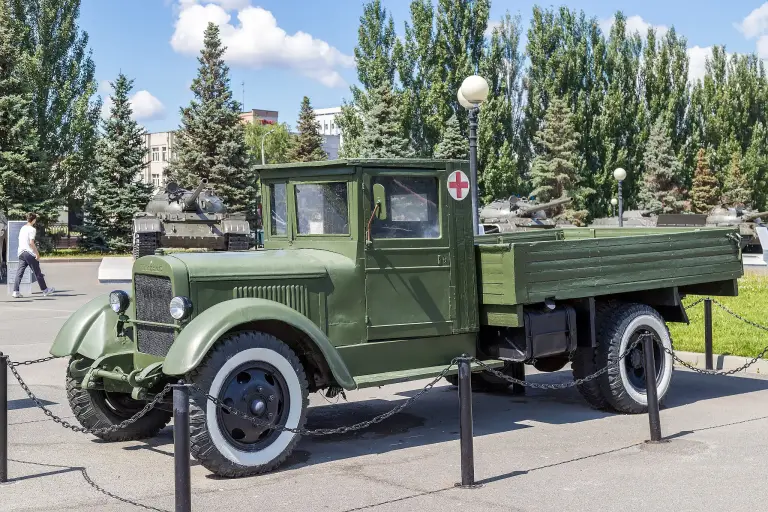
The ZIS-15 was a Soviet medium-duty truck developed at the ZIS works as a replacement for the ageing ZIS-5. It existed only as prototypes, built from 1938, but its final 1944 version became the basis for the post-war ZIS-150.
ZIS-15 at a glance
| Maker | Zavod Imeni Stalina (ZIS), Moscow |
|---|---|
| Type | prototype medium-duty truck |
| Prototypes | from 1938; final ZIS-15K built in 1944 |
| Payload | up to 5 tonnes on the highway, 3.5 tonnes on dirt roads |
| Engine | 5.56 L six-cylinder petrol, 82 hp at 2650 rpm |
| Later engine | 90 hp at 2700 rpm in the third prototype |
| Gearbox | five-speed with an overdrive fifth gear |
| Wheelbase | 4100 mm and 4400 mm prototypes |
| Fuel tank | 100 L |
| Cab | three-seat all-metal cab with a V-shaped split windscreen |
| Led to | ZIS-150 (1947–1957) |
Based on one source (Russian Wikipedia).
History of the ZIS-15
By the late 1930s the ZIS-5, itself developed from the American Autocar Dispatch SA, was considered outdated. Work on a new truck began at ZIS: in 1937 the plant built a prototype with a new all-metal cab of streamlined shape and a sloped windscreen, and this work developed into the ZIS-15.
The first ZIS-15 prototype, completed for the 18th Congress of the Communist Party, received a more powerful engine than the ZIS-5, a gearbox with helical gears and new 36 by 8 inch tyres. Its wheelbase grew to 4100 mm, so the cardan drive was made double with an intermediate support. The brakes remained mechanical but gained a vacuum booster, a transmission disc brake was added, and the fuel tank capacity rose to 100 litres. The main external difference was the modern three-seat all-metal cab with a V-shaped split windscreen.
By the middle of 1939 the first prototype had covered more than 5,000 km in road tests with loads of up to 5 tonnes, and the results were considered positive. Only the 82 hp engine was judged insufficient for the increased payload. In 1939 prototypes were built with wheelbases of 4100 and 4400 mm, and the third prototype received a boosted engine with aluminium pistons and a compression ratio of 5.7, producing 90 hp at 2700 rpm. It also gained a five-speed gearbox with an overdrive fifth gear, new eight-stud wheel discs and revised wings, radiator grille and bonnet.
A planned family
A whole family was planned on the ZIS-15 basis: the ZIS-15 truck, the ZIS-16 bonneted bus, the ZIS-17 cab-over bus, the ZIS-23 six-wheel-drive truck, the ZIS-24 four-wheel-drive truck, the ZIS-25 and ZIS-28 gas-generator vehicles, the ZIS-26 tractor unit and the ZIS-D7 diesel. In 1940 a long-wheelbase ZIS-15 was shown at the All-Union Industrial Exhibition, and the plant prepared for production, but the war prevented the plans. Of the whole family, only the ZIS-16 bus entered series production.
In 1943, as the war turned, work on the new truck resumed. The prototype built in 1944, designated ZIS-15K, completed the development of the family and, after further refinement, became the prototype of the four-tonne ZIS-150, produced from 1947 to 1957.
Design and features
- Modern cab: a three-seat all-metal cab with a streamlined shape and a V-shaped split windscreen replaced the wooden-framed ZIS-5 cab.
- More powerful engine: the ZIS-5 six was developed to 82 hp, and the third prototype used a 90 hp version with aluminium pistons.
- Five-speed gearbox: the third prototype gained a five-speed unit with an overdrive fifth gear.
- Stronger chassis: a longer wheelbase, double cardan shaft with intermediate support and a vacuum brake booster.
ZIS-15 versions
- First prototype (1938): 82 hp, 4100 mm wheelbase, four-speed gearbox.
- 1939 prototypes: two wheelbases of 4100 and 4400 mm.
- Third prototype (1939): 90 hp engine, five-speed gearbox and revised body details.
- ZIS-15K (1944): final prototype and direct ancestor of the ZIS-150.
The ZIS-15 was the predecessor of the ZIS-150, and its family included the ZIS-16 bus, the only member to reach series production. More vehicles are in the ZIS collection.
Sources
- ЗИС-15, Russian Wikipedia: prototypes, design, planned family and ZIS-150 link