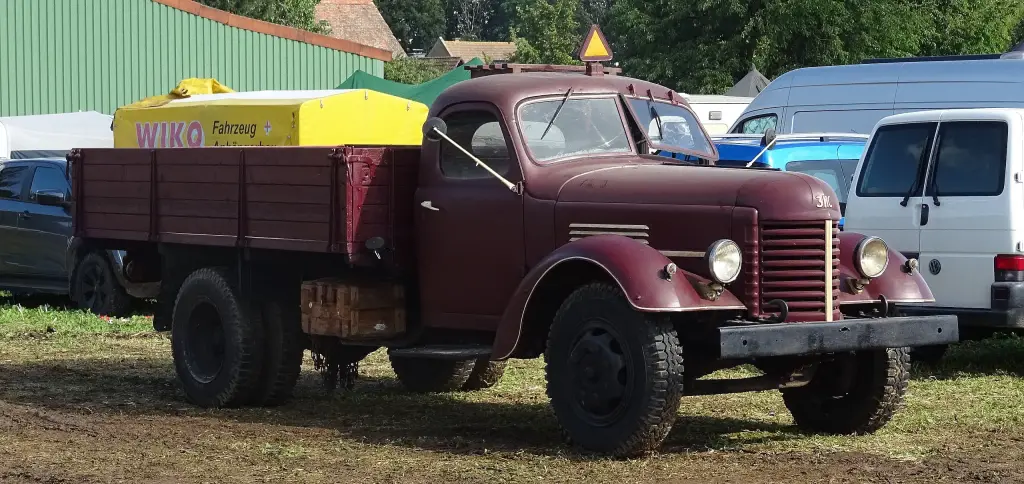
The ZIS-150 was a Soviet truck that replaced the ZIS-5 on the assembly line in 1947. Together with the GAZ-51 it became the main Soviet truck of the 1950s, and it was built in a total of 774,615 examples.
ZIS-150 at a glance
| Maker | Zavod Imeni Stalina (ZIS), later ZIL, Moscow |
|---|---|
| Production | 1947–1957 (modernized version until 1965) |
| Replaced | ZIS-5 |
| Replaced by | ZIL-164 |
| Engine | ZIS-120 six-cylinder, 5,555 cc |
| Power | 95 hp (70 kW); 90 hp at 2400 rpm in the specification |
| Gearbox | five-speed manual with a two-disc dry clutch |
| Payload | 4,000 kg |
| Top speed | 65 km/h loaded |
| Weight | 3,900 kg without load |
| Dimensions | 6,720 x 2,385 x 2,180 mm |
| Built | 774,615 in all versions |
Based on one source (English Wikipedia).
History of the ZIS-150
Already at the end of the 1930s the ZIS-5 was due to be replaced by a modern design. Soviet engineers had gained experience with American trucks through the licensed production of the Ford AA as the GAZ-AA, and the new developments were strongly influenced by American practice. In 1938 the Stalin works presented the ZIS-15, with a newly developed chassis, an 82 hp engine and a new three-seat all-metal cab.
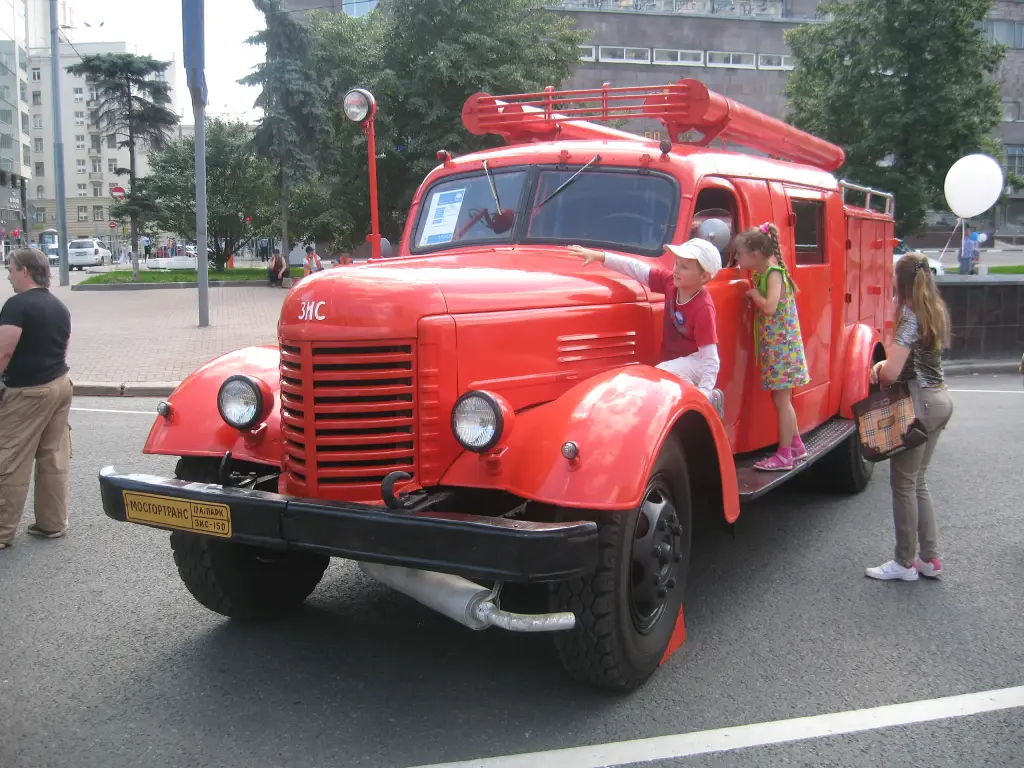
Further prototypes were built only in 1944, now under the name ZIS-150. The Lend-Lease Act brought a large amount of American technology to the Soviet Union during the war, including International K-7 trucks, which strongly influenced the styling of the Soviet vehicle. On 30 October 1947 the first small series was introduced; testing had shown that the 82 hp engine was too weak, so the ZIS-150 received an uprated 95 hp engine and its payload was increased to 4,000 kg.
The assembly line was set up at the plant in January 1948. Serial production began on 27 April 1948, and production of the ZIS-5 was halted three days later. From 1951 the ZIS-150 was also produced at the Kutaisi plant as the KAZ-150. In 1956 Stalin’s name was removed and the factory was renamed Zavod imeni Likhacheva; in the following year production of the vehicle, now called the ZIL-150, was discontinued in favour of the ZIL-164, a modernized variant. A total of 774,615 ZIS-150 vehicles were produced in various versions, and production of the modernized variant ended in 1965.
Design and mechanics
The truck was powered by the six-cylinder ZIS-120 engine. For the first time in Soviet commercial vehicle construction it used a five-speed manual transmission, connected to the engine through a two-disc dry clutch, and air-operated brakes were also new in Soviet truck construction. The rear axle had twin tyres, all axles were sprung with leaf springs and designed as rigid axles. The weak point of the design was the cardan shaft, which tended to crack and then break under full load; the compressed-air hoses were often destroyed in the process, leading to a sudden loss of braking power.
The cabin consisted of a wooden frame planked with sheet metal and protected with varnish; the doors were made of wood, the side windows were retractable, and the left half of the two-part windscreen could be opened. In 1950 the ZIS-150 was modernized with a new carburettor and exhaust manifold, and the cab became entirely metal. In 1956 the engine received a light-alloy cylinder head and the compression ratio rose to 6.2, increasing output to 71 kW; the frame was reinforced, hydraulic shock absorbers were fitted and rubber buffers limited the travel of the front leaf springs.
Foreign production
The Kutaisi Auto Mechanical Plant started producing a copy of the ZIS-150 in 1951 as the KAZ-150. Production also started in other communist countries: in Romania as the SR-101 by Steagul Roșu in Brașov between 1954 and 1960, and in China as the Jiefang CA-10 by First Automobile Works until 1986. A prototype was also built in North Korea under the name Cholima, but it did not enter production. Parts of the SR-101 chassis were still used for its successor, the SR-131 Carpați.
Design and features
- Five-speed gearbox: the first Soviet commercial vehicle with a five-speed manual transmission.
- Air brakes: another first in Soviet truck construction, and the system could also operate trailer brakes.
- Modern cab: the cab was wooden-framed at first and became all-metal in the 1950 modernization.
- Wide production: built in the USSR and copied in Romania, China and elsewhere, with 774,615 vehicles in all versions.
ZIS-150 versions
- ZIS-150 (1947–1957): the original production version.
- ZIS-120N (1956–1957): tractor-trailer version.
- KAZ-150: copy built at Kutaisi from 1951.
- SR-101: Romanian version built in Brașov from 1954 to 1960.
- Jiefang CA-10: Chinese version built until 1986.
- ZIL-164: modernized successor, outwardly distinguished by vertical grille bars and a new bumper.
The ZIS-150 replaced the ZIS-5 and was itself replaced by the ZIL-164. The ZIS-151 was its six-wheel-drive military stablemate. More trucks are in the ZIS collection.
Video: ZIS-150 Relocation from IL-14/ЗИС-150 Перегонка от ИЛ-14
Video on YouTube.
Sources
- ZIS-150, English Wikipedia: history, production, mechanics and specifications