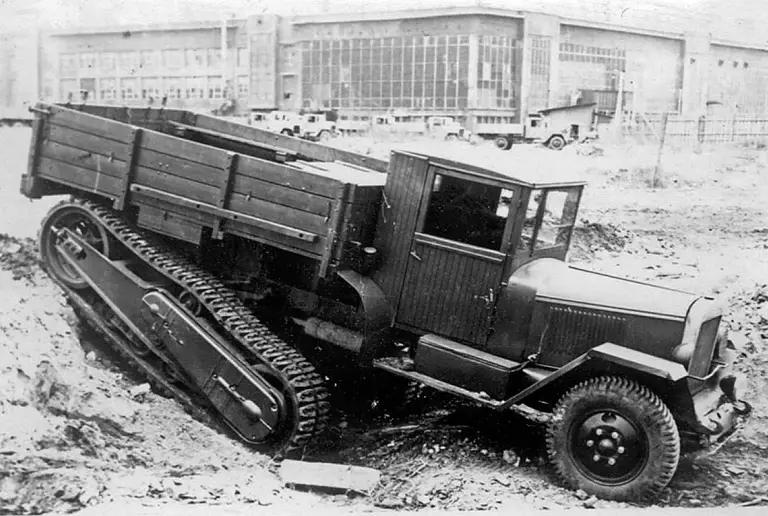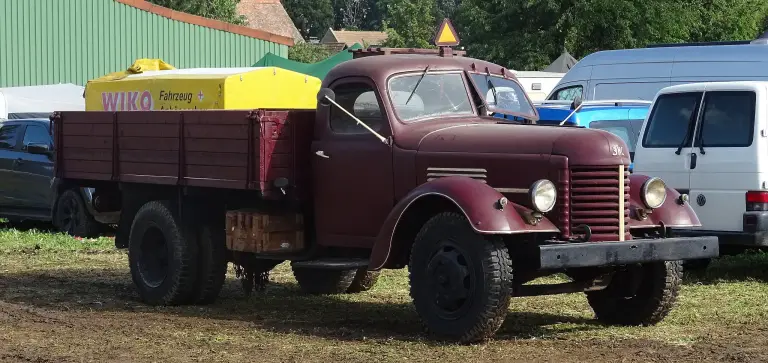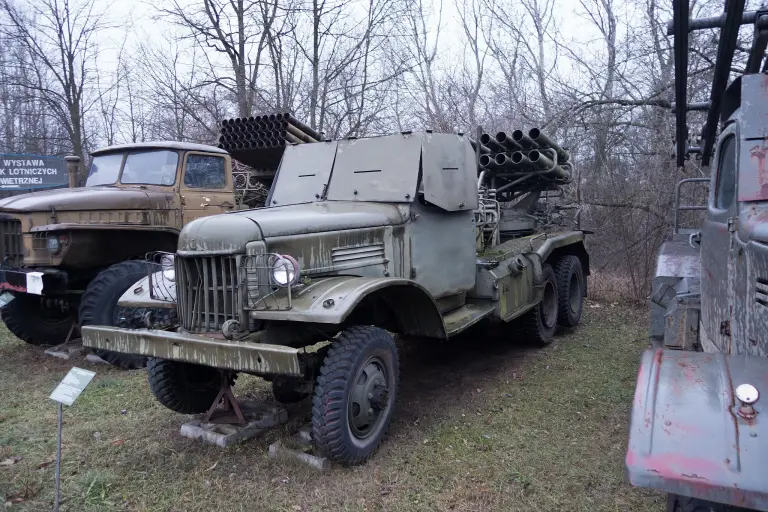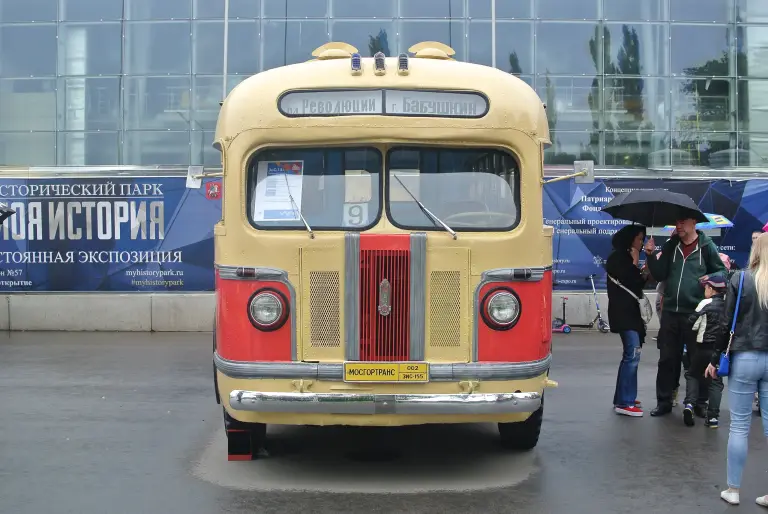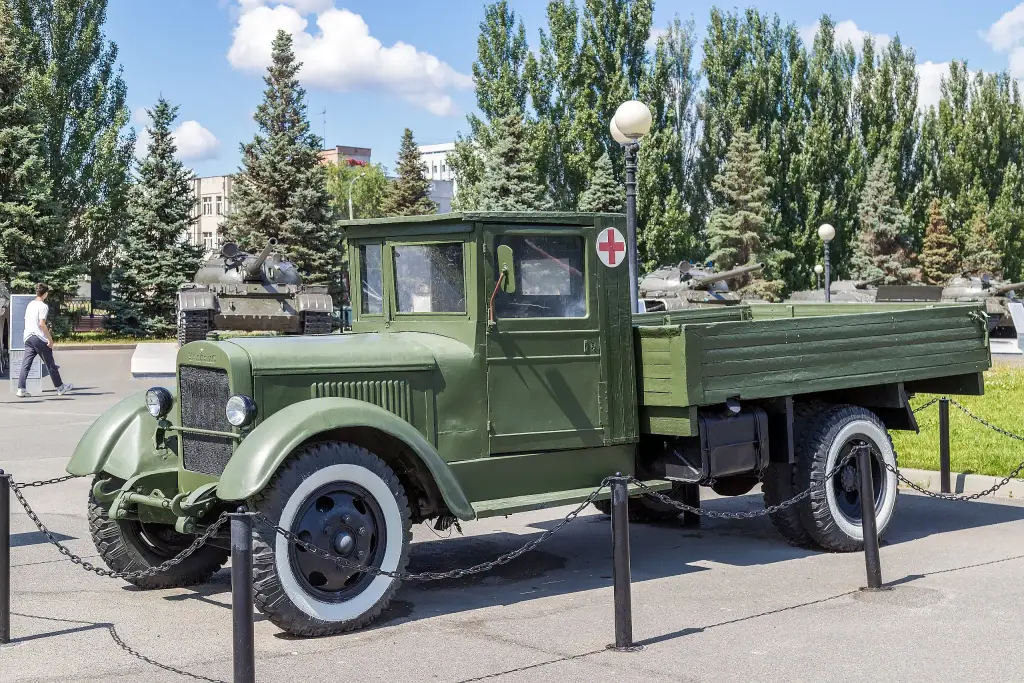
The ZIS-5 was a 4×2 Soviet truck produced by the Moscow ZIS factory from 1933 to 1948. Together with the GAZ-AA it became the main Soviet truck from the 1930s into the 1950s, and soldiers knew it as the Tryohtonka, the three-tonner.
ZIS-5 at a glance
| Maker | Zavod Imeni Stalina (ZIS), Moscow |
|---|---|
| Production | 1933–1948 at ZIS; other plants until 1958 |
| Based on | Autocar Model CA, built under licence |
| Payload | 3 tonnes |
| Red Army fleet | 104,200 trucks by 20 June 1941 |
| Built | about 1 million at all plants; 532,311 at ZIS |
| Simplified version | ZIS-5V from May 1942 |
| Engine-swap version | ZIS-50 (1947–1948) |
| Armoured derivative | IZ armoured car (1941) |
| Export | the first Soviet motor vehicle exported |
Based on one source (English Wikipedia).
History of the ZIS-5
In 1931 the Moscow AMO plant was re-equipped and expanded with the help of the American A.J. Brandt Co. and began producing the AMO-2, intended to replace the AMO-F-15, the first Soviet truck. The AMO-2 was based on the Autocar Dispatch SD after a licence agreement with the Autocar Company. It was later modernized as the AMO-3, and in 1933 the plant was renamed Factory No. 2 Zavod Imeni Stalina. The ZIS-5 itself was based on the Autocar Model CA produced under licence, although two references state that it was based on the AMO-3.
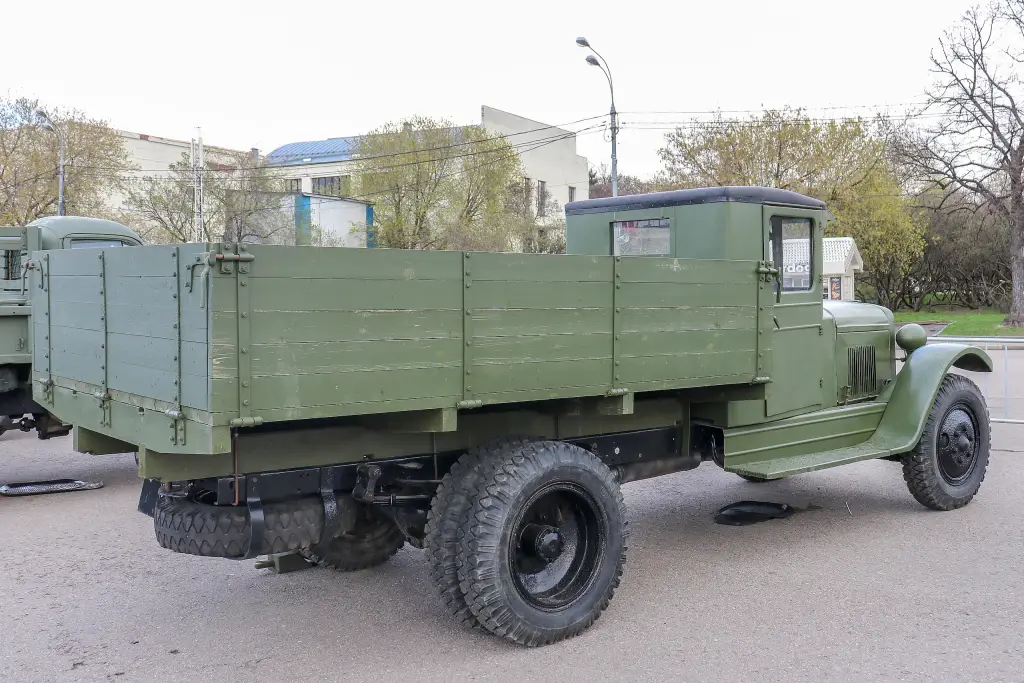
Serial production of the new truck started on 1 October 1933. It was an instant success and, together with the GAZ-AA, became the main Soviet truck of the 1930s through the 1950s. By 20 June 1941 the Red Army had 104,200 ZIS-5 trucks in use. Facing the German invasion, the Moscow production line was stopped in the autumn of 1941 and some 12,800 pieces of equipment were moved to Ulyanovsk, Miass, Shadrinsk and Chelyabinsk. Production at Ulyanovsk lasted from February 1942 to 1944, and UralZIS production ran from July 1944 to 1955.
The wartime ZIS-5V
At the end of 1941, wartime shortages of raw materials forced changes to the construction of the ZIS-5. All changes were focused on simplifying manufacture and using less material: the round stamped fenders were replaced with flat bent ones, cabs and foot boards were made from wood, the brakes were removed from the front wheels, the rear body had a tailgate swinging only, and sometimes the right headlight and the bumpers were omitted. The simplified model, designated ZIS-5V, was produced from May 1942 in Ulyanovsk and later also in Moscow and Miass. Overall production of all models reached about one million units at all plants, with ZIS alone producing 532,311; during the war years about 83,000 ZIS-5s of both versions were built.
The Moscow ZIS plant restarted production of the ZIS-5V in April 1942. Near the end of 1947 the new ZIS-120 engine was complete but the ZIS-150 truck was not, so these engines were placed in ZIS-5V chassis and the result was named the ZIS-50; 13,701 were produced in 1947 and 1948. The Moscow plant discontinued the ZIS-5V and ZIS-50 on 30 April 1948 in favour of the ZIS-150. In 1956 UralZIS modified the ZIS-5 with a new engine, carburettor, steering mechanism, 12-volt electrical system and oval fenders, and the model became the UralZIS-355 or ZIS-355. The Miass plant continued to produce the ZIS-5V until 1958.
In service
During the war the ZIS-5 was used on all fronts, where it was valued for its simple and reliable construction. Apart from cargo duties it served as a light artillery tractor and for troop transport, with 25 soldiers able to sit on five benches in the rear body. It was also the base for many special trucks, including refuellers, field workshops, ambulances, portee guns and anti-aircraft platforms. After the GAZ-AA it was the second most used Red Army truck of the 1933–1943 period. ZIS-5 trucks worked on the Road of Life, the only supply line to the besieged city of Leningrad, on the frozen surface of Lake Ladoga; the remains of one were recovered from the lake in 2024 and are to be exhibited in the Battle of Leningrad Museum.
In 1941 the ZIS-5 was used as the basis for improvised armoured cars built by the Izshorsky plant under the designation IZ. The initial order of 20 vehicles carried a 45 mm anti-tank gun, 3–10 mm of armour and a Degtyaryov machine gun; the engine compartment was sealed with two armoured intakes over the front grille. About 80 more were built, some with quadruple Maxim guns and others unarmed as armoured personnel carriers. The first was delivered to the Leningrad People’s Militia on 15 July 1941, and the last operational cars were seen around Leningrad in January 1943. The ZIS-5 was also the first Soviet motor vehicle to be exported, with 100 trucks sold to Turkey in 1934 and further batches to Afghanistan, Iraq, Iran, Spain, China, Latvia, Lithuania, Estonia, Mongolia and Romania.
Design and features
- Simple and reliable: the truck was valued for its straightforward construction and was used on every front during the war.
- Three-ton payload: the Tryohtonka nickname came from its three-tonne capacity.
- Many special bodies: refuellers, field workshops, ambulances, portee guns and anti-aircraft platforms were built on the chassis.
- Wide export: it was the first Soviet motor vehicle exported, sold to Turkey and many other countries.
ZIS-5 versions
- ZIS-5 (1933–1941): the original production truck.
- ZIS-5V (from 1942): simplified wartime version with wooden cab and flat fenders.
- ZIS-50 (1947–1948): ZIS-5V chassis with the new ZIS-120 engine, 13,701 built.
- UralZIS-355 (1956): post-war UralZIS modernization with a new engine and 12-volt electrics.
- IZ armoured car (1941): improvised armoured vehicle on the ZIS-5 chassis.
The ZIS-5 was replaced by the ZIS-150; its three-axle derivative was the ZIS-6, and the ZIS-12 was a lengthened version. More trucks are in the ZIS collection.
Video: ZIS 5 LKW ЗИС 5 OLDTIMER CLASSIC TRUCK LASTWAGEN грузовик Олдтаймер ЗИЛ ZIL Russian UdSSR CCCP
Video on YouTube.
Sources
- ZIS-5 (truck), English Wikipedia: development, production, wartime use, IZ armoured car and export