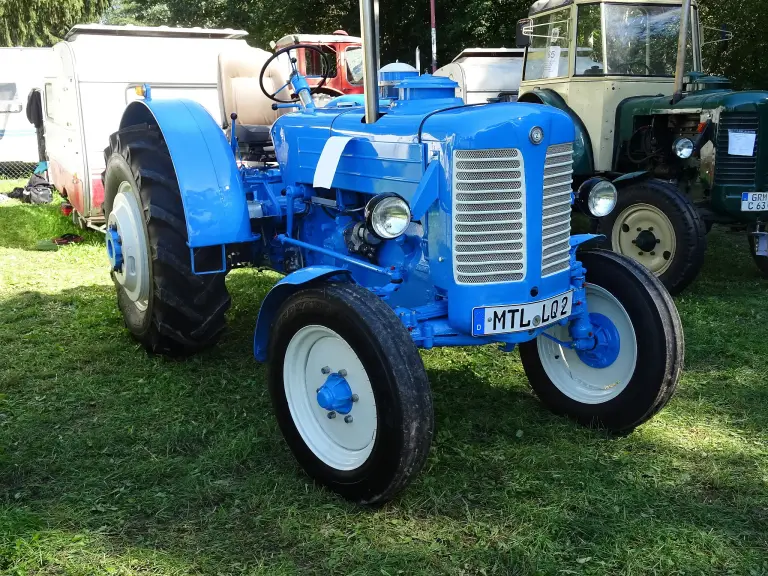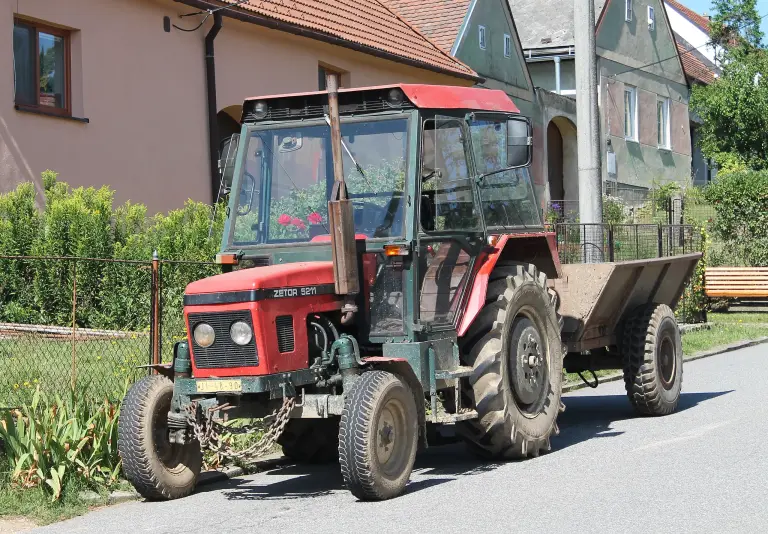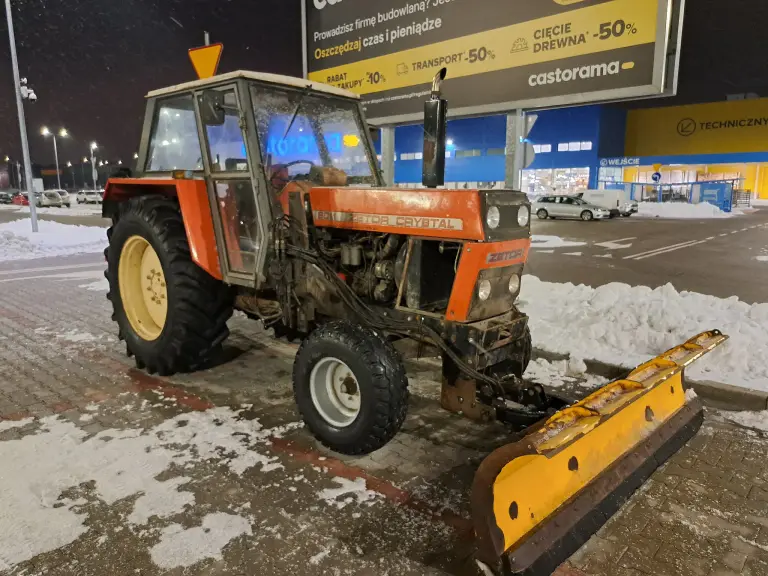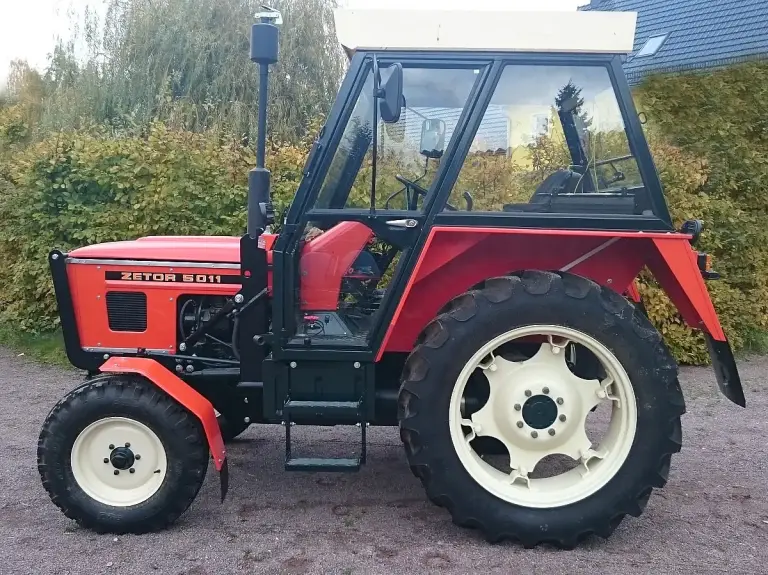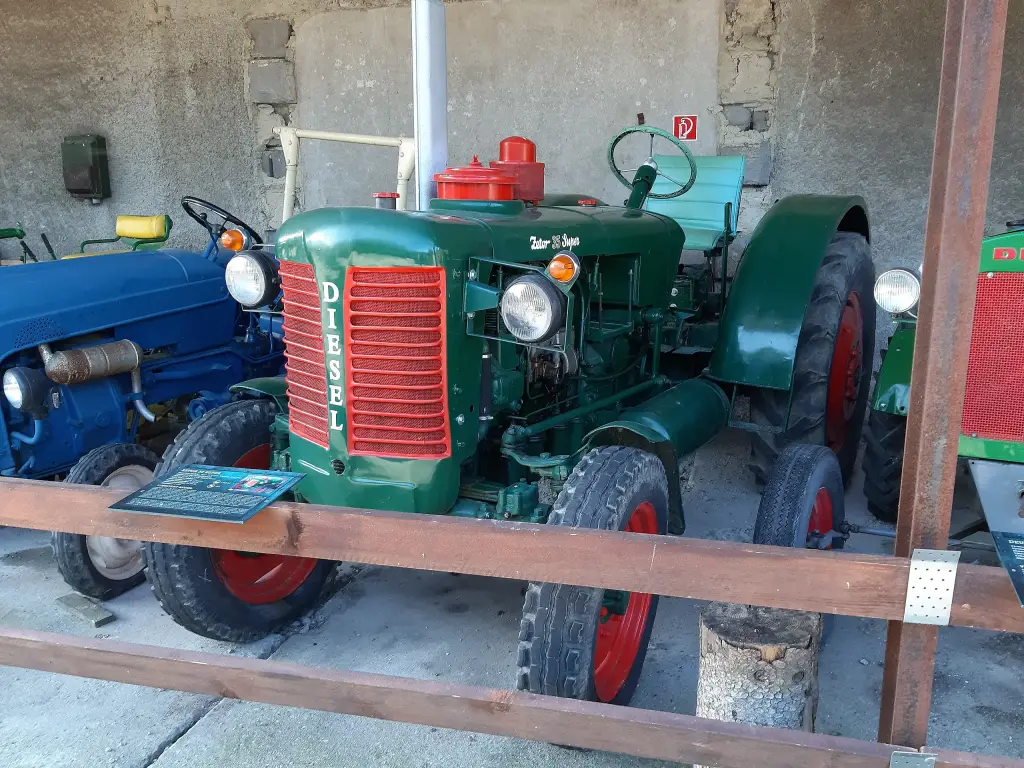
The Zetor 35 was the heavier and more powerful companion to the Zetor 25. Sold in its developed form as the Zetor 35 Super, it was designed for the hardest farm work, could handle heavier implements than the small Zetor, and was built from 1955 to 1960.
Zetor 35 at a glance
| Maker | Zetor, Brno, Czechoslovakia |
|---|---|
| Developed | 1954 |
| Production | 1955–1960 |
| Built | about 21,000 |
| Engine | four-cylinder inline water-cooled diesel, OHV |
| Bore and stroke | 105 x 120 mm |
| Capacity | 4,160 cm³ |
| Power | 42 hp (31 kW) |
| Maximum speed | 24 km/h |
| Gearbox | 5 forward and 1 reverse, or 10+2 with reduction |
| Tyres | 6×20 front, 13×28 rear |
| Weight | 2,860 kg |
History of the Zetor 35
The Zetor 35 grew out of the prototype Zetor 30, a tractor shown in 1949 and awarded a gold medal at the Prague exhibition but never put into series production. The factory decided that a stronger machine was needed, and the design was developed during 1954 for production from 1955. It was built until 1960, when the modernized Zetor 50 Super took over, and about 21,000 were made.
Mechanical layout
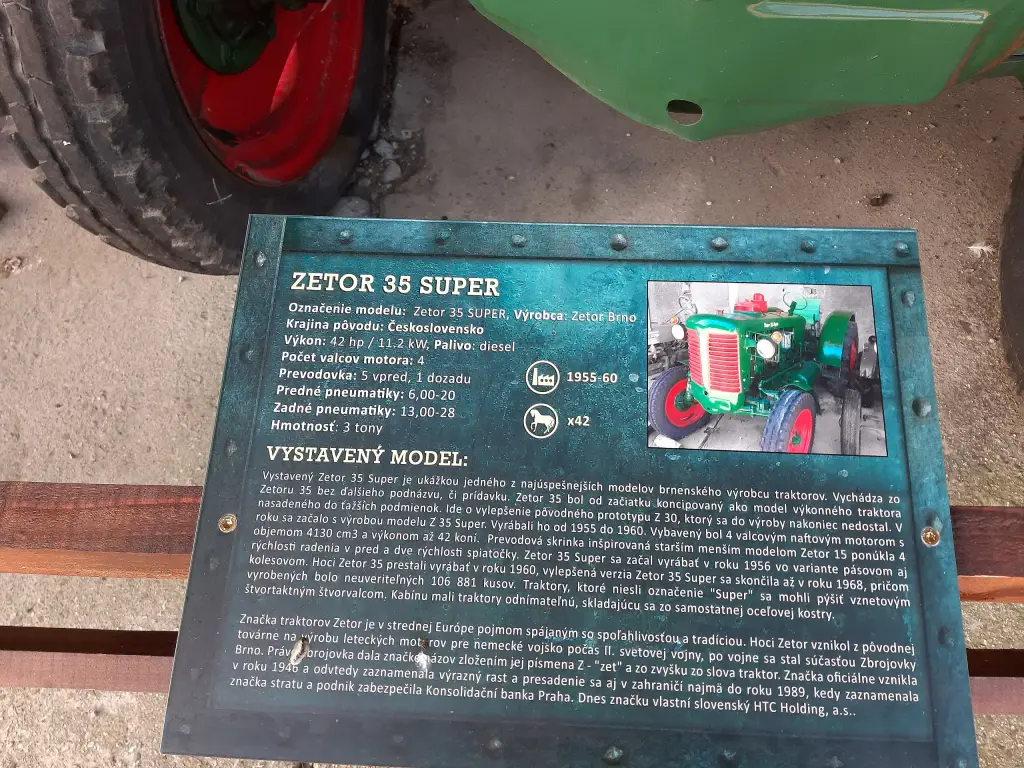
The tractor used the gearbox developed for the Zetor 15 of 1948–1949, with final drives and half-shafts taken from the Zetor 25K. The engine was a four-cylinder inline water-cooled diesel with OHV valve gear and direct injection into combustion chambers formed in the pistons; it displaced 4,160 cm³ from a bore and stroke of 105 by 120 mm and produced 42 hp at 1,500 rpm. Drive passed through a dry single-plate clutch of 350 mm. Originally the tractor had a gearbox without reduction; after modernization a reduction unit could be bought and fitted, although with it engaged fourth gear could not be used. In normal form there were five forward speeds and one reverse, with road speeds of 3.9, 5.15, 7.42, 12 and 24 km/h.
In the field
With its larger engine and heavier build the 35 was meant for heavy agricultural work and could handle heavier implements than the 25. It was fitted with a pulley for driving machinery by flat belt and had a more powerful hydraulic system. The type was sold mainly in Czechoslovakia and neighbouring markets; Poland took only about 1,200 and Finland between 1,700 and 2,700, despite a reasonable price. Most were painted green or red. A tracked version, the Zetor Super P, was offered from 1956 to 1958 with a two-drum winch for forestry work and about 4,200 were built.
Design and features
- Four-cylinder 42 hp diesel: 4,160 cm³, OHV valve gear and direct injection.
- Five-speed gearbox: five forward ratios and one reverse, with an optional reduction giving ten and two.
- Heavy-duty build: designed for the hardest field work with heavier implements than the Zetor 25 could handle.
- Belt pulley: a flat-belt pulley drove stationary machinery.
- Tracked derivative: the Super P of 1956–1958, with a winch, was built for forestry.
Zetor 35 versions
- Zetor 35: the standard five-speed tractor of 1955–1960.
- Zetor 35 with reduction: an optional reduction unit giving ten forward and two reverse speeds.
- Zetor 35 Super: the developed version introduced in 1958.
- Zetor Super P: tracked forestry version of 1956–1958, 4,200 kg, with a two-drum winch.
The 35 followed the Zetor 25 and was replaced by the Zetor 50 Super. More tractors are in the Zetor collection.
Video: Zetor Super 35
Video by roman15pb on YouTube.
Sources
- Zetor 35, Czech Wikipedia: engine, clutch, gearbox, speeds, tyres
- Zetor 35, Slovak Wikipedia: origins, gearbox, hydraulic system, production
- Zetor 35, Polish Wikipedia: development, export numbers, Super P, dimensions