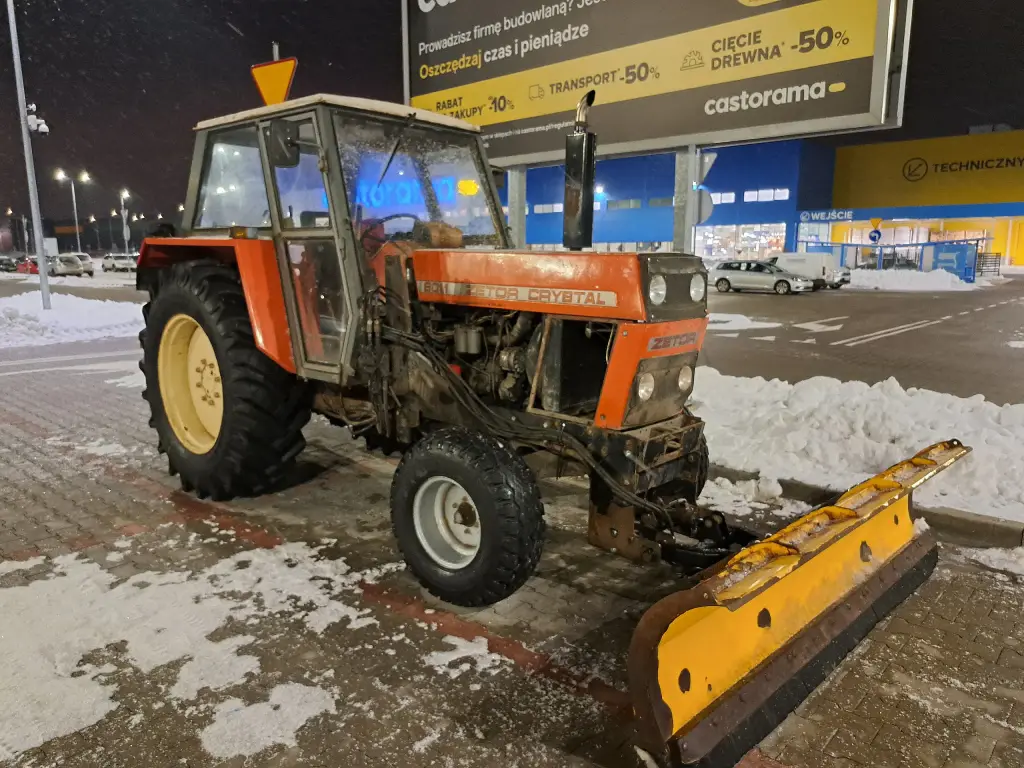
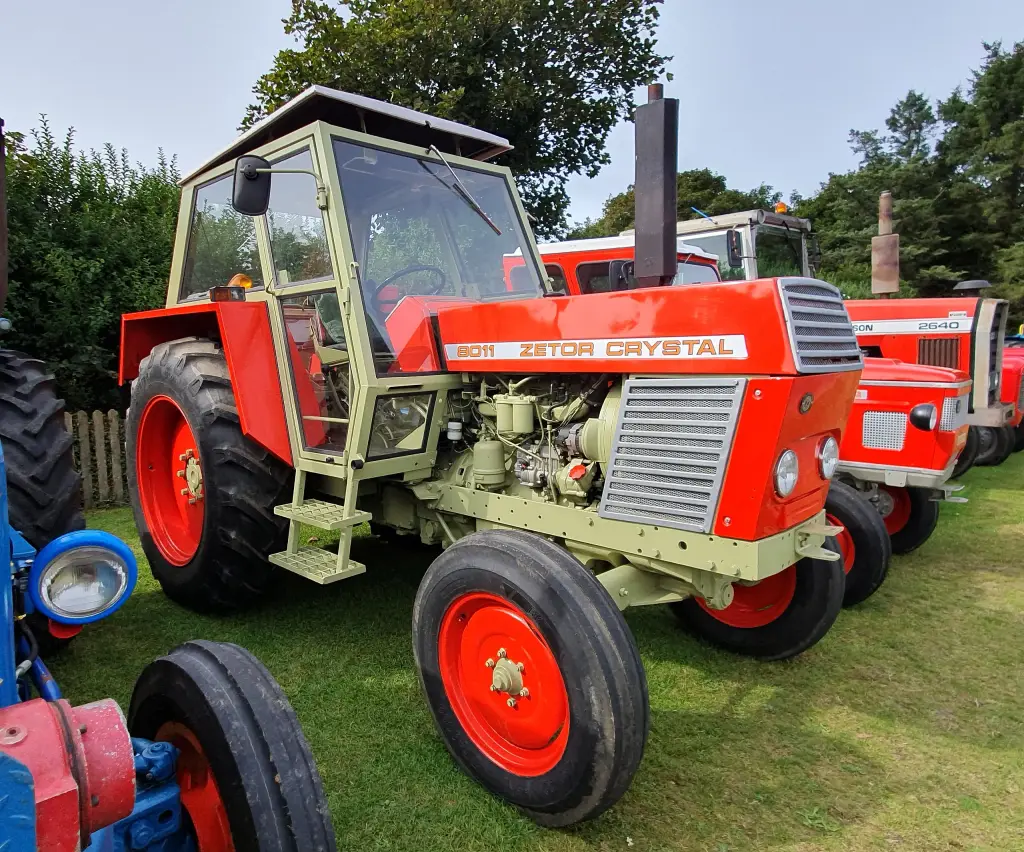
The Zetor 8011 was the first tractor of Unified Series II, the more powerful Zetor family introduced in 1968. It began the line that grew into the Crystal range, and it belonged to the generation in which Zetor put the world’s first production safety cab on a tractor.
Zetor 8011 at a glance
| Maker | Zetor, Brno, Czechoslovakia |
|---|---|
| Introduced | 1968 |
| Family | Unified Series II |
| Power class | about 80 hp |
| Family output range | 80–160 hp |
| Suffix -11 | rear-wheel drive |
| Four-wheel-drive twin | Zetor 8045 |
| Related models | 10011, 12011, 16045 Crystal |
| Later production | Z&TSacute; Martin, Slovakia |
There is no separate Wikipedia article on the 8011; this page is based on the sections on Unified Series II in the Czech and English articles on the Zetor company.
History of the Zetor 8011
Zetor’s first unified range, Unified Series I, was built around small and medium tractors with two to four cylinders. In 1968 the company added a second range above it. Unified Series II covered 80 to 160 hp and gave Zetor a place in the market for larger, heavier tractors that could pull bigger implements and work larger fields.
Czechoslovak-Polish cooperation
The new range was not purely a Czech project. In 1964 a joint Czechoslovak-Polish tractor research centre was set up by Zetor and the Polish manufacturer Ursus, and Unified Series II was developed under the supervision of Czesław Sławski and Jaroslav Zezula. The collaboration exchanged engineering knowledge and design principles between the two state industries, which were building tractors for the same Comecon markets.
The safety cab
Unified Series II introduced what Zetor describes as the world’s first safety cab for tractors with a roll-over protection system mounted on vibration isolators. The cab also brought noise inside down below 85 dB. It was the first time a manufacturer had put such a structure into series production rather than offering it as an accessory, and it gave the Zetor brand international recognition beyond its traditional markets.
The Crystal line
The 8011 was followed by the 8045 with four-wheel drive, then by the 10011, 10045, 12011, 12045 and 16045 Crystal as the range grew in power. The type numbers worked as elsewhere at Zetor: the first digits gave the approximate power, the -11 ending meant rear-wheel drive and the -45 ending meant both axles driven. In the 1980s production was moved to Slovakia, where the tractors were built as the Z&TSacute;S Martin 8211 to 16245 and later as the 8311 to 18345. The modernized 8111 and the rest of the 8000 and 10000 series continued the line, and the Crystal name is still used by Zetor today for its heaviest range.
Design and features
- Start of Unified Series II: the first of the 80–160 hp family introduced in 1968.
- Safety cab: the range brought the world’s first production cab with roll-over protection on vibration isolators.
- Quieter workplace: noise inside the cab was reduced to below 85 dB.
- Joint development: designed with Ursus of Poland through a research centre set up in 1964.
- Crystal heritage: the 8011 began the line that led to the 12011 and 16045 Crystal and to today’s Crystal range.
Zetor 8011 versions
- Zetor 8011: the rear-wheel-drive 80 hp tractor of 1968.
- Zetor 8045: the four-wheel-drive version of the same model.
- Zetor 10011 and 10045: the 100 hp models added to the family.
- Zetor 12011, 12045 and 16045 Crystal: the larger members, up to 160 hp.
- Z&TSacute;S Martin 8211–16245: the Slovak-built versions of the 1980s.
The 8011 came above the Unified Series I tractors and began the Crystal line that led to Unified Series III. More are in the Zetor collection.
Video: Heavy ploughing with a Zetor 8011
Video by Jakub1626 on YouTube.
Sources
- Zetor, Czech Wikipedia: Unified Series II, model list, Z&TSacute;S Martin production
- Zetor, English Wikipedia: safety cab, noise level, Czechoslovak-Polish cooperation