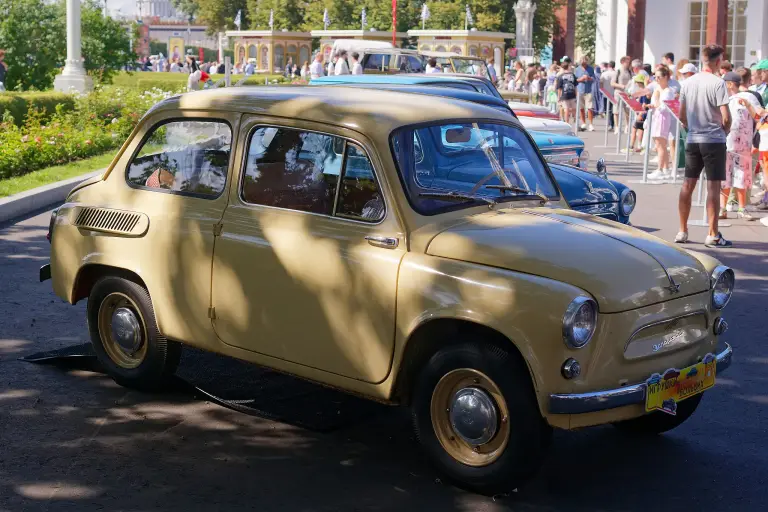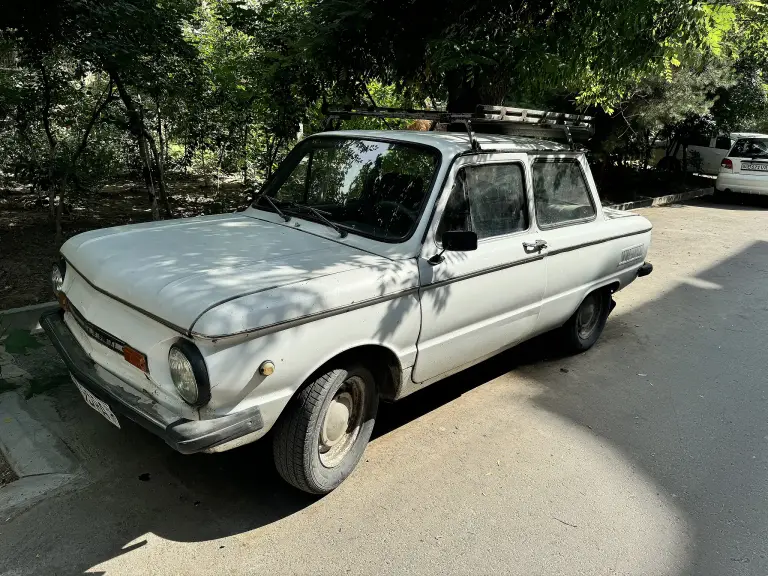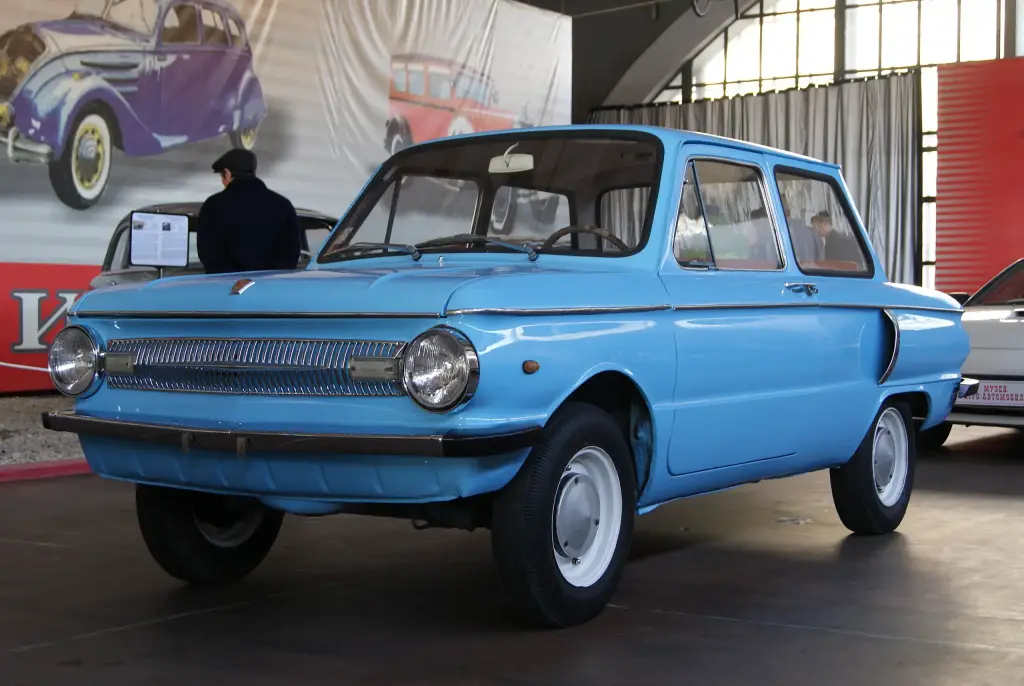
The ZAZ-966 was the second generation of the Zaporozhets, produced from 1966. It was longer and heavier than the ZAZ-965, had a completely redesigned rear suspension and, from 1967, a new 1.2-litre engine. Round air intakes on the rear wings gave it the nickname ‘big-eared’.
ZAZ-966 Zaporozhets at a glance
| Maker | ZAZ, Zaporizhzhia, Ukrainian SSR |
|---|---|
| Production | 1966–1974 |
| Predecessor | ZAZ-965 |
| Body | two-door sedan, rear engine |
| Engine, 966V | 887 cc air-cooled V4, 30 hp |
| Engine, 966 | 1,198 cc V4, 40 hp from 1967 |
| Length | 3,730 mm (ZAZ-965: 3,326 mm) |
| Wheelbase | 137 mm longer than the ZAZ-965 |
| Rear suspension | longitudinal A-arms, two joints per half-shaft |
| Gearbox | new four-speed manual |
| Nickname | ‘big-eared’ (vuhastyi) |
The English Wikipedia article covers the whole Zaporozhets series; the history of the 966 comes from the Ukrainian article.
History of the ZAZ-966 Zaporozhets
Development of a replacement for the ZAZ-965 began in Zaporizhzhia in the spring of 1961, almost as soon as the 965 had entered the line, and a prototype was shown at the VDNKh exhibition in Moscow in November that year. A lack of experience among the plant’s own designers, who had not developed the 965 themselves, delayed the project, and the first series cars of the second generation reached the line only on 12 October 1966. They were transitional ZAZ-966V cars with a slightly updated 887 cc engine of 30 hp, because production of the new 1.2-litre engine was not yet ready.
Full production of the ZAZ-966 with its own 1,198 cc, 40 hp engine began in 1967. Even then there were not enough of the larger engines, and some cars of the following 968 model were still fitted with the 30 hp unit. The plant never reached its planned output of 150,000 cars a year; only by 1973 did it approach 100,000, largely because the country’s automotive resources were concentrated on building the Volga plant.
The 966 was noticeably larger than the 965, at 3,730 mm against 3,326 mm, but most of the extra length went into the overhangs, the wheelbase grew by only 13.7 cm, and the cabin did not become much roomier. Its main technical advance was a new rear suspension with longitudinal A-arms and two joints on each half-shaft instead of the diagonal arms and swinging half-axles inherited from the Fiat 600; the same layout was later used by BMW on its E21 and E30 models. The gearbox was also new and proved strong, although the half-shafts remained a weak point. Stylistically the body followed the fashion set by the Chevrolet Corvair and the NSU Prinz IV, with a belt line that wrapped around the car.
Design and features
- Round side air intakes: mounted on the rear wings to feed the engine, they gave the car its ‘big-eared’ nickname.
- New rear suspension: longitudinal A-arms and two joints per half-shaft gave better kinematics than the 965.
- 1.2-litre engine: the 40 hp MeMZ unit of 1967 was a bored-out development of the air-cooled V4.
- Strong gearbox: the four-speed unit had enough reserve that tuners used it with much more powerful engines.
- Corvair-inspired styling: the wrapped belt line copied a look that was widely imitated in the 1960s.
ZAZ-966 Zaporozhets versions
- ZAZ-966V (1966–1967): the transitional model with the 887 cc, 30 hp engine.
- ZAZ-966 (1967–1974): the full version with the 1,198 cc, 40 hp engine.
- Disabled-driver versions: the plant built cars with hand controls, which at times took up to a quarter of output.
The 966 succeeded the ZAZ-965 and was developed into the ZAZ-968, which stayed in production until 1994. More cars are in the ZAZ collection.
Video: stance zaz 966
Video by Andrey Prihodko on YouTube.
Sources
- ZAZ Zaporozhets, English Wikipedia: series overview, nicknames, mobility versions
- ЗАЗ-966, Ukrainian Wikipedia: development, engines, dimensions, suspension, output