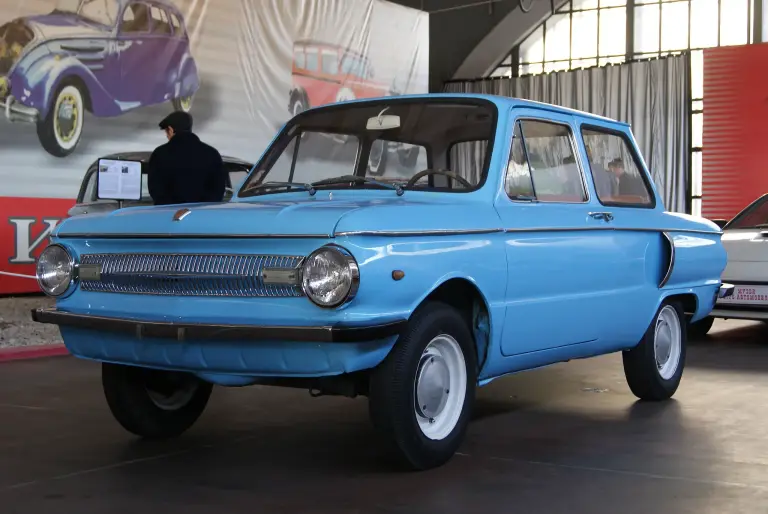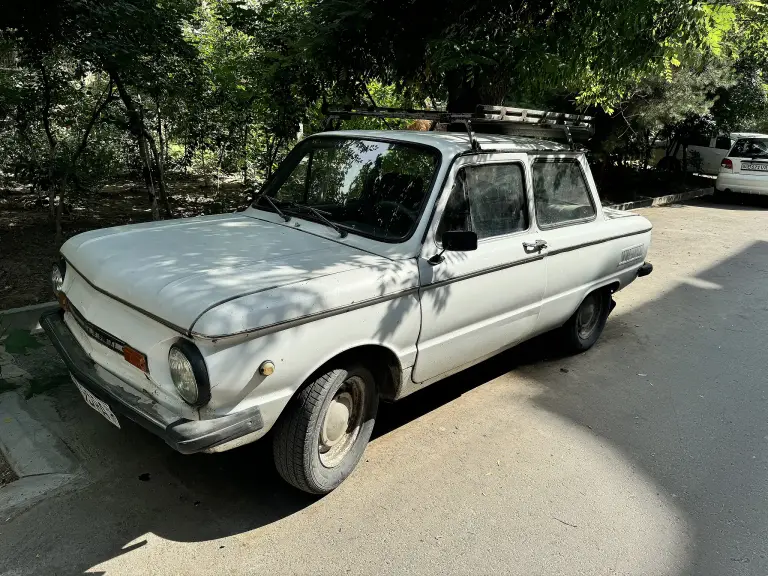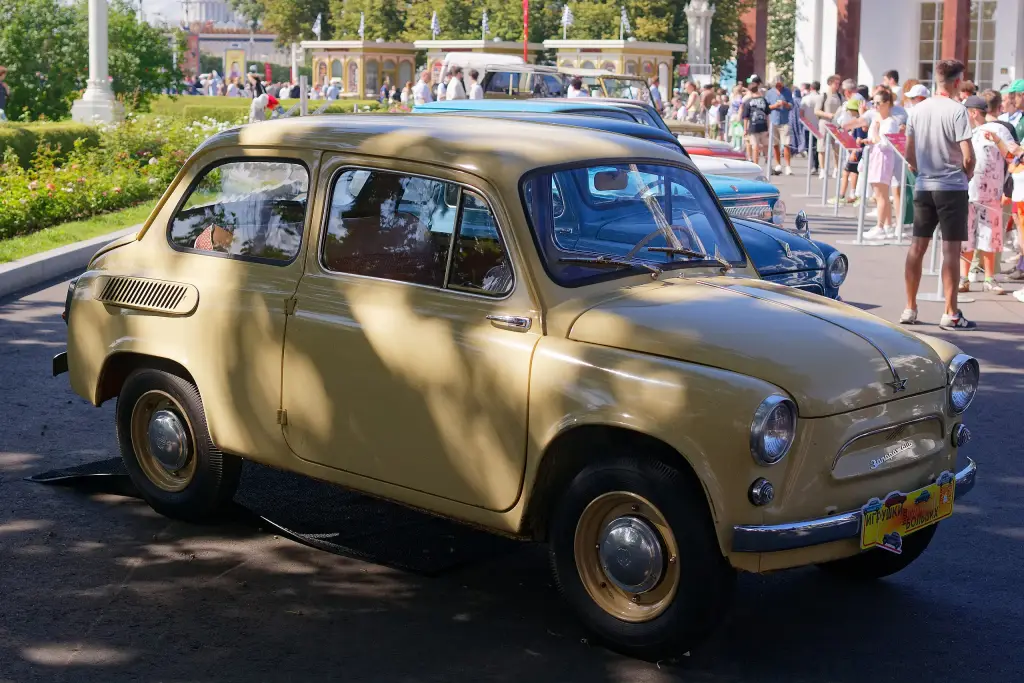
The ZAZ-965 Zaporozhets was the first series-produced car of the Zaporizhzhia automobile plant, built from 1960 as the cheapest car of the Soviet Union. Its rear-mounted air-cooled V4, independent suspension and light weight suited poor roads, and its insect-like shape earned it the nickname ‘hunchback’.
ZAZ-965 Zaporozhets at a glance
| Maker | ZAZ, Zaporizhzhia, Ukrainian SSR |
|---|---|
| Production | ZAZ-965 1960–1963; ZAZ-965A 1962–1969 |
| Body | two-door coupe, rear engine |
| Engine | 746 cc air-cooled V4, 23 hp (MeMZ-965) |
| Engine from 1962 | 887 cc V4, 27 hp; 30 hp from November 1966 |
| Layout | rear-wheel drive, independent suspension all round |
| Dimensions | 3,330 × 1,395 × 1,450 mm |
| Wheelbase | 2,023 mm |
| Kerb weight | 660 kg |
| Price in 1961 | 1,800 roubles |
| Built | 322,106 cars of the 965 family |
The English Wikipedia article covers the whole Zaporozhets series; details of the 965 itself come from the Ukrainian article.
History of the ZAZ-965 Zaporozhets
Work on a simple economy city car began in 1956, partly to replace the soon-to-be-discontinued Moskvitch 401. The Soviet automotive ministry, following a European trend in which city cars made up between 25 and 40 per cent of sales, chose the Fiat 600 as the model to follow, although the resulting ZAZ was a completely different car underneath. The first prototype, the Moskvitch-444, was designed by MZMA in October 1957; it used the same glass for the front and rear windows and had 200 mm of ground clearance on 13-inch wheels.
The prototype’s first engine, a flat twin from the Irbit motorcycle plant, produced only 17.5 hp and lasted 30,000 km between overhauls, so a replacement was sought. The ministry preferred the NAMI-G, a rear-mounted 746 cc V4 of 23 hp developed for the LuAZ-967 amphibious vehicle, with a magnesium alloy block. Its adoption required a redesigned rear end and new rear suspension, and the LuAZ designers’ influence brought independent suspension on all four wheels. Production was approved in 1958, the first car was delivered on 12 June 1959, and series production at Zaporizhzhia began in October 1960 at a price of 1,800 roubles. The first customers, workers of the plant itself, received their cars in November 1960, and about 1,500 were built before the end of that year.
The ZAZ-965 was a two-door coupe with a steel unitary body, 3,330 mm long and weighing 660 kg. The engine sat behind the rear axle, while the luggage compartment was in the front together with the 30-litre fuel tank, the spare wheel, the washer bottle and the battery under the floor; the seats could be folded into sleeping places. The front doors were hinged at the rear and opened against the direction of travel, partly to make access easier for disabled drivers. From November 1962 the improved ZAZ-965A received an 887 cc engine of 27 hp, and from November 1966 some cars were fitted with a 30 hp version. The 965A remained in production until May 1969, three years of that time alongside its successor, the ZAZ-966.
Design and features
- Air-cooled V4 behind the rear axle: an unusual layout for a car, chosen because the engine was already in production for a military amphibian.
- Independent suspension on all four wheels: with torsion bars at the front and 200 mm of ground clearance, it coped well with bad roads.
- Rear-hinged doors: a pre-war arrangement that also helped disabled drivers get in.
- Front luggage compartment: the fuel tank, spare wheel and battery were all carried ahead of the driver.
- Simple maintenance: the car was designed to be serviced by its owner, a major advantage in the Soviet Union.
ZAZ-965 Zaporozhets versions
- ZAZ-965 (1960–1963): the original car with the 746 cc, 23 hp engine.
- ZAZ-965A (1962–1969): 887 cc engine of 27 hp and a higher top speed of about 90 km/h.
- Late ZAZ-965A (1966–1969): some cars received the 30 hp MeMZ-965A engine.
- ZAZ-965S: a right-hand-drive van with blanked-off windows for the Soviet post office.
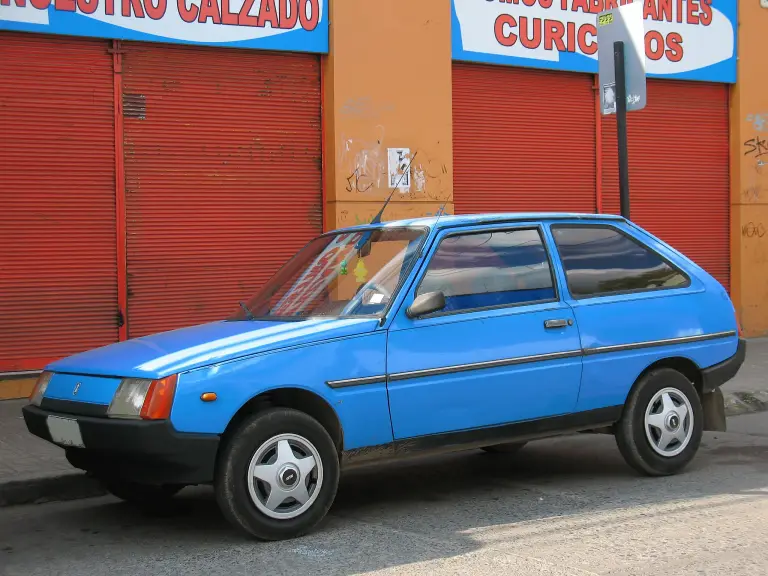
The 965 was replaced by the ZAZ-966, which grew into the long-lived ZAZ-968; the front-wheel-drive ZAZ Tavria finally ended the rear-engined line. More cars are in the ZAZ collection.
Sources
- ZAZ Zaporozhets, English Wikipedia: origins, engine choice, production dates, 965A
- ЗАЗ-965, Ukrainian Wikipedia: design details, dimensions, price, first sales