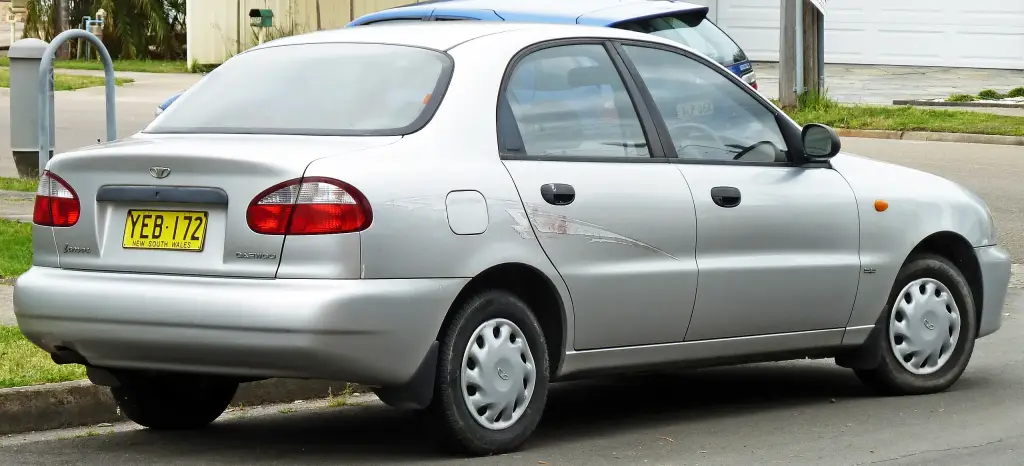
The ZAZ Sens is the version of the Daewoo Lanos produced and sold in Ukraine by ZAZ. The Lanos was designed by Giorgetto Giugiaro and launched by Daewoo in 1997; after Daewoo’s own production ended in 2002, the car continued under licence in several countries, including Ukraine.
ZAZ Sens at a glance
| Model | ZAZ Sens, the Ukrainian-market Lanos |
|---|---|
| Base car | Daewoo Lanos, designed by Giorgetto Giugiaro |
| Daewoo production | 1997–2002 |
| Licensed production | continued after 2002, ending in 2017 |
| Body styles | three-door hatchback, five-door hatchback, four-door sedan |
| Panel van | added by ZAZ in 2006 |
| Model codes | T100 at launch, T150 for the 1999 update |
| Engines | 1.3, 1.5 and 1.6-litre E-TEC four-cylinders |
| Suspension | based on the Daewoo Nexia, derived from the Opel Kadett E |
| Predecessor | Daewoo Nexia |
| Replaced by | Daewoo Kalos |
Based on one source. The ZAZ Sens is the Ukrainian-market version of the Daewoo Lanos, and the English Wikipedia article on the Lanos covers the car’s design, engines and production; details specific to the ZAZ-built Sens are not given there.
History of the ZAZ Sens
Daewoo began developing the Lanos in autumn 1993 to replace the Nexia as its small family car. The project studied competitors from 20 manufacturers, with the Toyota Tercel, Opel Astra and Volkswagen Golf seen as the toughest, and four design studios submitted clay models. Giorgetto Giugiaro’s design was chosen, and Italdesign developed the final exterior and interior. By the end of 1995, 150 prototypes had been built in three body styles, and the programme was completed in only 30 months, with the car launched in South Korea in November 1996 and European production starting in 1997.
The Lanos was sold under several names: Daewoo Sens, ZAZ Sens and ZAZ Lanos in Ukraine, Doninvest Assol and ZAZ Chance in Russia, FSO Lanos in Poland and Chevrolet Lanos in Ukraine, Russia and Egypt. The Sens therefore belongs to the same family as the Lanos: a compact hatchback or sedan with a MacPherson-strut front end, a rear suspension derived from the Opel Kadett E by way of the Nexia, and a range of E-TEC four-cylinder engines from 1.3 to 1.6 litres. The most powerful 1.6 DOHC version had larger front brake discs, a larger master cylinder, longer gear ratios and stiffer front springs.
Daewoo’s own production of the Lanos ended in 2002, but assembly continued under licence around the world. In 2006 ZAZ added a panel van version, and production of the Lanos family finally ended in 2017. Trim levels changed over the years: the S was the basic car without a CD player or power windows, the SE was a small step up, the SX usually brought a radio, power windows, a power mirror and fog lights, and in the last years the SE and SX were replaced by the SPORT with red and black leather seats and a silver dashboard trim.
Design and features
- Giugiaro design: the body and interior were styled by Italdesign after four studios submitted proposals.
- Three body styles: three-door and five-door hatchbacks and a four-door sedan, later joined by a ZAZ-built panel van.
- E-TEC engines: 1.3, 1.5 and 1.6-litre four-cylinders, with the 1.6 DOHC as the most powerful option.
- Kadett-derived chassis: the suspension came from the Nexia, itself based on the Opel Kadett E.
- Ukrainian production: the Sens kept the Lanos on the ZAZ line long after Daewoo stopped making it.
ZAZ Sens versions
- ZAZ Sens hatchback: the three-door and five-door versions of the Lanos.
- ZAZ Sens sedan: the four-door body, the original Lanos shape of 1996.
- Panel van (2006): a commercial version produced by ZAZ.
- SPORT (2001–2002): the final Daewoo trim with leather seats and silver dashboard trim.
The Sens is the Lanos-based stablemate of the ZAZ Slavuta and the ZAZ Tavria, and it shares its base with the Russian-market ZAZ Chance. More cars are in the ZAZ collection.
Sources
- Daewoo Lanos, English Wikipedia: development, names, engines, trims, end of production