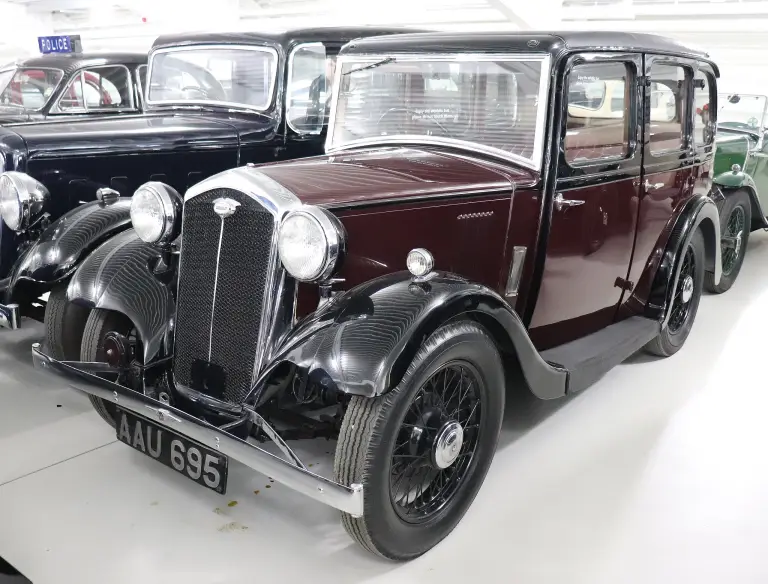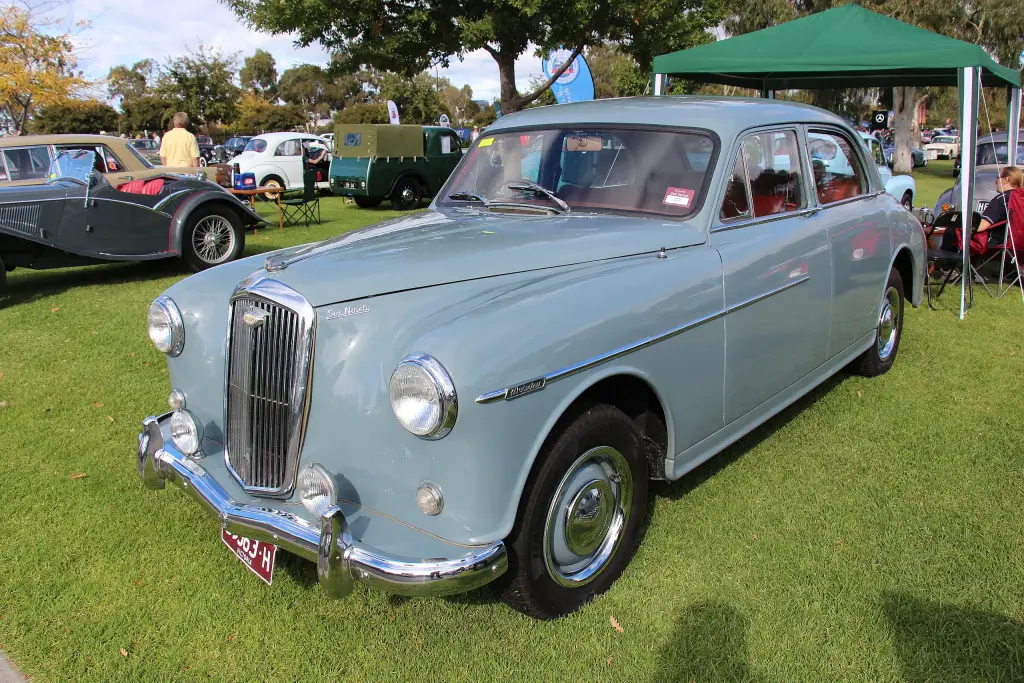
The Wolseley 6/90 was announced on the first day of the October 1954 British Motor Show and replaced the 6/80 as Wolseley’s flagship. It combined Riley Pathfinder body panels with BMC’s new 2.6-litre C-Series six, and between 1954 and 1959 it was the only car to wear the famous illuminated Wolseley radiator badge.
Wolseley 6/90 at a glance
| Maker | Wolseley Motors, British Motor Corporation |
|---|---|
| Production | 1954–1959 |
| Predecessor | Wolseley 6/80 |
| Successor | Wolseley 6/99 |
| Body | four-door saloon, Riley Pathfinder panels |
| Engine | 2,639 cc C-Series straight-six |
| Power | 95 hp |
| Transmission | four-speed manual; overdrive or automatic optional from 1957 |
| Series I | 5,776 built |
| Series II | 1,024 built |
| Series III | 5,052 built |
| Price, 1955 test | £1,063 including tax |
| Performance, 1955 test | 96 mph; 0–60 mph in 17.3 s; 21.6 mpg |
Based on one source, the English Wikipedia article.
History of the Wolseley 6/90
A new flagship
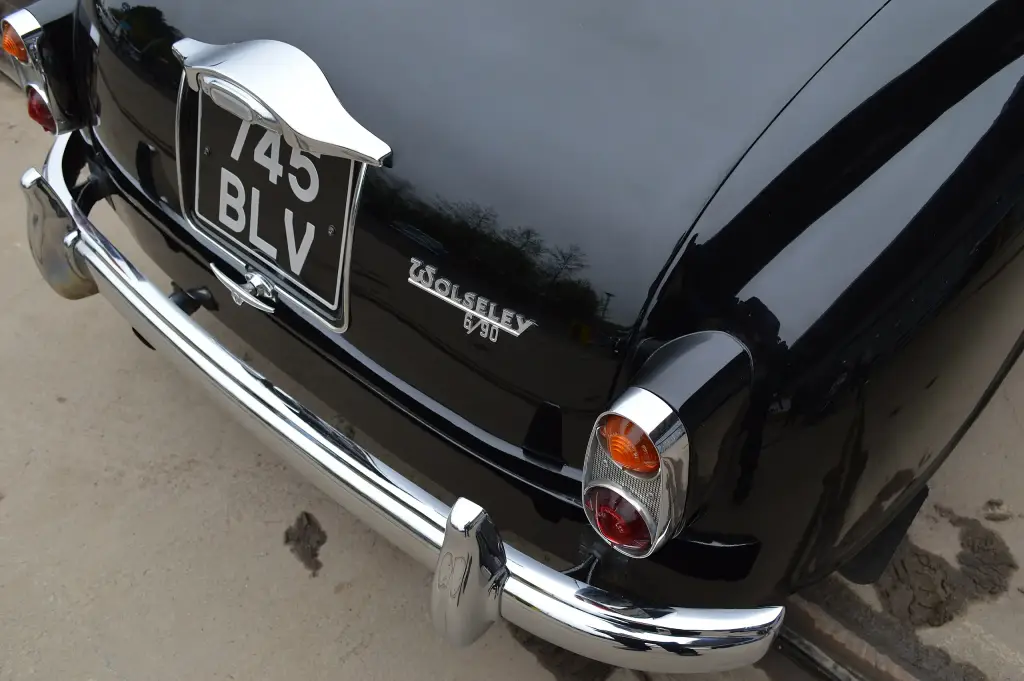
The 6/90 replaced the 6/80 in 1954 and was badged Six-Ninety on the bonnet and 6/90 on the bootlid. Where the post-war austerity 6/80 had shared all but its radiator shell and interior finish with the Morris Six, the 6/90 used the Italian-style body panels of the previous year’s Riley Pathfinder, although not Riley’s sporting “big four” engine or its suspension. The Pathfinder and 6/90 were both Nuffield designs, conceived before Nuffield merged with Austin to form BMC. The Wolseley received the new BMC C-Series straight-six of 2,639 cc and 95 hp, coupled to a four-speed manual gearbox. Inside there was a grey striped Formica instrument panel and a large central chrome mesh “cheese-cutter” speaker grille; the handbrake sat under the dash beside the steering column, the gearchange was column-mounted opposite the dip switch, and the leather front seats were mounted closely together with a folding armrest in the rear bench.
Three series
The Series I ran to 5,776 cars before the Series II arrived in 1957. The Series II brought leaf springs on the live rear axle, a more conventional walnut dashboard and a floor-mounted gear lever, unusually on the right-hand side of right-hand-drive cars; overdrive or automatic transmission were optional. It lasted only eight months and 1,024 cars before giving way to the Series III in 1958, which had larger power brakes and a larger rear window and was also sold, rebadged, as the Riley Two-Point-Six. Total Series III production was 5,052. The Motor tested a 6/90 in 1955 and recorded 96 mph, 0–60 mph in 17.3 seconds and 21.6 mpg; the test car cost £1,063 including taxes.
Police work and the end of the line
Until the early 1960s the definitive British police car was a black Wolseley 6/90 with a brass Winkworth bell on its front bumper. Production ended in 1959 with the introduction of the Pininfarina-designed 6/99. The 6/90 is also remembered for the sacking of its designer, Gerald Palmer, by BMC’s Leonard Lord in favour of Alec Issigonis. A die-cast model of the car was produced by Lansdowne in 2007.
Design and features
- Pathfinder bodywork: Italian-style panels from the Riley Pathfinder, with Wolseley trim.
- C-Series six: 2,639 cc and 95 hp, giving a 96 mph top speed in road tests.
- Distinctive interior: grey striped Formica panel and a chrome mesh speaker grille.
- Illuminated badge: the only car to carry the lit Wolseley radiator badge between 1954 and 1959.
- Police equipment: a familiar sight with a brass Winkworth bell on the bumper.
Wolseley 6/90 versions
- Series I (1954–1957): column gearchange and Formica dashboard; 5,776 built.
- Series II (1957): leaf springs, walnut dash and floor gearchange; 1,024 built.
- Series III (1958–1959): larger power brakes and rear window; 5,052 built.
- Riley Two-Point-Six: the same Series III design sold under the Riley marque.
The Wolseley 6/80 was the model the 6/90 replaced, and the Wolseley 15/60 arrived at the end of the 1950s as the marque’s smaller Farina saloon. More cars are in the Wolseley collection.
Video: Wolseley 6/90 Revival Ep.10 – Driving on the Open Road!
Video on YouTube.
Sources
- Wolseley 6/90, English Wikipedia: history, series, engineering, road test, production