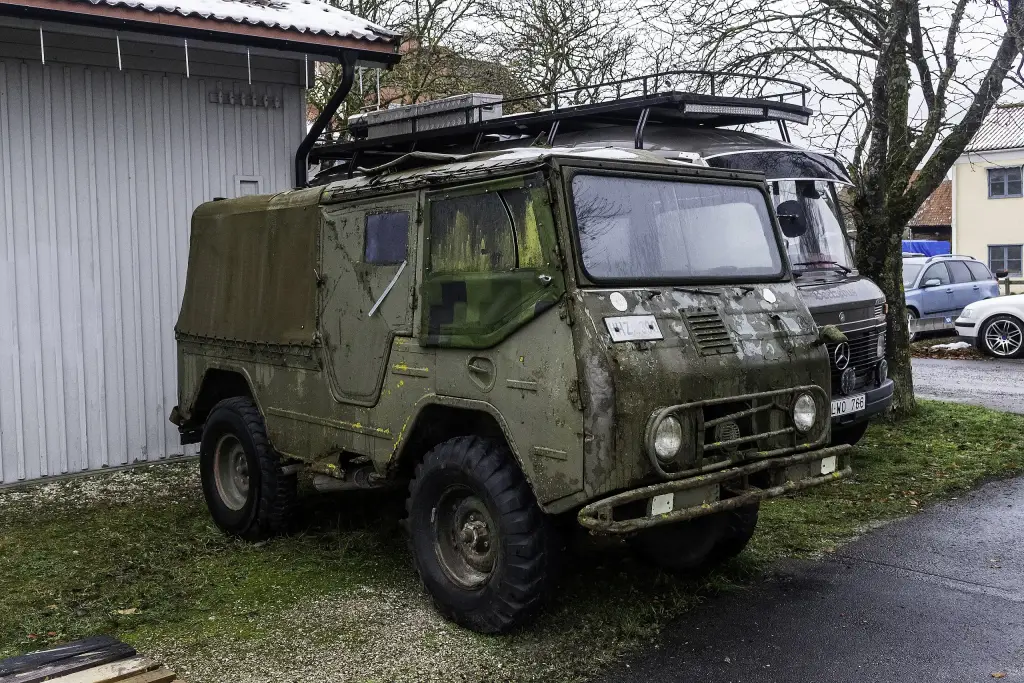
The Volvo L3314 was a range of light military off-road vehicles built for the Swedish Army from 1963, after a pre-series of 90 L2304 vehicles delivered in 1959–1961. Civilian versions and the related C202 are usually known as the Volvo Laplander.
Volvo L3314 at a glance
| Pre-series | L2304, 90 vehicles, 1959–1961, B16 engine |
|---|---|
| Full production | L3314 from 1963 |
| Engine | 1.8-litre B18A, 65 hp, 1,778 cc |
| Gearbox | modified Volvo M40 with ZF VG 50 transfer case |
| Bodies | soft-top, hardtop, half-cab, anti-tank and radio versions |
| Built at | Volvo’s Lundby plant, Gothenburg |
| Numbers | 7,737 L3314, 1,116 L3315, 367 L3304, 3,322 C202 |
| Military name | Personlastterrängbil 903, nicknamed Valp |
| Successor | Volvo C303 in the late 1970s |
History of the Volvo L3314
In the early 1950s Volvo received an order to develop a new utility vehicle for the Swedish Army. A pre-run series of 90 vehicles called the L2304 was delivered between 1959 and 1961 with a Volvo B16 engine, and full-scale deliveries of the improved L3314 began in 1963 with the 1.8-litre B18.
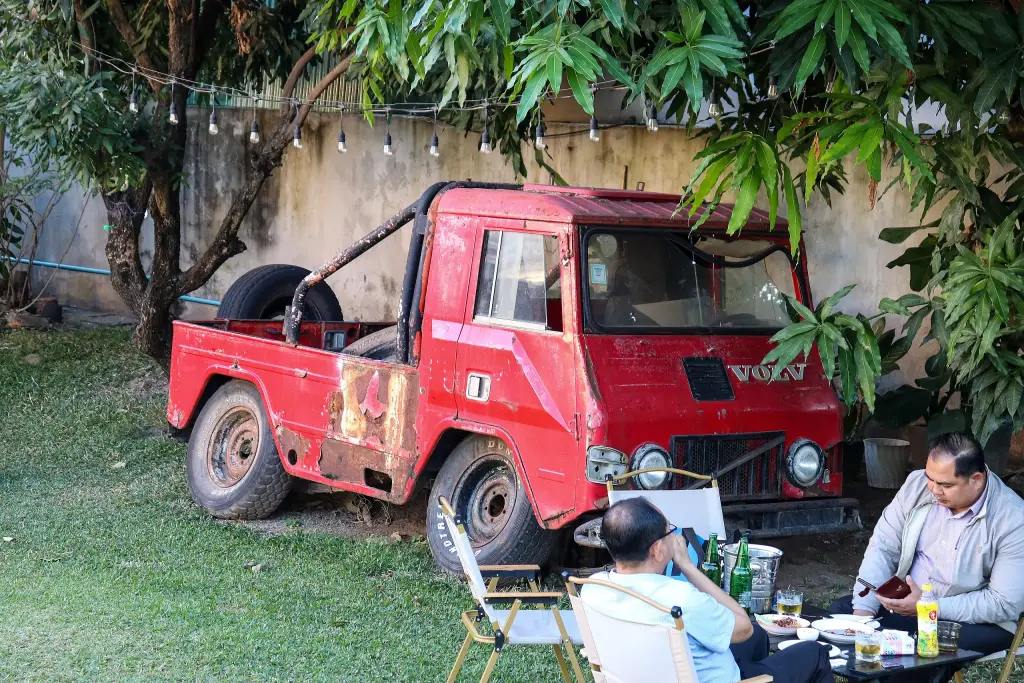
The L33 series came with different bodies: the L3314SU soft-top as the base version, the L3314HT hardtop with a mechanical winch, the L3304 open anti-tank vehicle and the L3315 communications version with a shielded 24-volt system. All were forward control, with the cab over the front axle, except the open L3304. The L3314 used constant-velocity joints of the Rzeppa type in its front axle, a modified Volvo M40 gearbox and a ZF VG 50 transfer case.
Army names
The Swedish Army adopted the L3314SU in 1959 as the Personlastterrängbil 903 and the hardtop as the 903B. The L3315 became the Radiopersonterrängbil 9033 and was soon nicknamed Valp, meaning puppy, for its clumsy looks. The open L3304 was the Pansarvärnspjästerrängbil 9031, armed with a 90 mm recoilless anti-tank gun, and a few half-cabs carried the Bofors Bantam missile. A fire-fighting version, the Brandterrängbil 921, could drive a trailer through a power take-off.
Abroad
The Norwegian Army bought about 2,000 L3314Ns with a folding windscreen and 24-volt electrics, assembled at Raufoss. The Royal Netherlands Army took a version able to ford deeper water than the standard half-metre limit, and Saudi Arabia received some 200 L3314N Öken desert versions, which curiously kept their Norwegian ski racks.
An upgraded civilian model appeared in 1977 as the C202 Laplander, a hardtop with the more powerful 2.0-litre B20 engine of 82 hp, less robust axles and no differential brake. It was built only at the Csepel works in Hungary as a cheaper alternative to the C303, and 3,322 were made. The L3314 itself was succeeded by the Volvo C303 in the late 1970s.
Design and features
- Forward control: cab over the front axle for a short, agile vehicle.
- B18 engine: 65 hp from 1,778 cc, with a modified M40 gearbox.
- Many bodies: soft-top, hardtop, radio, anti-tank and fire versions.
- C202 Laplander: Hungarian-built civilian version with the B20 engine.
- Long service: military surplus vehicles still used by enthusiasts.
Volvo L3314 versions
- L3314SU: soft-top base version, the Pltgb 903.
- L3314HT: hardtop with mechanical winch.
- L3315: radio and command vehicle, the Valp.
- L3304: open body with a 90 mm recoilless gun.
- C202 Laplander (1977): civilian hardtop built in Hungary.
The L3314 was succeeded by the Volvo C303, which kept the portal-axle idea for heavier military work. More vehicles are in the Volvo collection.
Sources
- Volvo L3314, English Wikipedia: development, variants, army names, exports, C202, production