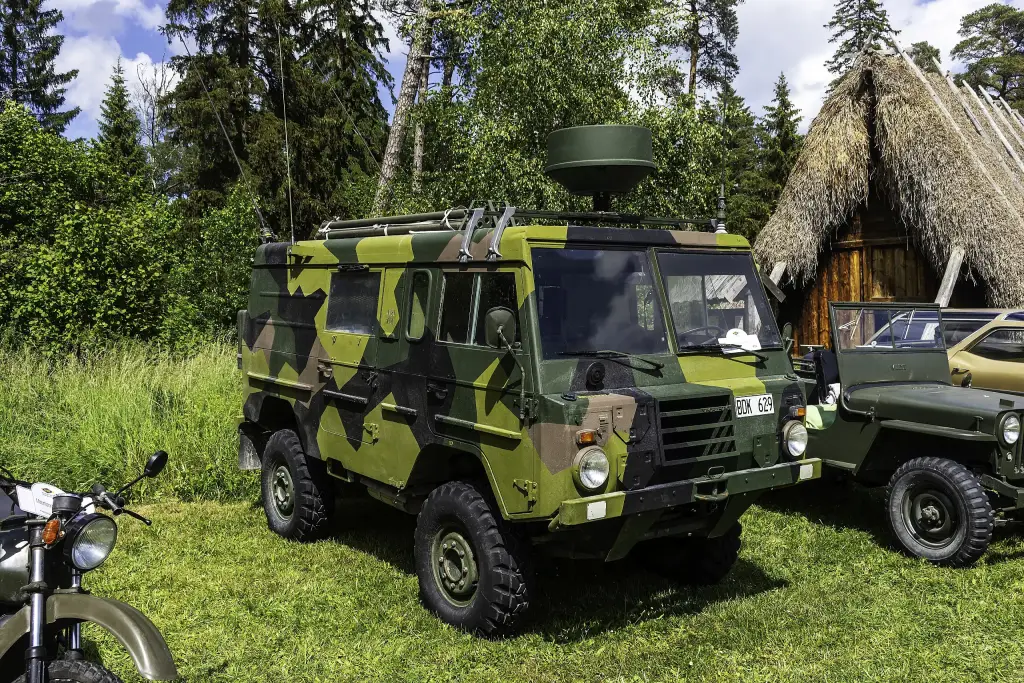
The Volvo Cross Country C303, known in Swedish army service as the Terrängbil 11 or Tgb 11, was the base of a family of military off-road vehicles produced by Volvo from 1974. It was developed from the L3314 series and built as a 4×4 and a 6×6.
Volvo C303 at a glance
| Production | from 1974 |
|---|---|
| Bodies | 4×4 C303/Tgb 11, 6×6 C304/Tgb 13, 6×6 C306/Tgb 21 and 22 |
| Engine | Volvo B30A petrol, 125 hp; 117 hp in military editions |
| Torque | 224 Nm at 2,500 rpm |
| Drivetrain | portal axles with locking differentials |
| Top speed | about 100 km/h |
| Weight | 2,400 kg unladen for the C303, 3,390 kg for the C306 |
| Fuel tank | 85 litres |
| Built | 8,718 vehicles of the C3 series |
| Rally | class win in the 1983 Paris–Dakar for trucks under 10 tonnes |
History of the Volvo C303
The C303 was developed in the late 1960s from the successful L3314 series and went into production in 1974. It was built as a 4×4 and a 6×6, while an 8×8 version was planned and dropped. Power came from the B30 six-cylinder petrol engine of Volvo’s civilian cars, the B20 having been used in the prototypes.
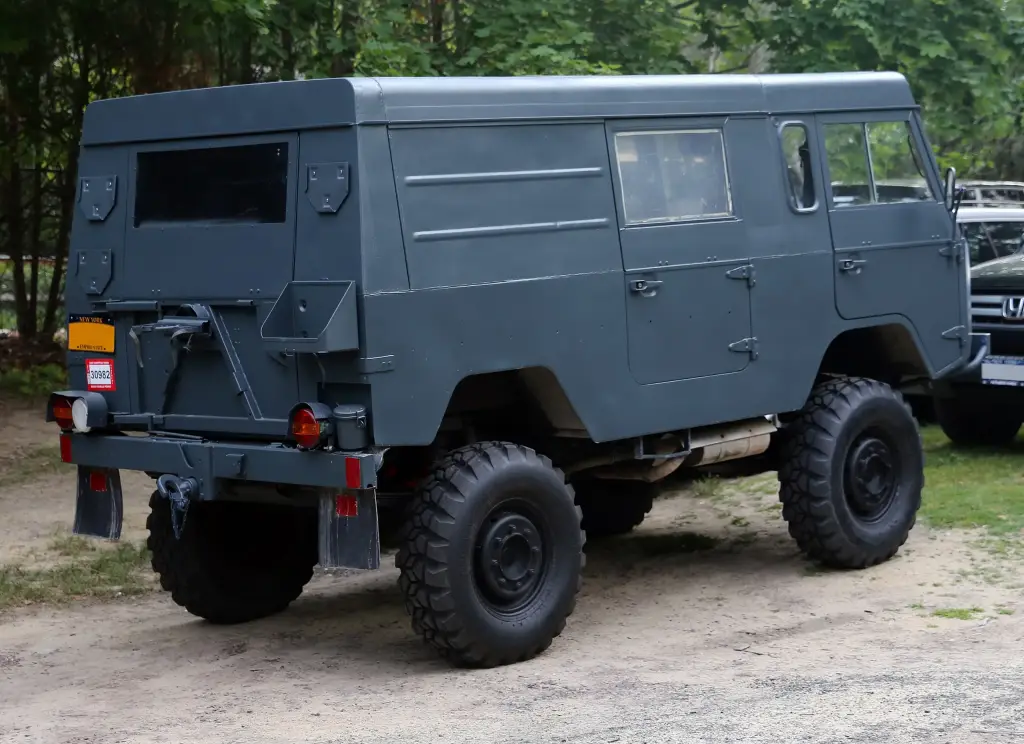
The defining feature was the suspension: portal axles with locking differentials gave very high ground clearance, in the manner of a Unimog, and the body was deliberately narrow so that the vehicle could pass between trees and along narrow forest tracks. Leaf springs were used front and rear with drum brakes all round and tyres of 8.90×16, 285/80-16 or 9.00×16.
The C3 family
In Swedish service the vehicles carry Terrängbil numbers. The 4×4 C303 became the Tgb 11 hardtop, the Tgb 1111 soft-top with a 90 mm recoilless anti-tank gun, and radio-carrying Tgb 1112 and 1113. The 6×6 C304 became the Tgb 13 hardtop, the larger radio Tgb 1313, the Tgb 1314 ambulance and the Tgb 1321 artillery command vehicle. The longer 6×6 C306 served as Tgb 21, a troop carrier for up to 19 soldiers, and Tgb 22 with room for eleven and equipment for the RBS 70 anti-aircraft missile.
A total of 8,718 vehicles of the C3 series were made, about 75% for military service and the rest for civilian buyers such as rescue services and electricity companies. In the 1983 Paris–Dakar rally a Volvo C303 won the class for trucks under ten tonnes. The type served with the Swedish, Estonian, Latvian and Lithuanian forces and with Angola and Malaysia, where the army and the Royal Malaysian Police used it from about 1970 to 1990.
Design and features
- Portal axles: very high ground clearance with locking differentials.
- Narrow body: designed to pass between trees on forest tracks.
- B30 engine: the six-cylinder unit from Volvo’s cars.
- Many variants: hardtop, soft-top, radio, ambulance and troop carriers.
- Proven in competition: a class win on the 1983 Paris–Dakar.
Volvo C303 versions
- C303 / Tgb 11: basic 4×4 hardtop.
- Tgb 1111: 4×4 soft-top with a 90 mm recoilless gun.
- C304 / Tgb 13: 6×6 hardtop, with radio and ambulance versions.
- C306 / Tgb 21 and 22: long 6×6 troop carriers.
- Civilian versions: rescue, power company and private use.
The C303 followed the Volvo L3314 of the 1960s, which it replaced in production. More vehicles are in the Volvo collection.
Sources
- Volvo C303, English Wikipedia: development, variants, data, users