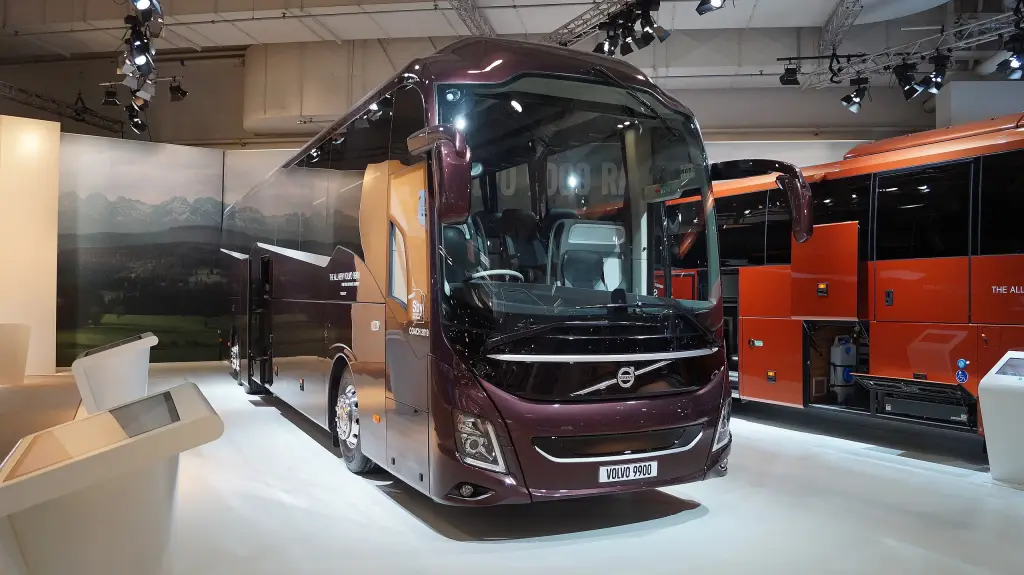
The Volvo 9900 is a coach best known for its theatre floor, which raises the seats towards the rear of the bus. The first generation was built by Drögmöller in Heilbronn, Germany, from 2001 to 2005; since 2007 it has been made in Poland as part of the 9700 family.
Volvo 9900 at a glance
| Introduced | 2001 |
|---|---|
| First builder | Drögmöller, Heilbronn, Germany, 2001–2005 |
| Since 2007 | built at Volvo Polska, Wrocław |
| Concept | theatre seating with a window line rising to the rear |
| Forerunner | Drögmöller E330 Comet |
| Chassis | B12B, B13R from 2010, B11R from 2013 |
| Lengths | 12.0 m two-axle, 12.8 and 13.7 m tri-axle |
| Generations | 2001, 2007, 2013, 2018 |
| Market | Europe only |
History of the Volvo 9900
The 9900 replaced the Volvo B12-600 and was the first Drögmöller coach built completely to Volvo specifications on the Volvo TX platform. Its central idea came from the Drögmöller E330 Comet: theatre seating and a window line that slopes gently upwards towards the rear. Where the B12-600 was only a two-axle 12-metre coach, the 9900 was also offered as a tri-axle of 12.8 and 13.7 metres. All Drögmöller-built examples used the Volvo B12B chassis.
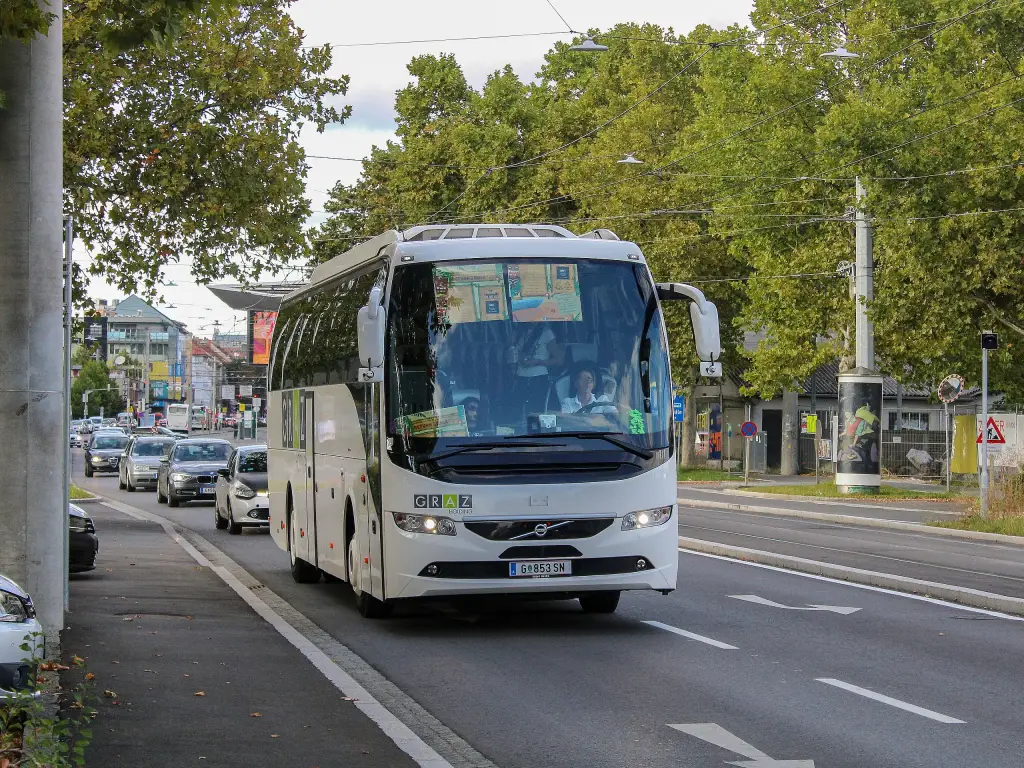
Volvo closed the Heilbronn plant in 2005, which stopped 9900 production until the new generation of the 9700 was ready. In 2007 the model returned as part of the 9700 family, built in Poland with styling identical to the second-generation 9700 apart from the sloping window line. It proved a little too identical, so early in 2008 a small facelift changed exterior details, most visibly the lower front and the air intakes.
Chassis generations
In 2010 the B12B gave way to the new B13R, and in 2011 Volvo added a silver stripe along the lower window line, partly because operators had taken to painting their 9700s to look like 9900s. The third generation arrived in 2013 with the styling details of the third-generation 9700 and the Euro VI B11R chassis, and was displayed at Busworld Kortrijk in October 2013. A fourth generation was unveiled in May 2018 alongside the 9700, similar to the 9800 and built only for the European market in Poland.
Place in the range
The 9900 sits above the standard 9700 as a premium touring coach, sold alongside the stripped-down 9500. Its sloping side glass and stepped floor give passengers in the rear a clear view forward over those in front, which is why it is popular on long sightseeing and express services in Scandinavia, Germany and France.
Design and features
- Theatre floor: rear seats raised step by step for a clear view forward.
- Rising window line: the signature exterior clue to the 9900.
- Drögmöller heritage: developed from the E330 Comet concept.
- Modern chassis: B12B, then B13R and B11R with Euro VI engines.
- European only: built in Poland for the home continent.
Volvo 9900 versions
- 9900 first generation (2001–2005): Drögmöller-built, B12B chassis.
- 9900 second generation (2007): Polish-built member of the 9700 family.
- 2013 generation: new styling, B11R chassis.
- 2018 generation: fourth generation, Europe only.
The 9900 is the premium member of the Volvo 9700 family and uses much of the chassis technology of the Volvo B11R. More buses are in the Volvo collection.
Sources
- Volvo 9900, English Wikipedia: origins, generations, chassis, styling