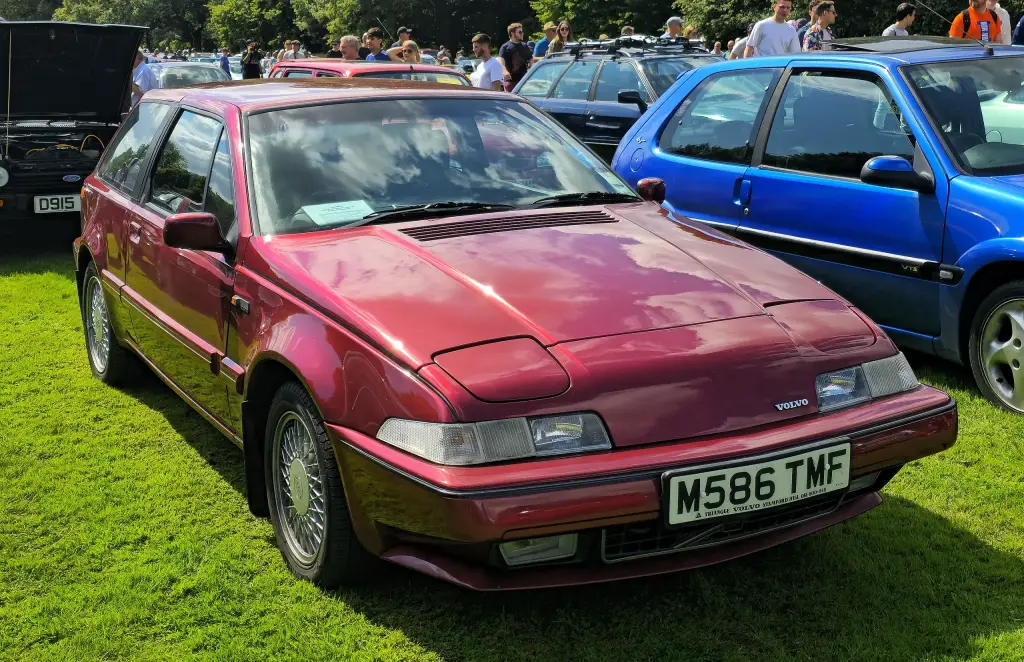
The Volvo 480 was a sporty four-seat compact coupé built in Born in the Netherlands from 1986 to 1995. It was the first front-wheel-drive Volvo, the only one with pop-up headlights, and it was aimed squarely at younger buyers.
Volvo 480 at a glance
| Production | 1986–1995 |
|---|---|
| Built in | Born, Netherlands |
| Body | three-door, four-seat hatchback coupé |
| Layout | front-wheel drive, transverse engine |
| Engines | Renault four-cylinders, 1.7 and 2.0, turbocharged option |
| Headlights | pop-up, the only Volvo so equipped |
| Rear axle | Lotus-developed |
| Public launch | Geneva Motor Show, March 1986 |
| UK sales | 22,421, the highest of any country |
| Platform relative | Volvo 440/460 |
History of the Volvo 480
Volvo spent six years taking the 480 from first idea to production. The press launch was on 15 October 1985, the car appeared in public at the Geneva Motor Show in March 1986, went on sale in mainland Europe that May and in Britain and Ireland on 11 June 1987.
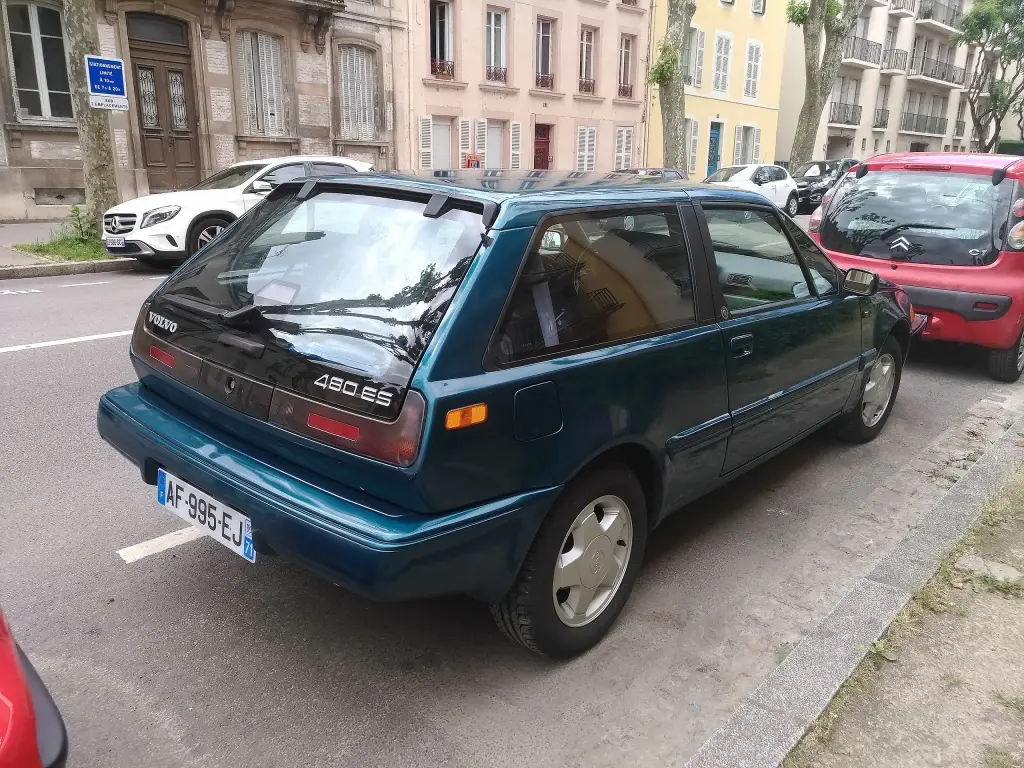
The 480 was designed by Volvo’s Dutch subsidiary to change the company’s frumpy image and attract buyers between 25 and 40 with a higher than average education. It was a four-seater with what the press called a sleek hatch body, quite unlike Volvo’s traditional boxy cars. The frameless glass hatch linked it to the 1800ES of the 1970s and, later, the C30. Panels such as the nose cone and bonnet were made of composites to save weight and protect pedestrians.
Engineering choices
The pop-up headlights were adopted to meet US rules on minimum headlight height while keeping the aerodynamic shape, and the bumpers were designed to withstand a 5 mph impact without damage. The car had good handling thanks to a Lotus-developed rear axle. The normally aspirated Renault engines were not powerful but were reliable. A fully electronic Info Centre with fuel gauge, range, instant economy and average speed was standard on most cars, alongside daytime running lights, follow-me-home lighting and a rear wiper that switched on in reverse.
Plans to sell the 480 in the United States as a 2+2 sports wagon were cancelled in February 1988 because of the weak dollar. The federalised engine did allow the 480 Turbo to be exported to Japan from 1989.
Special editions
In 1991 came the Paris Blue limited edition with turquoise bumpers and trim, two-tone leather, a MOMO steering wheel and 14-inch alloy wheels. The 1992 Two-Tone edition wore Peacock Green over Smoke Silver paint with a split vinyl and velour interior and 15-inch Taurus wheels. A GT edition followed for the UK on 1 June 1994.
Design and features
- Front-wheel drive: the first Volvo to drive its front wheels.
- Pop-up headlights: unique among Volvos and a response to US lighting rules.
- Lotus rear axle: sharp handling unusual for the marque.
- Electronics: an early digital Info Centre and numerous convenience features.
- Composite panels: weight-saving nose cone and bonnet.
Volvo 480 versions
- 480 ES (1986): the standard 1.7-litre car.
- 480 Turbo: blown version, also exported to Japan from 1989.
- Paris Blue (1991): turquoise-trimmed limited edition.
- Two-Tone (1992): two-colour paint and interior.
- 480 GT (1994): UK-market edition.
The 480 shared its platform with the Volvo 440 and 460, and its glass hatch idea returned on the Volvo C30. More cars are in the Volvo collection.
Sources
- Volvo 480, English Wikipedia: development, design, equipment, special editions