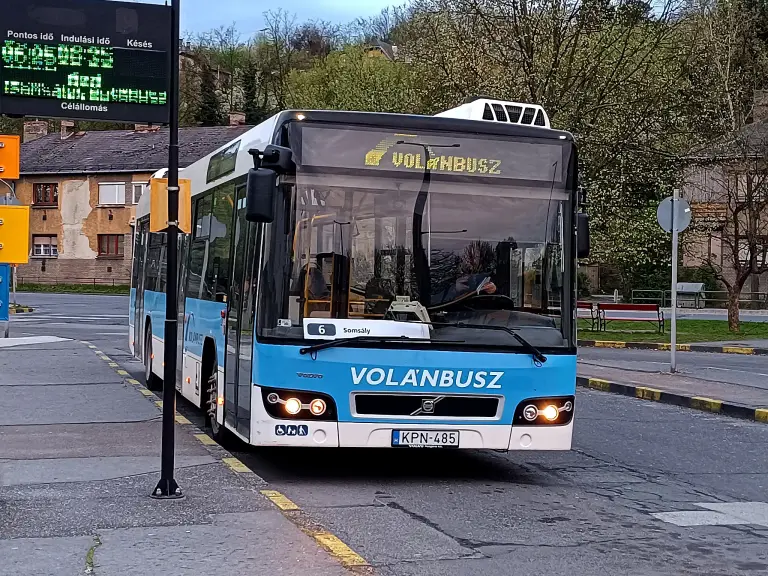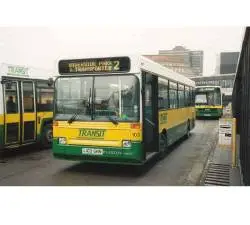
The Volvo B6 was a midibus chassis with a 5.5-litre engine, built from 1991 to 1999. It was Volvo’s answer to the Dennis Dart in the British and European midibus market, with a low-entry B6LE version added in 1995.
Volvo B6 at a glance
| Production | 1991–1999 |
|---|---|
| Engine | 5.5-litre TD63 and D6A in-line six turbodiesel |
| Power | 180 or 210 bhp |
| Lengths | B6-36 8.5 m, B6-41 9.0 m, B6-50 9.9 m, B6-45 9.1 m coach |
| Low entry | B6LE, left-hand drive from launch, right-hand drive from 1995 |
| Pre-production | about 30 chassis by Steyr Bus in Vienna |
| Series production | Irvine, Scotland, from March 1993 |
| UK deliveries | 627 between 1993 and 1997 |
| B6LE built | 394 for the UK, 1995–1999 |
| Successor | B6BLE, 1999 |
Based on one source, the English Wikipedia article on the B6. Free photographs of the midibus chassis are not available, so the page keeps the photos already on the record.
History of the Volvo B6
The B6 was launched in 1991 in several lengths: the 8.5-metre B6-36, the 9.0-metre B6-41, the 9.9-metre B6-50 and a 9.1-metre coach version, the B6-45. Left-hand-drive markets could order a 350 mm low-entry floor from the start, but right-hand-drive operators had to wait until 1995. In Britain the car was first marketed as the B6R, a name later used only in the Asia-Pacific region.
About 30 pre-production chassis were built by Volvo’s subsidiary Steyr Bus in Vienna, mostly as coaches, and only nine of those reached Britain. In March 1993 series production began at Volvo’s new bus chassis plant in Irvine, Scotland. The B6-50 was immediately popular and the short B6-36 was soon replaced in buyers’ favour by the B6-41. The B6-45 midicoach sold badly: only fourteen were built by 1995, when the right-hand-drive version was withdrawn, and the last one, unsold since 1995, went to the Russian embassy in 1998.
Step-entrance B6s were discontinued in right-hand-drive markets in 1997, while left-hand-drive versions lasted until the B6BLE arrived in 1999; the step-entrance B6 never had a direct successor. Between 1993 and 1997, 627 B6s were delivered in Britain. Most were built for the UK, with 61 exported to Hong Kong and a few to Australia, where Blue Ribbon bought five, Southtrans four and Whyalla City Transport two.
B6LE
The low-entry B6LE was initially left-hand drive only, becoming available as right-hand drive in 1995 to compete with the Dennis Dart SLF. It replaced the B6 in some markets in 1997 and was itself replaced by the B6BLE in 1999, with 394 built for Britain including two test beds for the B6BLE. Hong Kong took 20 B6LEs with Plaxton Pointer bodies, ten with ALX200 bodies and 30 with local Jit Luen bodywork.
Design and features
- 5.5-litre six: a compact engine for a midibus, at 180 or 210 bhp.
- Four lengths: from 8.5 to 9.9 metres plus a 9.1-metre coach.
- Low-entry option: 350 mm floor height for easier access.
- Scottish build: series production at Irvine from 1993.
- UK favourite: 627 buses in four years.
Volvo B6 versions
- B6-36: 8.5-metre short midibus.
- B6-41: 9.0-metre, the length most buyers chose.
- B6-50: 9.9-metre, the launch favourite.
- B6-45: 9.1-metre midicoach, only fourteen right-hand-drive examples.
- B6LE: low-entry version, 394 for Britain.
The B6 was replaced by the B6BLE and sat below the larger Volvo B10M in the range. More buses are in the Volvo collection.
Sources
- Volvo B6, English Wikipedia: lengths, production, exports, B6LE, engines