The VespaCar, later known as the Ape, is the three-wheeled light commercial vehicle that Piaggio derived from the Vespa scooter. Introduced in 1948 and at first marketed as the VespaCar or TriVespa, it has been in continuous production ever since, mostly in India since 2013.
Vespa Ape at a glance
| Maker | Piaggio |
|---|---|
| Introduced | 1948 |
| First names | VespaCar, TriVespa |
| Type | three-wheeled light commercial vehicle |
| Based on | the Vespa scooter |
| Early engines | 50, 125 and 150 cc |
| Later engine | up to 1000 cc |
| Cab | added with the Ape C of 1956 |
| Steering | handlebar; a steering wheel came later |
| Ape 50 payload | 175–205 kg |
| Ape TM payload | 700–805 kg |
| Italian production | ended 16 October 2013, moved to India |
Based on one source: the English Wikipedia article on the Piaggio Ape. The records merged here covered the VespaCar, the name under which the Ape was first sold.
History of the Vespa Ape
From scooter to load carrier
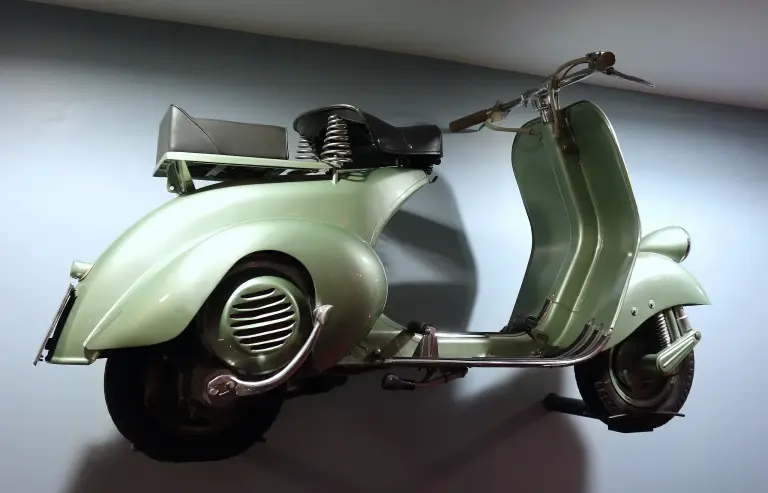
After the war many Italians could not afford a car, and in 1947 the aircraft designer Corradino D’Ascanio drew a light three-wheeled commercial vehicle that Piaggio approved. The first Ape was a cabless adaptation of the Vespa: two rear wheels were added and a flat load bed was placed over the rear axle. Early models had 50, 125 or 150 cc engines, and later versions went up to 1000 cc. The name Ape, Italian for bee, was adopted for the production vehicle, while the first examples were sold as the VespaCar or TriVespa.
The first models
The Ape A of 1948–1952 had a 125 cc engine, a wooden pickup bed and the front fork mounted to the left of the wheel hub, with a column-mounted gear lever. The Ape B of 1952–1956 moved the fork to the right, used a pressed steel cargo bed and a cable gear change, and kept the 150 cc engine. The Ape C of 1956–1967 was the first with an enclosed cab; the engine sat under the driver’s seat and ran on a five per cent oil mix. The Ape D of 1964 added a 175 cc engine that could run on a two per cent mix, a trapezoidal headlight on the bulkhead and the first cab heater.
Later history
The Ape E of 1965–1973 went back to 150 cc, and the Ape MP of 1968–1978 moved the engine from the cab to the rear to improve comfort. The Ape 500 of 1981–1993 had a new front with two headlights on each side, the Ape Web and Ape Cross of 1994–1999 were aimed at younger buyers, and the Ape TM has been made since 1982 with 218 cc petrol or 422 cc diesel engines. The Ape 50 arrived in 1996, the Ape Classic in 2006, and the retro Calessino was built in limited numbers in 2007–2009, followed by the Calessino 200 from 2013.
Work and markets
The Ape has been sold as a van, a pickup, an autorickshaw and even an ambulance or a mobile advertising board. Its compact size lets it use narrow streets and park easily, and in Italy it often serves as an improvised market stall. Most Apes are now built in India by Piaggio India, where the autorickshaw is the common form; a small number were still made in Italy until 16 October 2013, when Piaggio announced that Italian production would end and all construction move to India. Current ranges are the Ape 50 with a 49.8 cc petrol engine and the Ape TM with 218 cc petrol or 422 cc diesel, the 50 carrying 175 to 205 kg and the TM 700 to 805 kg.
Design and features
- Vespa-based: the front end and mechanical layout came from the scooter, with two extra rear wheels.
- Handlebar steering: the original layout, with a steering wheel only on later models.
- Many bodies: pickup, van, tipper, autorickshaw, ambulance and advertising vehicle.
- Cab from 1956: the Ape C was the first with an enclosed cab; the D added a heater.
- Still in production: continuous manufacture since 1948, now mainly in India.
Vespa Ape versions
- Ape A (1948–1952): 125 cc, wooden pickup bed.
- Ape B (1952–1956): 150 cc, pressed steel bed.
- Ape C (1956–1967): first enclosed cab.
- Ape D (1964–1967): 175 cc, cab heater.
- Ape MP (1968–1978): rear engine for more comfort.
- Ape 50 and Ape TM: the current ranges.
- Ape Calessino (2007–2009): retro autorickshaw edition.
The four-wheeled Piaggio commercial vehicle is the Piaggio Porter, and the scooter the Ape was based on begins with the Vespa 125. More are in the Vespa collection.
Video: Vespa Car Fun
Video on YouTube.
Sources
- Piaggio Ape, English Wikipedia: history, model list, payloads, production