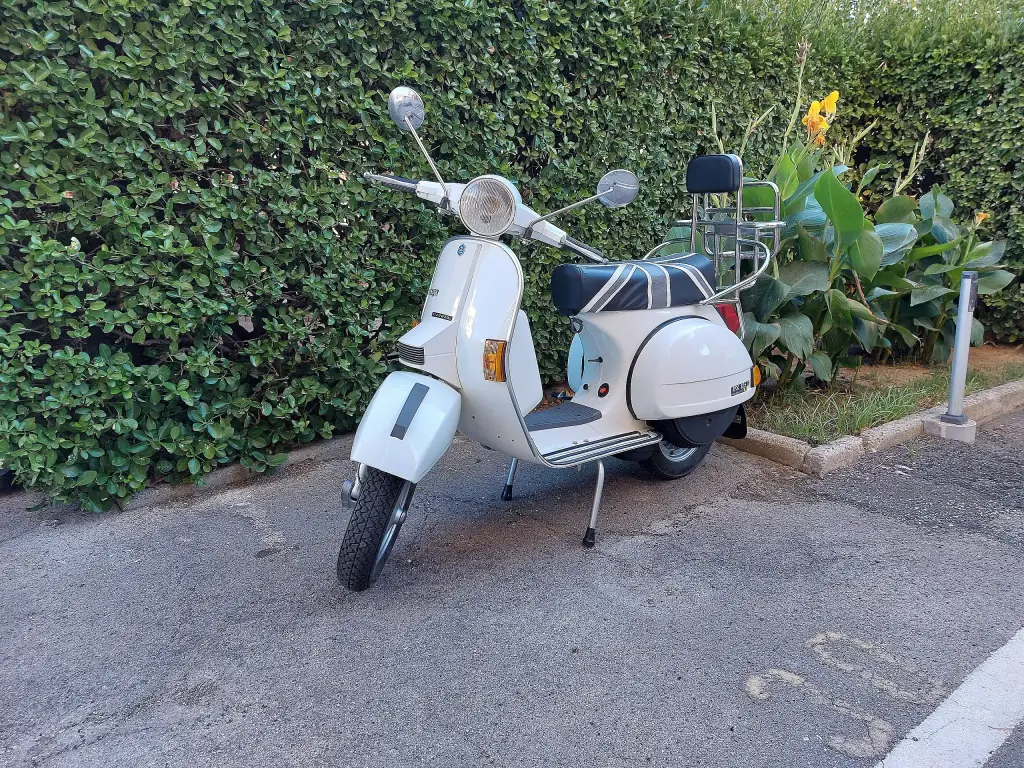
The Vespa PX, presented at the Milan show in 1977 as the Nuova Linea, was the most successful model in the history of the Vespa and the last of the classic two-stroke designs. It remained on sale, with a break in the late 1980s and several updates, until 2017.
Vespa PX at a glance
| Maker | Piaggio, Pontedera |
|---|---|
| Presented | Milan, 10 October 1977 |
| Production | 1977–2017 |
| First models | P125X, P200E, P150X from 1978 |
| Engine | single-cylinder two-stroke, air-cooled |
| Frame | steel monocoque, 1.5 mm panels |
| Gearbox | four-speed manual |
| Front suspension | new anti-dive design |
| Arcobaleno | 1982, with separate lubrication and fuel gauge |
| T5 Pole Position | 1985, almost 12 hp, 105 km/h |
| Front disc brake | from 1998 |
| Sales | over three million by 2013 |
History of the Vespa PX
Nuova Linea, 1977
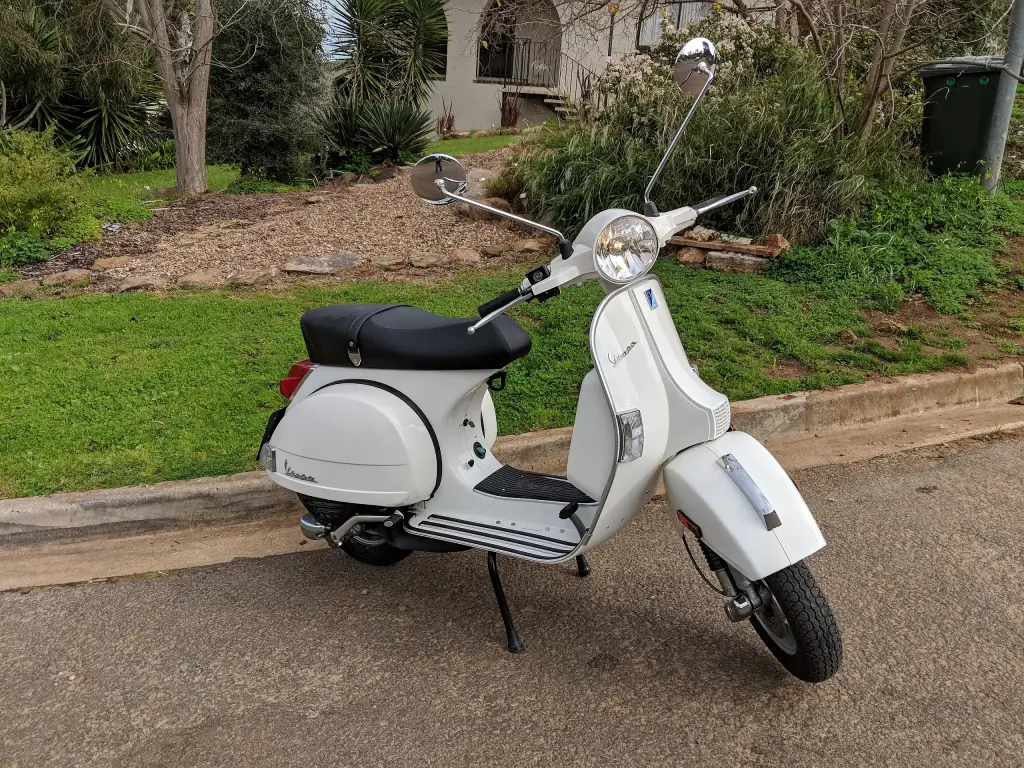
The PX was shown in Milan on 10 October 1977, where a giant 700 kg example was displayed with girls in mechanic’s overalls. The first model was the P125X, built on a new frame with an anti-dive front suspension for better stability under braking and a rear suspension with travel increased from 70 to 91 mm. It had drum brakes, a single-cylinder air-cooled engine with an aluminium head, a steel monocoque body of 1.5 mm panels and a range of almost 30 km per litre of two per cent mixture. It cost 808,630 lire, and indicators were optional at 45,000 lire. With it came the P 200 E, which despite the name was part of the same family, with Ducati electronic ignition; the P 150 X followed in 1978.
Electronic ignition and Arcobaleno
In 1981 electronic ignition was extended to the whole range, and the models became PX125E, PX150E and, from 1982, PX200E, with E for Elettronica. A PX80E with a 79.77 cc engine was sold for export. January 1982 brought the first Arcobaleno series, named for the four-colour band under the model code: a more padded seat of new design, a wider plastic floor, larger instruments with a fuel gauge, a plastic leg-shield trim, a bigger glovebox, a new rear light and horn grille, a self-centring front brake and a larger fork. A battery and the Elestart electric start followed in 1983 and 1984.
The T5
The 1985 PX 125 T5 Pole Position was the sporting version, its name referring to five transfer ports and to a trophy Piaggio gave to Formula One pole sitters; Nelson Piquet, the 1984 winner, received nine. It had a rectangular headlight under a small screen, a cut-off tail and a front spoiler, a new aluminium cylinder from Gilardoni, a compression ratio of 11:1, a 24 mm carburettor and an expansion exhaust. Power rose to almost 12 hp against 7.75 for the standard 125, and top speed to 105 km/h against 97.
Withdrawal and return
In Italy the PX was replaced by the Piaggio Cosa in 1988 but stayed on sale abroad; when the Cosa failed, the PX returned to Italy in 1994 with electric start and an oil mixer as standard. A Classic series marked the 50th anniversary in 1995. A front disc brake came in 1998, and a two-way catalyst in 1999 cost the range its 200 cc version. The 2001 restyle changed the lights, instruments, indicators and seat and brought back the Piaggio shield on the leg shield. After the 2007 Ultima Serie, the PX returned in 2010 with a catalyst for Euro 3, and production ended in early 2017 when the engine could not meet Euro 4.
Design and features
- Anti-dive front suspension: the key chassis change of 1977, with longer rear travel.
- Steel monocoque: 1.5 mm pressed panels, the classic Vespa construction.
- Four-speed manual: the last Vespa with a hand-operated gearbox rather than a CVT.
- Long life: forty years of production with a break in the late 1980s.
- T5: the sporting version with almost 12 hp and a rectangular headlight.
Vespa PX versions
- P125X, P200E, P150X: the 1977–1978 range.
- PX125E, PX150E, PX200E: electronic ignition from 1981–1982.
- Arcobaleno: the 1982 update with separate lubrication.
- PX 125 T5 Pole Position: the 1985 sports model.
- PX 125 T5 Classic: the 1992 anniversary model with the T5 engine.
- Ultima Serie and 2010 return: the 2007 run-out and the Euro 3 comeback.
The PX followed the classic largeframe line of the Vespa 125, and the smallframe of the same era is the Vespa 50 Special. Its modern successor in the range is the Vespa GTS, and more are in the Vespa collection.
Video: Vespa PX 125 (177 Polini)
Video on YouTube.
Sources
- Vespa PX, English Wikipedia: launch, models, Arcobaleno, T5, end of production
- Piaggio Vespa PX, Italian Wikipedia: prices, suspension travel, Cosa interlude, 1998 disc brake