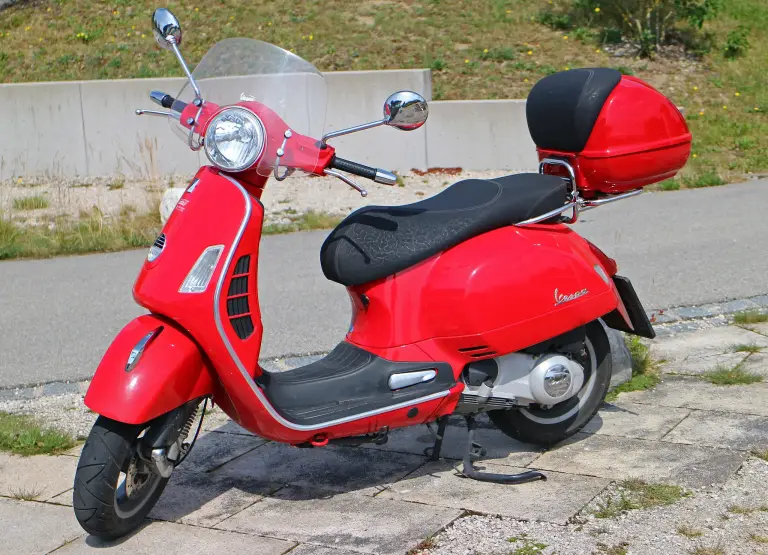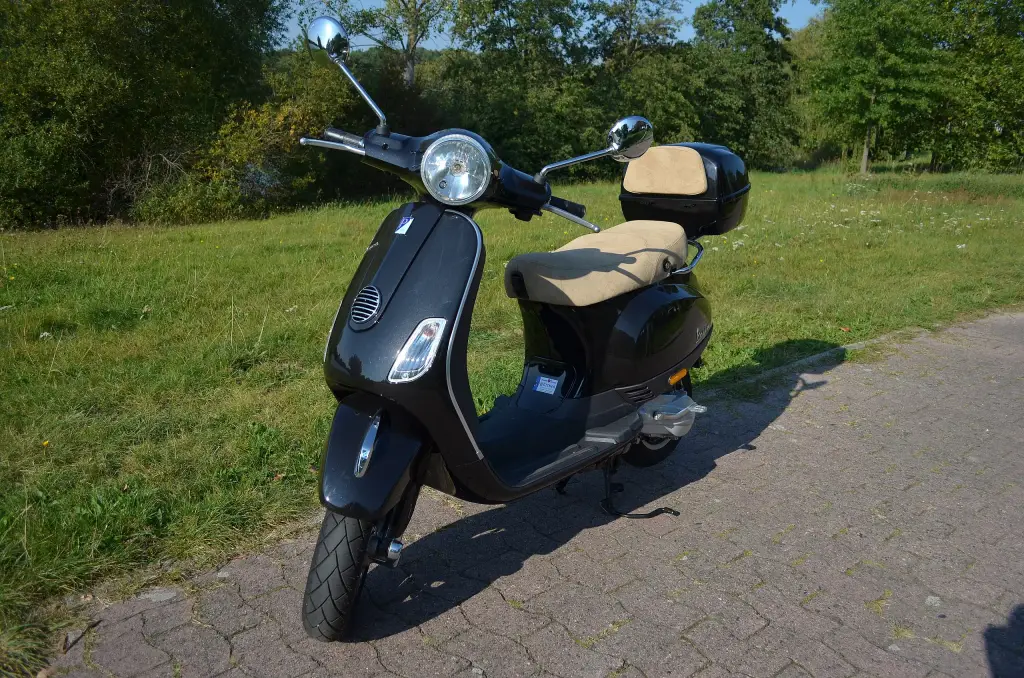
The Vespa LX was the small steel-bodied Vespa of 2005, created for the brand’s 60th anniversary and to replace the ET2 and ET4. It came with 50, 125 and 150 cc engines and was joined by two variations that outlived it in the public memory: the vintage LXV and the sporty S.
Vespa LX at a glance
| Maker | Piaggio, Pontedera |
|---|---|
| Presented | February 2005 |
| Purpose | replacement for the ET2 and ET4; 60th anniversary |
| Engines | 50, 125 and 150 cc, air-cooled |
| 50 cc | two-stroke and four-stroke, limited to 45 km/h |
| 125 cc | Leader four-stroke, 10.7 hp, 91 km/h |
| 150 cc | 151 cc, 12.1 hp, 95 km/h |
| Transmission | CVT |
| Brakes | front disc about 200 mm, rear drum |
| Wheels | 11 inch front, 10 inch rear, five-spoke alloy |
| 2009 restyle | new crest and chrome; engines became injected |
| End in Europe | 2013, replaced by the Vespa Primavera |
History of the Vespa LX
Launch in 2005
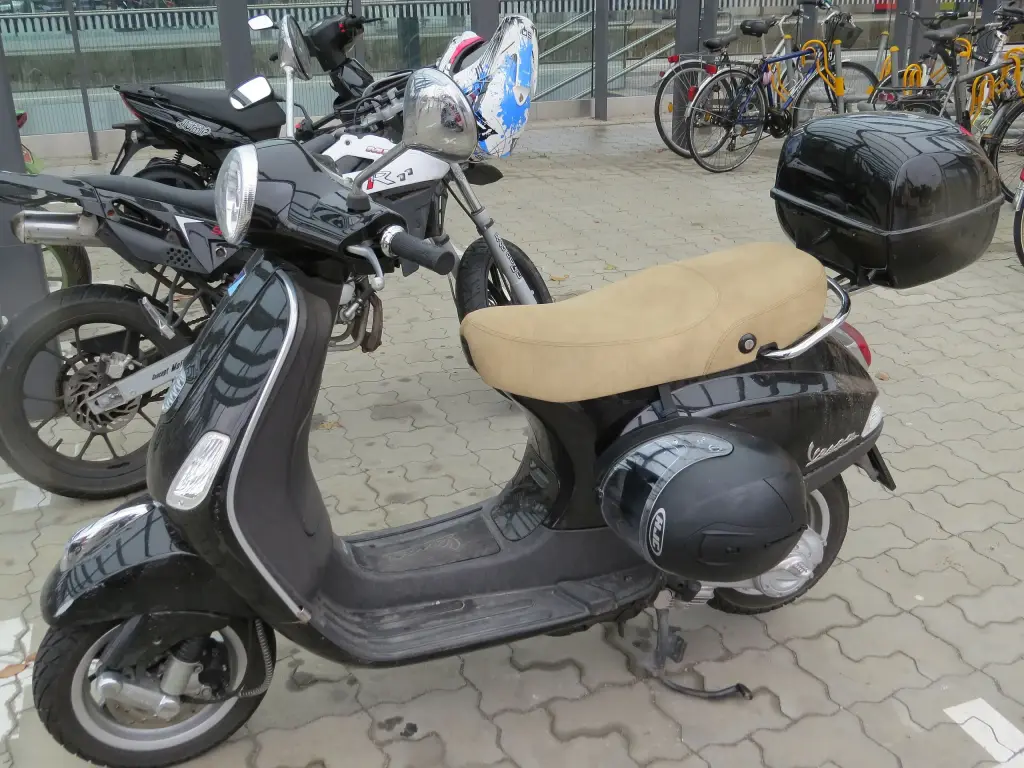
The LX was presented in February 2005. Its initials are the Roman numeral for 60, marking sixty years since the first Vespa, and its body was squarer than the ET2 and ET4 it replaced. Like every Vespa it used a steel supporting body, which also holds a 9.8-litre fuel tank. The front suspension kept the single-sided arm, the rear had a single double-acting hydraulic shock absorber, and the gearbox was a CVT. The wheels were five-spoke light alloys, 11 inches at the front and 10 at the back; the front disc brake of about 200 mm was in stainless steel with a two-piston caliper, while the rear kept the classic drum.
Engines
The LX was sold with 50, 125 and 150 cc engines, all air-cooled. The 50 was built as both a two-stroke and a four-stroke and limited to 45 km/h as a moped; the four-stroke weighed 102 kg and the two-stroke 96 kg. The 125 was a Piaggio Leader four-stroke of 10.7 hp giving 91 km/h, and the 150 was a 151 cc Leader of 12.1 hp giving 95 km/h. In June 2012 the 125 and 150 received three-valve heads and electronic injection. A restyle in 2009 added the crest on the front mudguard and chrome on the grips and horn grille, and brought injection across the range.
LXV
The LXV was the vintage version, the production form of the LX-60 concept shown at Milan in 2005. It had exposed chrome tubes for the handlebars, leather-covered grips, round analogue instruments in a chrome frame and a two-seat saddle divided between rider and passenger. It came out in the same year as the LX with a 50 cc two-stroke at 3,000 euros and a 125 cc four-stroke at 3,800 euros, first in Grigio Avio grey and later Verde Portofino and Bianco Siena. A Navy version followed in 2008, and from 2009 only the 125 remained.
S
The Vespa S arrived in 2007 after being shown at Milan the year before. It was based on the LX but had a rectangular headlight, a minimalist mudguard with a chrome crest, a front bow tie, squared mirrors, a red suspension spring and a pouch in place of the glove box; the rectangular light and mirrors recalled the Vespa 50 Special. At launch it came as a 50 cc four-stroke at 2,500 euros and a 125 at 3,200 euros, and the range grew in 2008 with the 50 two-stroke and the 150. A College edition and the S Sport followed.
Where it was built
Production started in Vietnam in June 2009 for Asian markets and in India in January 2012, where the local LX used a 125 cc three-valve engine. In Europe the LX was replaced in 2013 by the Vespa Primavera, though it continued in Asian markets.
Design and features
- Steel monocoque: the traditional Vespa body, with the fuel tank inside it.
- Three sizes: 50, 125 and 150 cc engines covered moped, light motorcycle and small scooter use.
- Modern chassis: single-sided front suspension, front disc brake and CVT.
- LXV retro style: chrome tube bars, leather grips, round instruments and a divided saddle.
- S details: rectangular headlight, squared mirrors and a red spring, inspired by the 50 Special.
Vespa LX versions
- LX 50: two-stroke and four-stroke moped versions.
- LX 125 and LX 150: Leader four-strokes, injected from 2009.
- LXV: the vintage version, from 2005.
- LXV Navy: 2008 special in midnight blue with a sand saddle.
- Vespa S: the 2007 model with the rectangular headlight.
- S Sport and S College: special editions of 2010 and 2011.
The LX replaced the Vespa ET, and its place in the range was taken by the Primavera while the largeframe line continued with the Vespa GTS. More are in the Vespa collection.
Video: münchen.tv 3G Ulrich Gerhardt | Vespa LX 50
Video on YouTube.
Sources
- Piaggio Vespa LX, English Wikipedia: dates, engines, brakes, LXV
- Piaggio Vespa LX, Italian Wikipedia: LX range, LXV and S details, prices