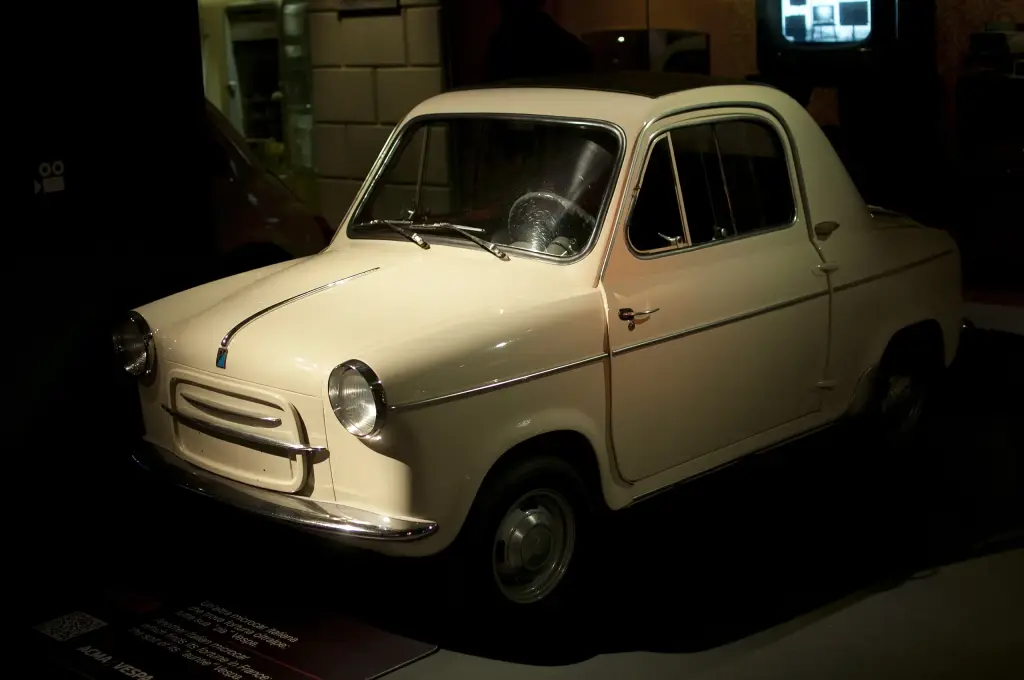
The Vespa 400 was a rear-engined microcar produced by ACMA in Fourchambault, France, from 1957 until 1961 to the designs of the Italian Piaggio company. It carried the name of the Vespa scooter and a two-stroke engine in the back, and was sold in Tourisme, Luxe and GT versions.
Vespa 400 at a glance
| Maker | ACMA, Fourchambault, France, for Piaggio |
|---|---|
| Production | 1957–1961 |
| Type | rear-engined two-seat microcar |
| Versions | Tourisme, Luxe, GT |
| Engine | two-cylinder two-stroke, air-cooled, 393 cc, 63 x 63 mm |
| Power | 13 hp, later 14 hp |
| Compression | 6.4:1, later 6.6:1 |
| Gearbox | three-speed and reverse; four-speed only in the GT |
| Brakes | hydraulic drums, 171 mm |
| Suspension | four-wheel independent, coil springs, front anti-roll bar |
| Top speed | 80–90 km/h |
| Built | about 30,000 |
History of the Vespa 400
Development
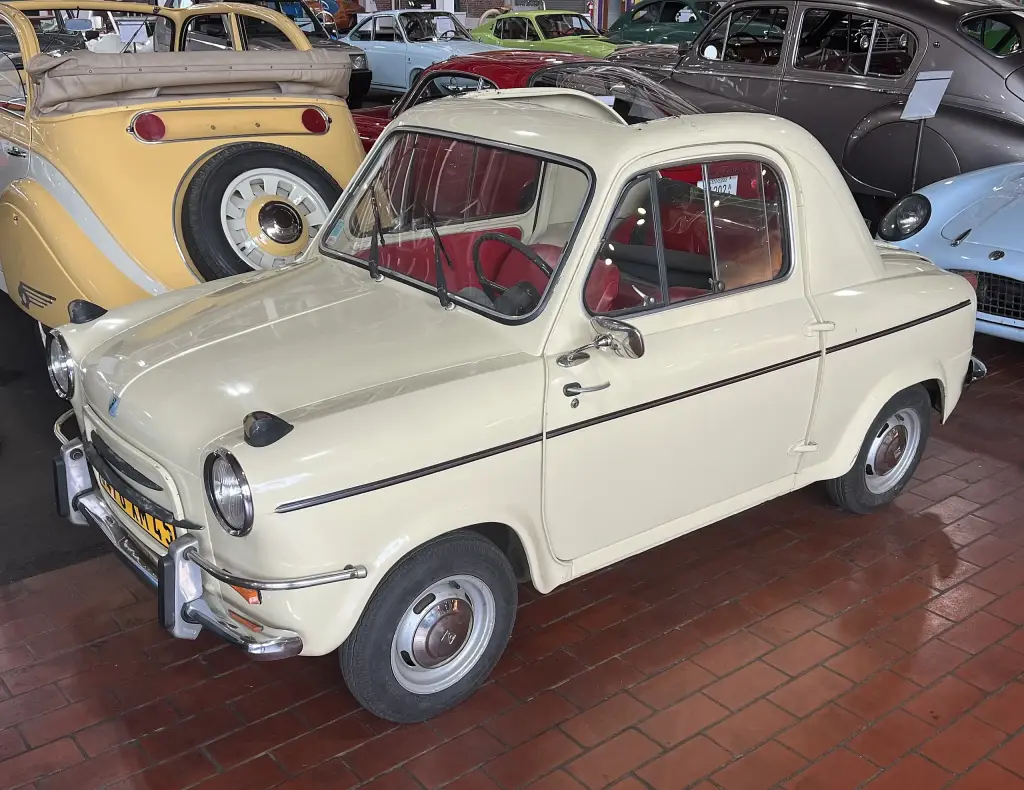
Piaggio had built scooters since 1946, and in the early 1950s Enrico Piaggio looked at a small four-wheeled car for the growing number of customers who wanted one. The project that became the Vespa 400 was developed in Italy, but production was placed in France: the French market was large, customs duties were high, and Piaggio preferred not to confront Fiat on its home ground. The work was given to ACMA at Fourchambault in the Nièvre, a Piaggio subsidiary that already assembled Vespa scooters under licence, and several prototypes were running by 1956. The design is credited to Piaggio engineers including Corradino D’Ascanio.
Launch in 1957
The car made its public debut on 26 September 1957 at a press presentation in Monaco, where three celebrity racing drivers, Louis Chiron, Juan Manuel Fangio and Jean Behra, were invited to attract the press. The first three cars were painted blue, white and red for the French flag. At the Paris show the Tourisme version was priced at 345,000 francs and the Luxe at 365,000 francs, against 374,000 francs for a Citroën 2CV and 399,000 for a Renault 4CV. Most of the car was French: the body came from Facel-Metallon, the carburettor from Solex, the ignition from Ducellier and the starter from Paris-Rhône; only the cast aluminium pistons came from the Italian supplier Borgo.
Production and decline
The launch brought 12,130 cars in 1958, the best year, but output fell to 8,717 in 1959 despite a price cut on the entry two-seater from 345,000 to 319,500 francs. The lines at Fourchambault could make about 30 cars a day, with a target of 100, but the Fiat 500 of 1957 arrived in the same market and the Vespa was late. Criticism centred on the awkward gear change, poor sound insulation and, before the carburettor was modified, high fuel consumption. Production ended in 1961 after about 30,000 cars; around a hundred were imported to Italy for dealers and Piaggio officials.
Engineering
The engine was a 393 cc air-cooled twin with a bore and stroke of 63 x 63 mm, giving the car its name. It produced 13 hp at first and 14 hp later. Because it was a two-stroke, oil had to be mixed with the petrol; from the summer of 1958 a semi-automatic dispenser in a separate reservoir was fitted, and a fully automatic mixing device came two years later. The gearbox was a three-speed with synchromesh on second and third, and a four-speed was offered only in the GT. Suspension was independent on all four wheels with coil springs and double-acting hydraulic shock absorbers, and the brakes were hydraulic drums of 171 mm. The 12-volt battery sat at the front behind a dummy grille on a sliding shelf, and the spare wheel was under the passenger seat.
Design and features
- Rear-mounted two-stroke: the 393 cc twin sat behind the rear axle and drove through a three-speed gearbox.
- Two-plus space: two seats with room behind them for luggage or two small children on an optional cushion.
- Fabric roof: the cabriolet roof could be rolled back from the windscreen to the engine cover.
- French production: built by ACMA at Fourchambault, with Italian design and almost entirely French components.
- Frugal: a road test recorded 55.3 mpg and a top speed of 51.8 mph.
Vespa 400 versions
- Tourisme: the simple entry version, 345,000 francs at launch.
- Luxe: the better-equipped version at 365,000 francs, with a de luxe saloon tested by Motor in 1959.
- GT: the 1961 version with a four-speed gearbox, built in about 200 examples.
- Esterel: a beach version presented by coachbuilders from 1959.
The 400 was the only car sold under the Vespa name; the scooters are in the Vespa collection, and the three-wheeled commercial side of the family is covered by the Vespa Ape.
Video: Newly restored Vespa 400 car goes for its first drive
Video on YouTube.
Sources
- Vespa 400, English Wikipedia: specifications, launch, production figures
- Vespa 400, French Wikipedia: development, prices, components, GT
- ACMA Vespa 400, Italian Wikipedia: prototypes, production, Italian imports