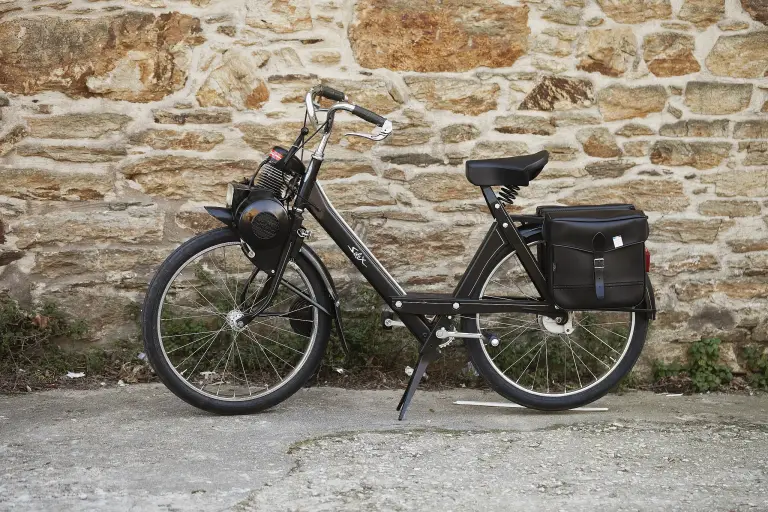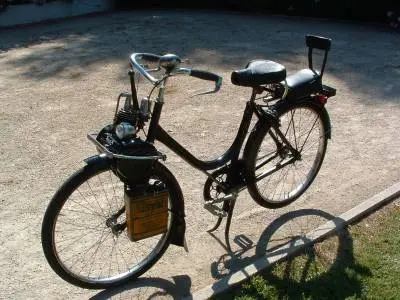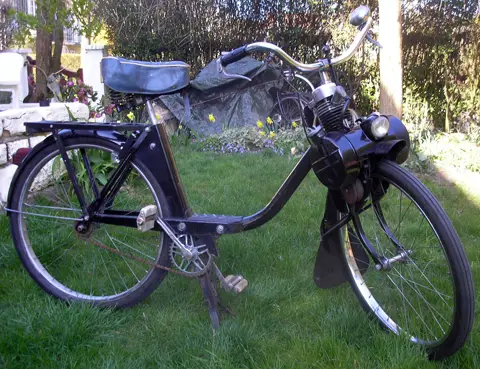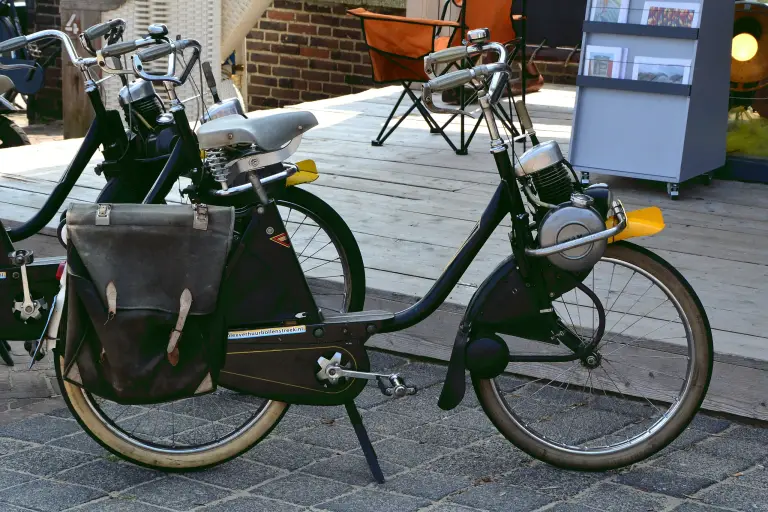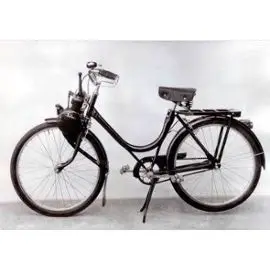
The Velosolex 660, introduced in 1955, replaced the bicycle-based chassis of the early Solex with a dedicated round-tube frame. Its engine was carried over unchanged from the 330, so the 660 was a step in the cycle parts rather than in the power unit, and it lasted only two years before the 1010 arrived.
Velosolex 660 at a glance
| Maker | Solex, Courbevoie (France) |
|---|---|
| Production | 1955–1957 |
| Engine | 49 cc two-stroke single |
| Power | 0.5 hp (0.37 kW), unchanged from the 330 |
| Frame | new dedicated round-tube frame |
| Frame before | swan-neck bicycle frame of the 45 and 330 |
| Transmission | roller pressed against the front tyre |
| Wheels | 24-inch rims |
| Clutch | manual, by a lever on the cylinder head |
| Brakes | rim brake on the front wheel |
| Predecessor | Velosolex 330 (1953) |
| Successor | Velosolex 1010 (1957) |
The 660 has no Wikipedia article of its own: it is described in the model history of the English, French and German articles on the VéloSoleX, which this page follows.
History of the Velosolex 660
From bicycle to moped
For its first nine years the Solex was, in effect, a bicycle with a motor on the front wheel, and its frame was made to bicycle practice. The 1955 model change to the 660 was the point at which the machine got a frame designed for the job. The old swan-neck frame, a curved tube recalling a bicycle, was replaced by a frame of straight round tubes that carried the engine block on the front fork and the rider in a more upright position.
The same engine
Under the new frame the engine was the 49 cc two-stroke of the 330, quoted at 0.5 hp (0.37 kW). It still drove the front tyre through a roller pressed on by two springs, still had no ignition switch, and was still started by pedalling with the decompression lever held and stopped by decompressing the cylinder. The clutch was a hand lever on the cylinder head that tipped the engine back off the tyre, which is how the rider switched to pedal power.
What stayed and what changed
The wheels were still 24 inches and the main stand was still standard. The engine block above the front wheel still held the fuel tank, the ignition and the headlamp, and the exhaust still ran down beside the mudguard. The machine remained a moped in the French sense: light, simple and rideable from the age of fourteen without a licence, which is why the Solex became the transport of schoolchildren, students and factory workers.
Two years, then a new engine
The 660 was replaced in 1957 by the Velosolex 1010, which kept the frame and updated the engine, introducing reverse scavenging. The round-tube frame of the 660 then served through the 1010, 1400, 1700 and 2200 until the square-section frame of the 3300 arrived in 1964. In the long run the 660 marks the moment the Solex stopped being a motorised bicycle and became a small motorcycle in its own right.
Design and features
- Purpose-built frame: a round-tube chassis in place of the swan-neck bicycle frame.
- Familiar engine: the 49 cc, 0.5 hp two-stroke of the 330, unchanged.
- Roller drive: the engine could be tipped back off the front tyre to pedal.
- Simple controls: decompression lever for starting and stopping, deceleration lever instead of a throttle.
Velosolex 660 versions
- Velosolex 660 (1955–1957): the standard model, round-tube frame and 49 cc engine.
- Early and late 660s: the sources list no specification changes within the run; the model was replaced whole in 1957.
- Licensed versions: Solex-type mopeds were also built in Geneva by Hispano Suiza until the mid-1950s and in Spain by Orbea during the 1950s.
The 660 took over from the Velosolex 330 and was replaced by the Velosolex 1010; its frame carried on through the Velosolex 2200. More mopeds are in the Velosolex collection.
Video: Solex 660
Video on YouTube.
Sources
- VéloSoleX, English Wikipedia: 1955 model, frame and engine
- VéloSoleX, French Wikipedia: engine block layout, starting, clutch, brakes
- Vélosolex, German Wikipedia: swan-neck and round-tube frames, wheels, main stand