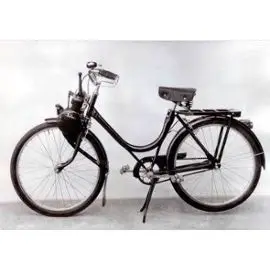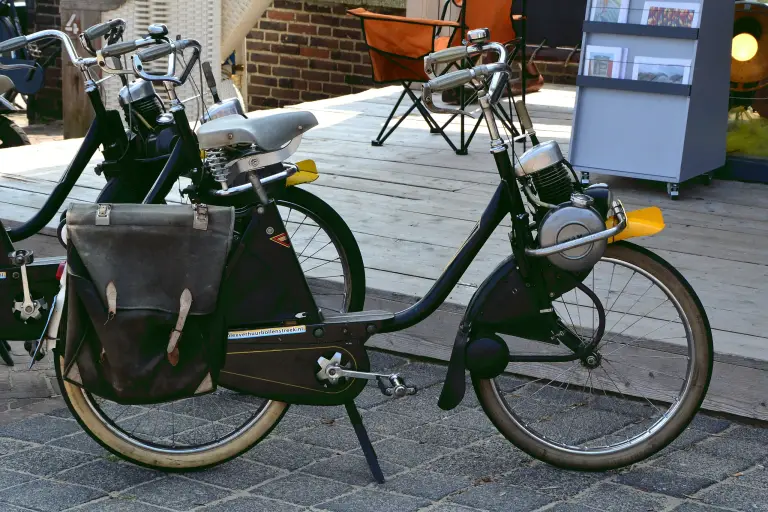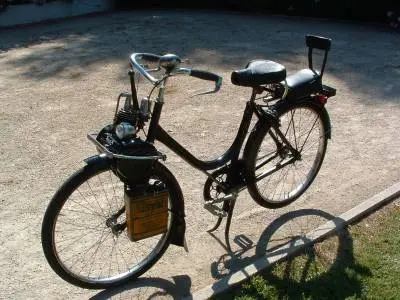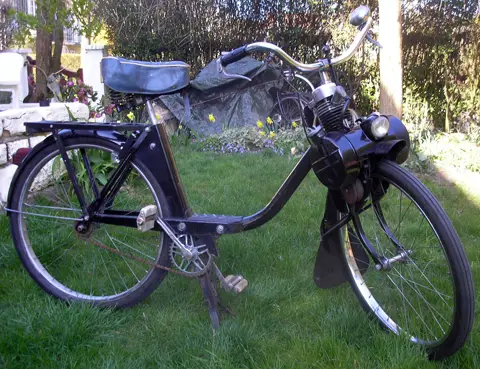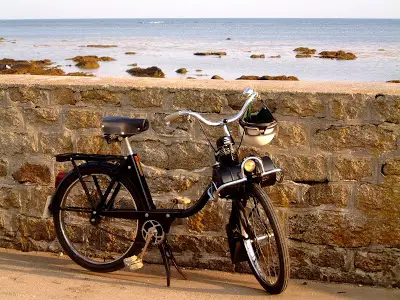
The Velosolex 2200, sold from 1961, was the most powerful of the round-tube Solex models. Its 49 cc engine was tuned to 0.7 hp, and it came with the automatic centrifugal clutch and fan cooling that had first appeared on the 1700 two years earlier.
Velosolex 2200 at a glance
| Maker | Solex, Courbevoie (France) |
|---|---|
| Production | 1961–1964 |
| Engine | 49 cc two-stroke single |
| Power | 0.7 hp (0.52 kW) |
| Clutch | automatic centrifugal |
| Cooling | air, with a fan |
| Frame | round-tube frame |
| Wheels | 19-inch rims |
| Transmission | roller pressed against the front tyre |
| Brakes | rim brake on the front wheel |
| Predecessor | Velosolex 1700 (1959) |
| Successor | Velosolex 3300 (1964) |
The 2200 has no Wikipedia article of its own: it is described in the model history of the English, French and German articles on the VéloSoleX, which this page follows.
History of the Velosolex 2200
Power and convenience together
By 1961 the Solex had come a long way from the 45 cc bicycle of 1946. The 1700 of 1959 had already taken two of the most tiring jobs away from the rider by fitting an automatic centrifugal clutch, which meant no more hand lever to disengage the engine, and by cooling the engine with a fan instead of relying on the airflow over the fins. The 2200 of 1961 added the other half of the package: more power.
0.7 hp from 49 cc
The engine stayed at 49 cc, but output rose to 0.7 hp (0.52 kW), a noticeable step up from the 0.5 hp of the 330, 660 and 1010. Over the next three years the model was developed through two versions, V1 and V2, with the power increase spread across them. For a machine weighing around 28 kg that was enough to keep up with town traffic and to climb the bridges and slight hills that had made the earlier 0.5 hp models hard work.
The last of the round tubes
The 2200 still used the round-tube frame that had replaced the swan-neck bicycle frame in 1955, and the 19-inch wheels that had come with the 1400 in 1958. Braking was still a rim brake on the front wheel alone: the small rear drum brake only arrived with the 3300 in 1964. The engine block above the front wheel still carried the tank, the ignition and the headlamp, and the moped still had no suspension, which is why the ride on bad surfaces was described as firm at best.
Replaced by the square frame
The 2200 gave way in 1964 to the 3300, which replaced the round tubes with a square-section frame and added the rear drum brake. The roller drive, the automatic clutch and the general layout of the engine block survived into that model and, through it, into the 3800 that became the best-selling Solex of all.
Design and features
- 0.7 hp: the highest output of the round-tube models, from the same 49 cc two-stroke.
- Automatic clutch: no hand lever to disengage the engine in normal riding.
- Fan cooling: a cooling fan kept the engine happy in traffic and at low speed.
- Roller drive: the engine could still be tipped back off the front tyre to pedal.
Velosolex 2200 versions
- 2200 V1: the first version, from 1961.
- 2200 V2: the later version, as the power increase was phased in over three years.
- Compared with the 3300 of 1964: same roller drive and automatic clutch, but the 3300 brought a square-section frame and a rear drum brake.
The 2200 was the last of the round-tube models: it was replaced by the Velosolex 3300 and its engine line led on to the Velosolex 3800. The earlier Velosolex 660 used the same frame. More mopeds are in the Velosolex collection.
Video: Solex 2200 Testing
Video on YouTube.
Sources
- VéloSoleX, English Wikipedia: 1961 model, power, V1 and V2
- Vélosolex, German Wikipedia: power, automatic clutch, fan cooling, frames, wheels
- VéloSoleX, French Wikipedia: rear drum brake from 1964, engine layout, roller drive