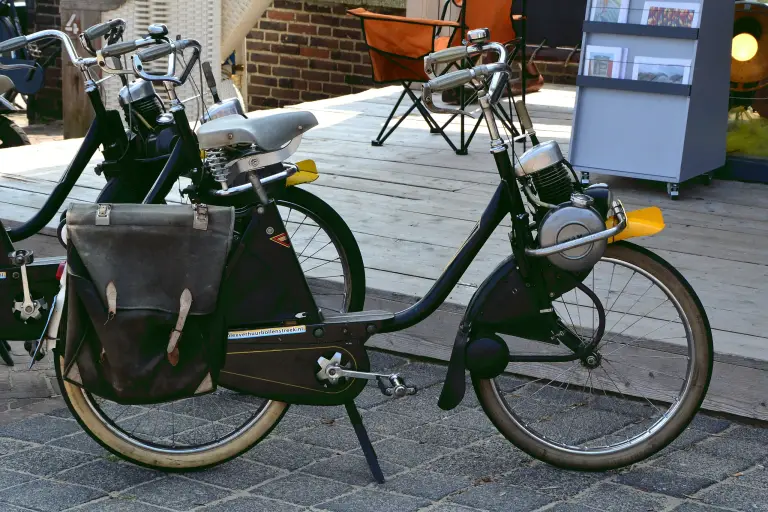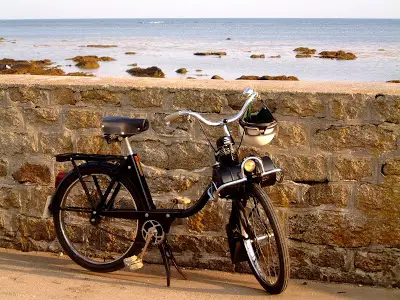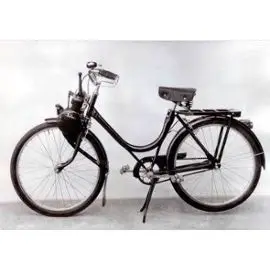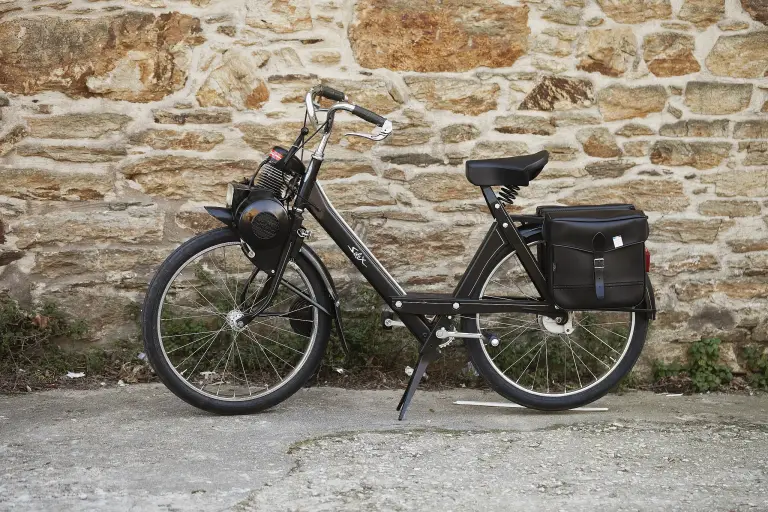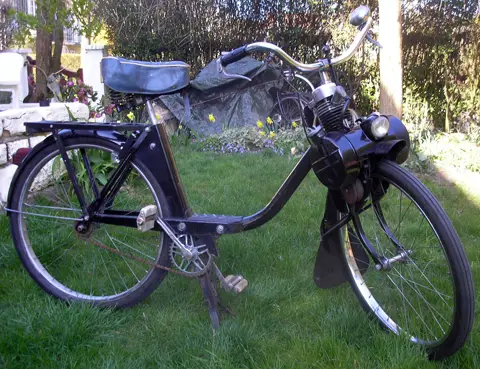
The Velosolex 1010 of 1957 was a quiet model change: the frame, wheels and roller drive of the 660 were carried over, and the work was done inside the 49 cc two-stroke, which became the first Solex engine with reverse scavenging.
Velosolex 1010 at a glance
| Maker | Solex, Courbevoie (France) |
|---|---|
| Production | 1957–1958 |
| Engine | 49 cc two-stroke single |
| Engine change | first Solex with reverse scavenging |
| Frame | round-tube frame, as on the 660 |
| Transmission | roller pressed against the front tyre |
| Wheels | 24-inch rims |
| Clutch | manual, by a lever on the cylinder head |
| Cooling | air, without a fan |
| Brakes | rim brake on the front wheel |
| Predecessor | Velosolex 660 (1955) |
| Successor | Velosolex 1400 (1958) |
The 1010 has no Wikipedia article of its own: it is covered in the model history of the English, French and German articles on the VéloSoleX, which this page follows.
History of the Velosolex 1010
An engine update in an unchanged frame
The 1010 arrived in 1957, two years after the 660 had given the Solex a frame of its own. Nothing outside the engine was rethought: the round-tube frame, the 24-inch wheels, the roller drive and the engine block above the front wheel all carried over. The change was in the cylinder, and it is the reason the model has a place in the Solex story.
Reverse scavenging
In a two-stroke, the fresh mixture entering the cylinder has to push the burnt gases out through the exhaust port, and how well it does that decides how much power the engine makes. The earliest Solex engines used a deflector piston, a crown with a ridge that steered the incoming charge. The 1010 was the first Solex to use reverse scavenging, in which the transfer ports are arranged so that the fresh mixture sweeps up the back of the cylinder and across the combustion chamber before leaving. The result is better filling and less mixture lost straight out of the exhaust. The sources do not quote a separate power figure for the 1010; it was the same 49 cc unit, revised rather than enlarged.
What the rider got
The rest of the machine was the Solex as it had been for a decade: start by pedalling with the decompression lever held, stop by decompressing the cylinder, slow down with a lever on the handlebar rather than a twist grip, and lift the engine off the tyre with a lever on the cylinder head when pedal power was wanted. The fuel tank, ignition and headlamp lived in the engine block above the front wheel, and the frame had no suspension at all.
A single year in the range
The 1010 was replaced in 1958 by the 1400, which cut the wheels from 24 to 19 inches. Its engine work was not wasted: the automatic centrifugal clutch and fan cooling that made the 1700 of 1959 so much easier to live with were built on the same 49 cc two-stroke, and the capacity itself stayed in production until 1988.
Design and features
- Reverse scavenging: the first Solex engine to use it, for better cylinder filling.
- Familiar frame: the round-tube chassis and 24-inch wheels of the 660.
- Hand clutch: the automatic centrifugal clutch only arrived with the 1700 in 1959.
- Roller drive: the engine could be tipped back off the front tyre to pedal.
Velosolex 1010 versions
- Velosolex 1010 (1957–1958): the standard model; the sources list no sub-versions.
- Compared with the 660: same frame, wheels and transmission, revised cylinder.
- Compared with the 1700 of 1959: the 1010 still had a hand clutch and no fan cooling.
The 1010 followed the Velosolex 660 and was replaced by the 1400; the engine line continued with the Velosolex 2200, which added the automatic clutch and more power. More mopeds are in the Velosolex collection.
Video: Velosolex 1010 Motor solex BJ 57
Video on YouTube.
Sources
- VéloSoleX, English Wikipedia: 1957 model, engine update
- Vélosolex, German Wikipedia: reverse scavenging, frames, wheels, later models
- VéloSoleX, French Wikipedia: engine block layout, starting, clutch, brakes