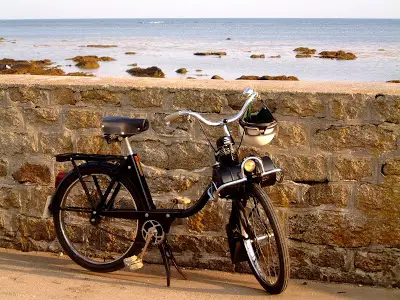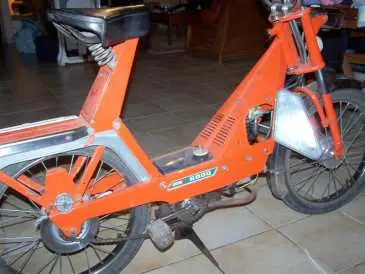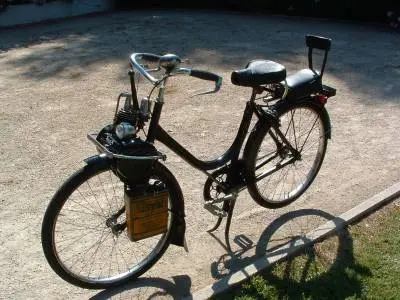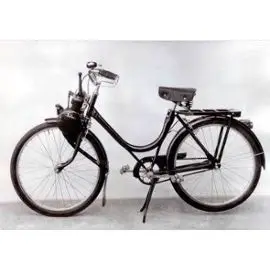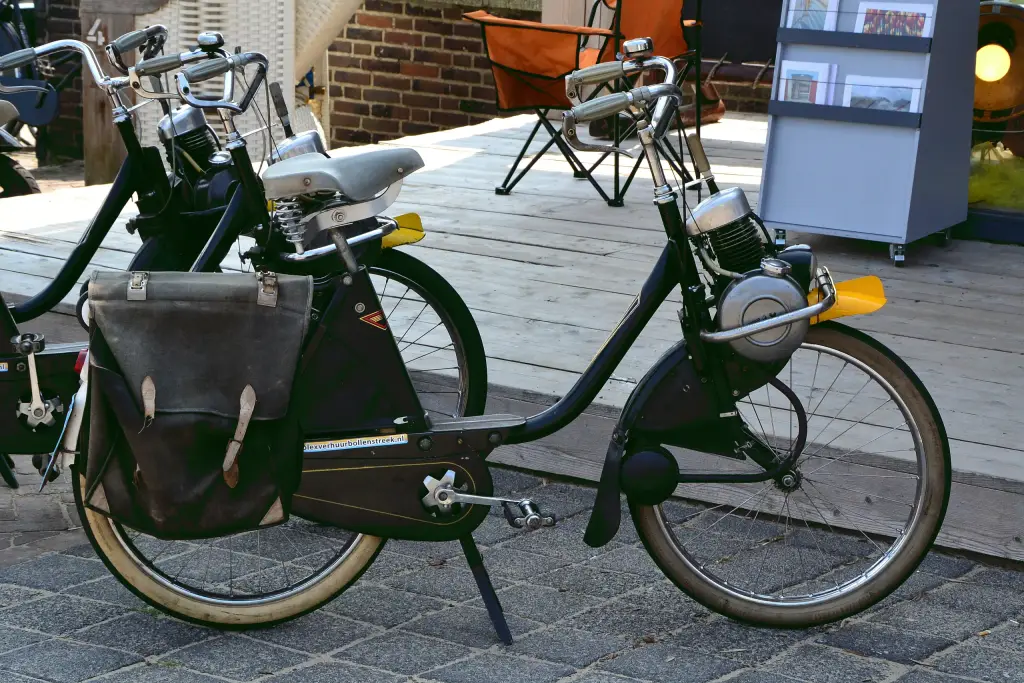
The Velosolex 3300 of 1964 was a turning point in the moped’s chassis history. It replaced the round-tube frame with a square-section one that stayed in production until 1988, and it was the first Solex to have a brake on the rear wheel.
Velosolex 3300 at a glance
| Maker | Solex, Courbevoie (France) |
|---|---|
| Production | 1964–1966 |
| Engine | 49 cc two-stroke single |
| Frame | square-section tube (new) |
| Frame life | kept until the end of production in 1988 |
| Transmission | roller pressed against the front tyre |
| Clutch | automatic centrifugal |
| Wheels | 19-inch rims |
| Brakes | front rim brake and, for the first time, a rear drum |
| Front brake | lever coupled to the carburettor deceleration control |
| Predecessor | Velosolex 2200 (1961) |
| Successor | Velosolex 3800 (1966) |
The 3300 has no Wikipedia article of its own: it is described in the model history of the English, French and German articles on the VéloSoleX, which this page follows.
History of the Velosolex 3300
A frame for the last twenty-four years
In 1964 the Solex exchanged the round steel tubes that had carried it since 1955 for a frame of square-section tube. The change looks modest, but it was the last chassis redesign the moped ever had: the same square-tube frame went into the 3800, the most common Solex of all, and stayed in production until French production ended in 1988. Everything that came after the 3300 was, in chassis terms, the same machine with different trim and a bigger following.
The first rear brake
Until 1964 the Solex stopped on a rim brake at the front wheel alone, which was adequate at 30 km/h and alarming in the rain. The 3300 added a small drum brake at the rear. It also coupled the front brake lever to the carburettor’s deceleration control, so that pulling the brake both slowed the moped and dropped the engine to idle, disengaging it while the rider kept the engine running. It was a small piece of integrated thinking of the kind that later became normal on mopeds and motorcycles.
What carried over
Under the new frame the 3300 kept the roller drive, the automatic centrifugal clutch and the fan-cooled 49 cc two-stroke of the 2200, as well as the 19-inch wheels. The engine block above the front wheel still contained the fuel tank, the ignition and the headlamp, the exhaust still ran down beside the front mudguard, and the moped still had no suspension. The sources do not restate the power figure for the 3300; it was the same engine family as the 2200, rated at 0.7 hp.
Two years before the 3800
The 3300 was replaced in 1966 by the 3800, which kept its frame and brakes and became the version most people picture when they think of a Solex. During the 3300’s two years in the range the marque was still independent, and the ownership changes that shaped the 3800’s later life — Motobécane in 1974, Yamaha in 1983 — were still ahead.
Design and features
- Square-section frame: the chassis that carried the Solex until 1988.
- Rear drum brake: the first Solex with brakes on both wheels.
- Linked front brake: the brake lever also cut the engine to idle through the carburettor.
- Automatic clutch and roller drive: the familiar Solex layout, unchanged.
Velosolex 3300 versions
- Velosolex 3300 (1964–1966): the standard model; the sources list no sub-versions.
- Compared with the 2200: same engine, clutch and transmission, new frame and a rear brake.
- Compared with the 3800 of 1966: the 3800 kept this frame and brake layout and added colour and trim options.
The 3300 followed the Velosolex 2200 and was replaced by the Velosolex 3800, which used the same frame. The much later Velosolex 6000 abandoned the roller drive altogether. More mopeds are in the Velosolex collection.
Video: SOLEX 3300
Video on YouTube.
Sources
- VéloSoleX, English Wikipedia: 1964 model, frame and rear brake
- VéloSoleX, French Wikipedia: rear drum brake, linked front brake, engine layout
- Vélosolex, German Wikipedia: square-section frame, wheels, later history