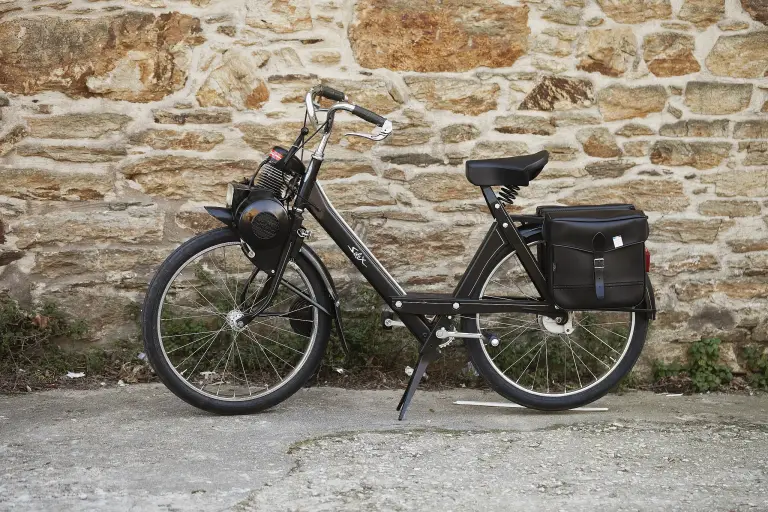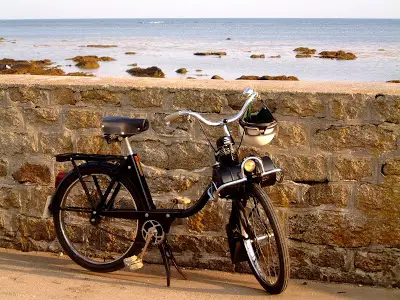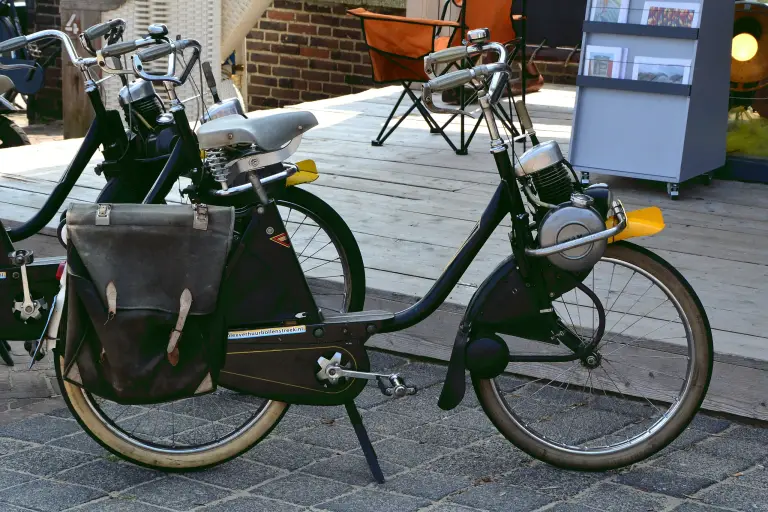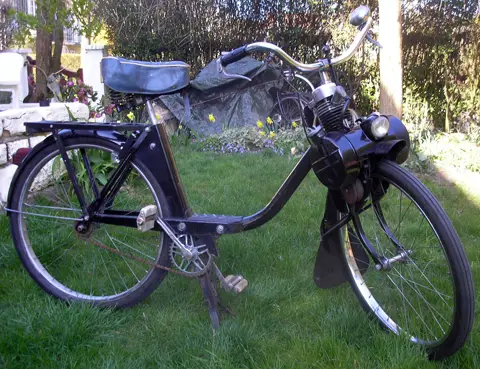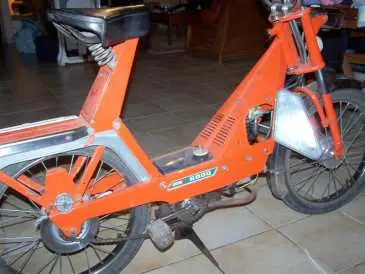
The Velosolex 6000 appeared in 1969 under the name Flash and was later renamed. It abandoned the roller that had driven every Solex since 1946: the engine moved away from the front wheel and drove the rear wheel through an angle gear, and the moped was given disc brakes.
Velosolex 6000 at a glance
| Maker | Solex, Courbevoie (France) |
|---|---|
| Production | from 1969 |
| First name | Flash, later renamed 6000 |
| Engine | 49 cc two-stroke, fan-cooled |
| Drive | angle gear to the rear wheel |
| Instead of | the roller pressed on the front tyre |
| Engine position | no longer above the front wheel |
| Brakes | disc brakes |
| Layout | conventional moped rather than a motorised bicycle |
| Predecessor | Velosolex 3800 (roller drive) |
| Related | Velosolex Tenor (1972, chain drive) |
The 6000 has no Wikipedia article of its own: the model is covered in the history sections of the English, French and German articles on the VéloSoleX, which this page follows. The sources give neither the date of the renaming nor the end of production.
History of the Velosolex 6000
The end of the roller
Every Solex built since 1946 had worked the same way: a small engine sat above the front wheel, drove it through a roller pressed against the tyre, and could be lifted off so the machine became a bicycle. The Flash of 1969 was the first to throw that layout away. The engine was no longer mounted over the front wheel, and it no longer touched the tyre at all. Instead it drove the rear wheel through an angle gear, a bevel drive.
An angle gear, not a cardan shaft
The German Wikipedia makes a point of the wording: the transmission is often wrongly described as a cardan shaft, when it is in fact a bevel or angle gear. The distinction matters to anyone restoring one, because the two are different mechanisms and the parts do not interchange. The engine itself was a fan-cooled two-stroke, and the brakes were discs rather than the rim brake and small drum of the 3800.
A different kind of moped
With the engine out of the front wheel, the Flash and 6000 were conventional mopeds rather than motorised bicycles: no roller to slip on a wet tyre, no lifting the engine to pedal, and a front end that steered without several kilos of engine and fuel above the wheel. The price was a more complicated machine than the 3800, which remained in production alongside it and was still the version most buyers chose.
Name and company
The Flash was renamed 6000, but no date for the change is given in the sources, and neither is the end of production. The same period brought the Tenor of 1972, which used a chain transmission and was the only Solex moped with an engine from another maker: Franco Morini gyromat units in the L and S series, Anker Laura engines in the GL and GS, and a few S4 versions with a Morini engine and a four-speed gearbox. In 1974 the marque passed to Motobécane, and French production of the Solex ended in 1988.
Design and features
- Angle-gear drive: the rear wheel driven through a bevel gear instead of a roller on the front tyre.
- Engine repositioned: no longer mounted above the front wheel.
- Disc brakes: a clear step up from the rim brake and rear drum of the 3800.
- Fan-cooled engine: the 49 cc two-stroke with forced cooling.
Velosolex 6000 versions
- Flash (from 1969): the model under its original name.
- 6000: the same moped after it was renamed; the sources give no date for the change.
- Tenor (1972): a related model with chain drive and, uniquely for Solex, engines from Franco Morini and Anker Laura.
The 6000 was sold alongside the Velosolex 3800, which kept the roller drive to the end, and it followed the Velosolex 3300 in the model history. More mopeds are in the Velosolex collection.
Video: VeloSoleX 6000 kardan.wmv
Video on YouTube.
Sources
- VéloSoleX, English Wikipedia: 1969 Flash, disc brakes, axle transmission, 1972 Tenor
- Vélosolex, German Wikipedia: angle gear, engine position, company history
- VéloSoleX, French Wikipedia: roller drive of the classic models, end of production