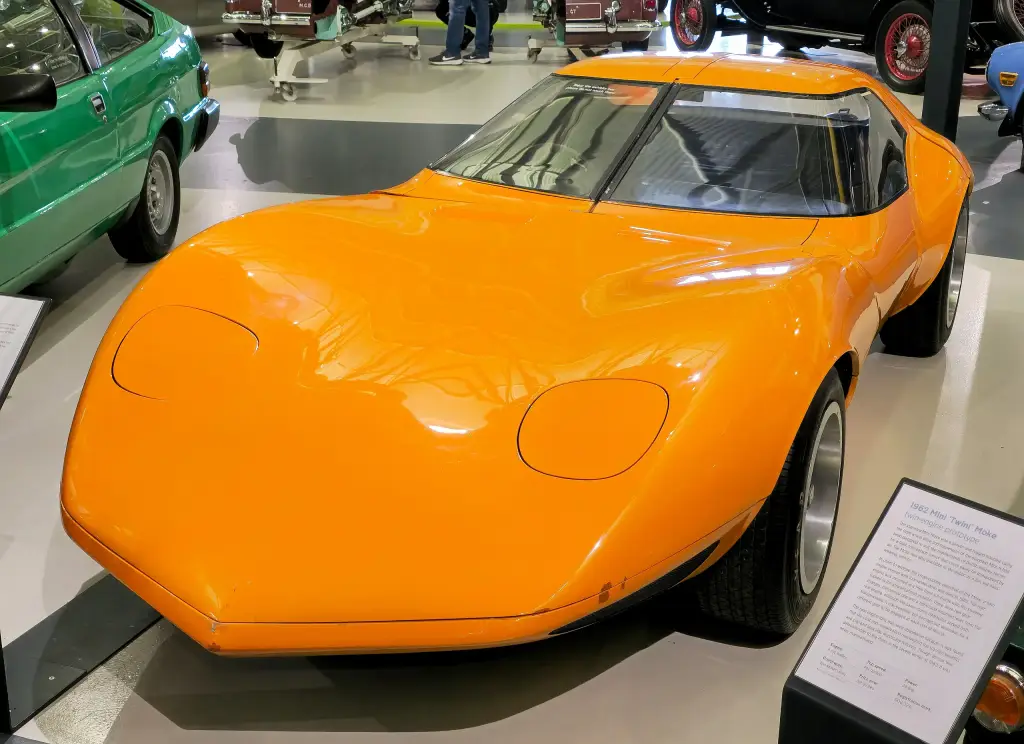
The Vauxhall XVR was a concept car built in 1966, its name standing for eXperimental Vauxhall Research. It debuted at the Geneva Motor Show in March 1966 to favourable reviews but never went into production, and only one of its three prototypes survives.
Vauxhall XVR at a glance
| Maker | Vauxhall Motors |
|---|---|
| Year | 1966 |
| Name | eXperimental Vauxhall Research |
| Debut | Geneva Motor Show, March 1966 |
| Prototypes | three: two glassfibre mock-ups and one metal running car |
| Builder of running car | Motor Panels of Coventry |
| Engines used | 1.5-litre four, then 2.3 and 2.0-litre slant-fours |
| Power | about 100 bhp with the 2.0 |
| Top speed | over 100 mph (160 km/h) |
| Survivor | one mock-up, at the British Motor Museum |
Written from the English Wikipedia article on the XVR, with the German article for background.
History of the Vauxhall XVR
Three prototypes of the XVR were built. Two were glassfibre rolling mock-ups with no engines, while one was a metal-bodied, fully functional example built by Motor Panels of Coventry; that was the car displayed at the Geneva Motor Show in March 1966. The concept took five months to design and build in total.
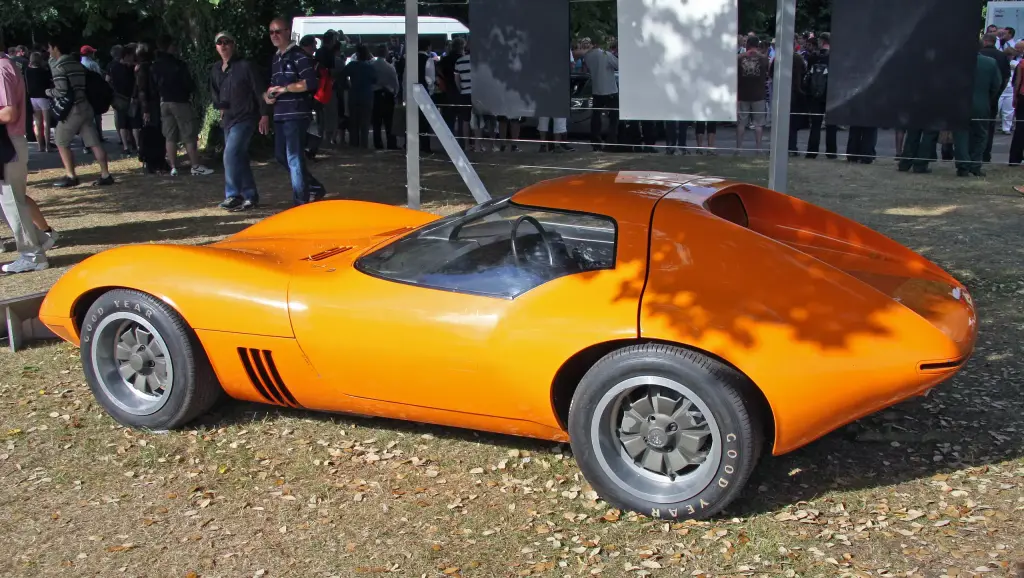
The running prototype was powered by several different front mid-mounted engines during its life. Because the intended engine was still under test, the XVR was fitted with a used 1.5-litre four, cleaned up and repainted, for Geneva. Once the 2.3-litre slant-four was ready, a tuned pre-production example of the variant later used in the Vauxhall VX4/90 was installed. Management then halted development and had a standard 2.0-litre slant-four of about 100 bhp fitted as the car went on the show circuit. The suspension was fully independent front and rear, with disc brakes at all four corners, and with the 2-litre engine the XVR could exceed 100 mph.
The design team was directed by David Jones and included Wayne Cherry, John Taylor, Leo Pruneau and Judd Holcombe. The styling was inspired by the 1965 Mako Shark II concept car from Chevrolet, and its notable features were a split windscreen, pop-up headlamps and gullwing doors hinged at the centre of the car, with the windscreen mounted to them.
Of the three cars, only one mock-up survives. The running prototype was damaged while on display in Canada and scrapped, and Vauxhall crushed the other mock-up. The surviving car is still owned by Vauxhall Motors and is on display at the British Motor Museum.
Design and features
- Gullwing doors: hinged at the centre of the car, with the windscreen mounted to them.
- Pop-up headlamps: hidden lights and a split windscreen.
- Mako Shark inspiration: styling derived from Chevrolet’s 1965 concept.
- One survivor: a single mock-up remains, at the British Motor Museum.
Vauxhall XVR versions
- XVR running prototype: the metal-bodied Geneva show car, later scrapped.
- XVR mock-ups: two glassfibre cars without engines, one of which survives.
The XVR’s design team included Wayne Cherry, who later shaped the Firenza droopsnoot and the SRV. More cars are in the Vauxhall collection.
Sources
- Vauxhall XVR, English Wikipedia: prototypes, engines, design, survivors
- Vauxhall XVR, German Wikipedia: concept background