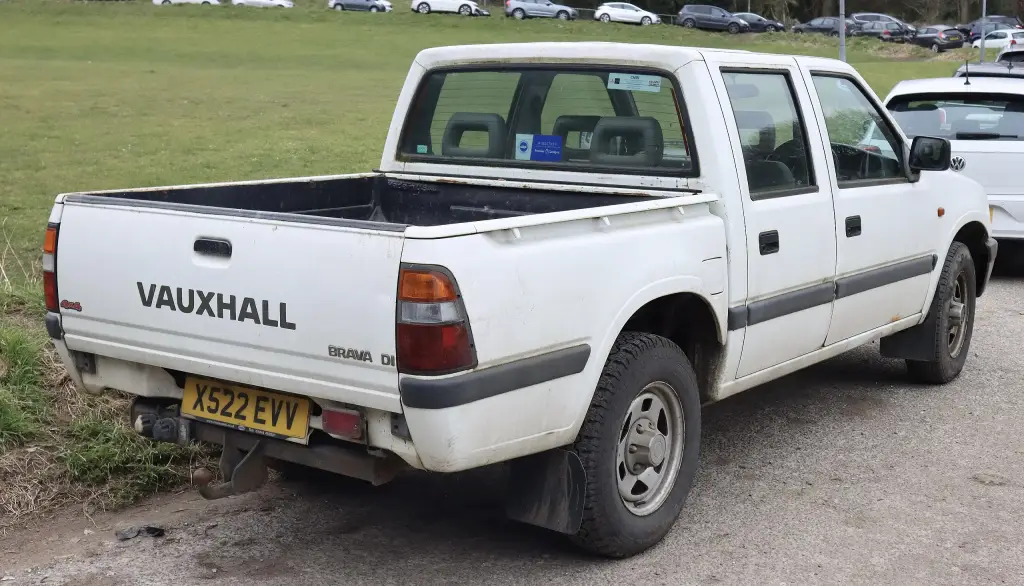
The Vauxhall Brava was the British name for the Isuzu Faster TF pickup, sold from 1991 to 2001. It was the commercial vehicle half of a joint range: on the continent the same truck was the Opel Campo, and in Germany and Britain it gave Vauxhall dealers a one-tonne pickup to sell alongside the vans.
Vauxhall Brava at a glance
| Maker | Vauxhall (Opel Campo on the continent) |
|---|---|
| Production | August 1991 – December 2001 |
| Based on | Isuzu Faster TF |
| Built by | IBC Vehicles, later GM Manufacturing Luton |
| Bodies | single cab, Sportscab and crew cab |
| Engines | 2.3 petrol 69 kW; 2.5 diesel 56 or 74 kW; 3.1 turbodiesel 80 kW |
| Drive | rear-wheel drive, four-wheel drive optional |
| Four-wheel drive | low-range transfer box and free-wheeling hubs |
| Facelift | May 1997 |
| Limited Edition | March 2001, crew cab with two-tone paint and air conditioning |
| Replaced by | Isuzu Rodeo (D-Max), 2002 |
The Brava is described in the German Wikipedia article on the Opel Campo and in the English article on the Isuzu Faster it was based on.
History of the Vauxhall Brava
The Brava was launched in August 1991 as Vauxhall’s version of the Isuzu Faster TF, built first by IBC Vehicles and later by GM Manufacturing at Luton. Like its rivals — the Toyota Hilux, Nissan Pick-up, Mitsubishi L200, Mazda B-Series, Volkswagen Taro and Ford Ranger — it came in three body styles: a two-door, two-seat single cab; a two-door with a pair of occasional rear seats called the Sportscab; and a four-door crew cab with a full rear bench. Canopies for the load bed were offered by Truckman, Road-Ranger and Brahma Hardtops.
The engine range was mostly diesel: a 2.5-litre unit of 56 kW, later raised to 74 kW, and a 3.1-litre turbodiesel of 80 kW that came only with four-wheel drive. The one petrol option was a 2.3-litre of 69 kW. Sportscab and crew cab models could be ordered with four-wheel drive, which brought a low-range transfer box and manual or automatic free-wheeling hubs.
In May 1997 the Campo and Brava were facelifted, and from then on the model was also built for Holden as the Holden Campo; the same change raised the 2.5-litre diesel from 56 to 74 kW. Shortly before production ended, Opel added a Limited Edition in March 2001 with two-tone paint, electric windows, electrically adjustable mirrors and air conditioning, available only as a four-wheel-drive crew cab with either the 3.1-litre turbodiesel or the uprated intercooled 2.5-litre.
Production ended in December 2001. Isuzu replaced the Faster with the D-Max in 2002, sold in Britain as the Isuzu Rodeo, and Vauxhall did not badge another pickup of its own.
Design and features
- Isuzu engineering: the Brava was an Isuzu Faster TF with Vauxhall badges.
- Three cab styles: single cab, Sportscab with occasional rear seats, and a full crew cab.
- Diesel range: 2.5-litre units of 56 or 74 kW and a 3.1-litre turbodiesel of 80 kW.
- Four-wheel drive: available with a low-range transfer box and free-wheeling hubs.
Vauxhall Brava versions
- Brava single cab: the basic two-seat commercial pickup.
- Brava Sportscab: two occasional rear seats behind the front pair.
- Brava crew cab: four doors and a full rear bench.
- Brava 4×4: four-wheel drive with low range.
- Limited Edition (2001): two-tone paint, electric windows and air conditioning.
The Brava was joined in Vauxhall showrooms by the Arena van and later by the Vivaro. More cars are in the Vauxhall collection.
Sources
- Isuzu Faster, English Wikipedia: TF generation, body styles, markets
- Opel Campo, German Wikipedia: production dates, engines, facelift, Limited Edition