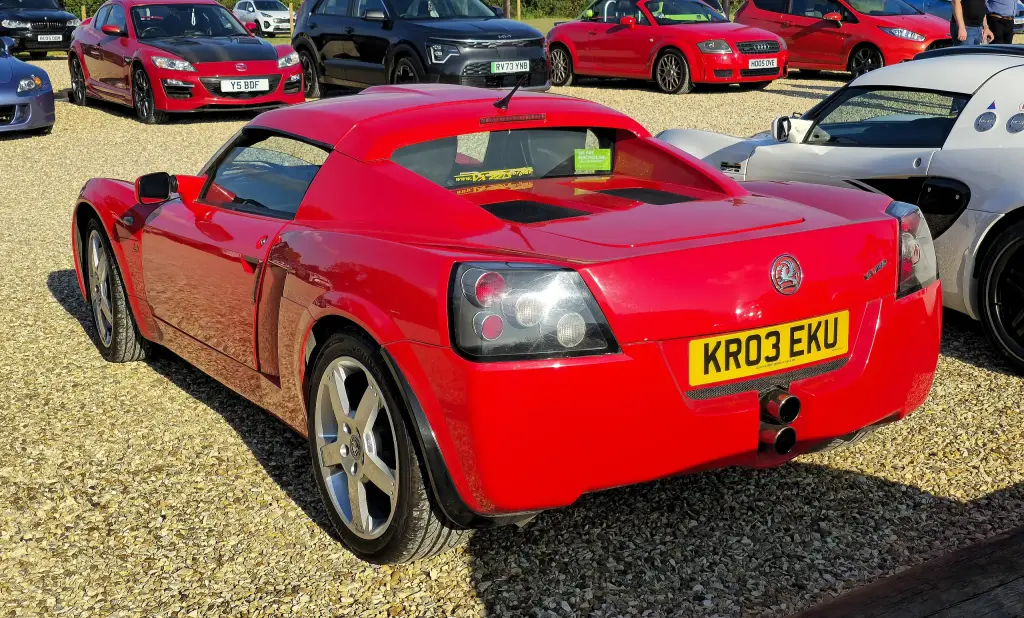
The Vauxhall VX220 was the British version of the Opel Speedster, a mid-engined two-seat sports car built by Lotus at Hethel in Norfolk from 2000 to 2005. It used a lengthened Lotus Elise chassis, weighed 875 kg and was Vauxhall’s lightest performance car in decades.
Vauxhall VX220 at a glance
| Maker | Vauxhall (Opel Speedster on the continent) |
|---|---|
| Production | 2000–2005 |
| Built at | Lotus, Hethel, Norfolk |
| Internal Lotus code | Type 116 |
| Chassis | aluminium, 72 kg, based on the Series 2 Elise with a 30 mm longer wheelbase |
| Body | fibreglass |
| Weight | 875 kg; 930 kg for the turbo |
| Engine | 2.2-litre Z22SE, 147 PS; 2.0-litre turbo, 200 PS |
| VXR220 | 2004, 60 cars, 220 hp |
| Total built | 7,207 |
Written from the English and German Wikipedia articles on the Opel Speedster; the Vauxhall VX220 is the British-badged version.
History of the Vauxhall VX220
Changes to European crash safety rules for the 2000 model year meant Lotus had to replace the original Elise. In October 1999 Lotus and General Motors struck a deal: GM provided the funds Lotus needed to develop a new Elise, and Lotus agreed to develop and produce the Opel Speedster and Vauxhall VX220 on a variation of the new Series 2 Elise chassis, with a 30 mm longer wheelbase and lower door sills than the Lotus. The first Speedster concept was shown at the Geneva Motor Show in March 1999.
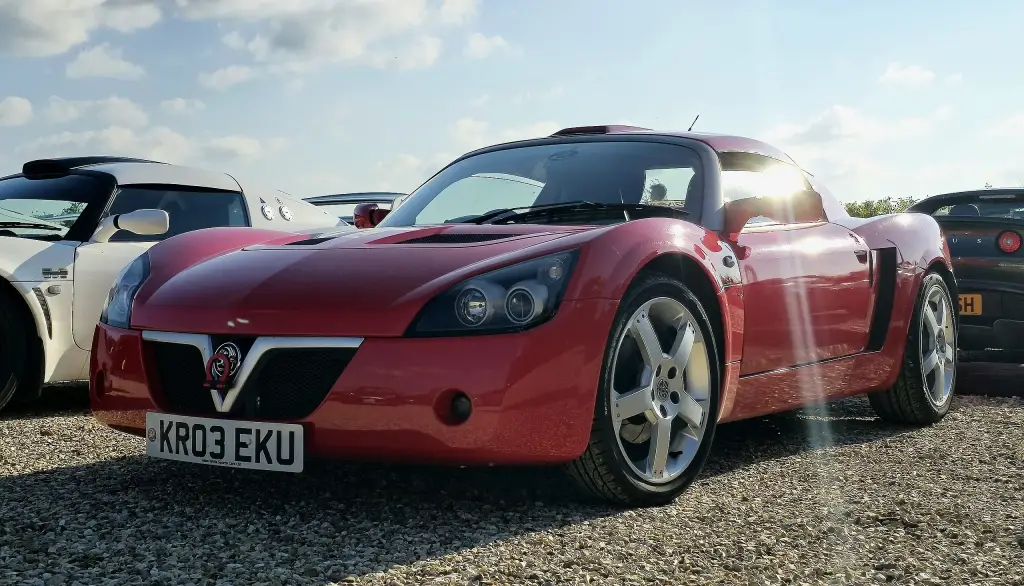
Where the new Elise used a 1.8-litre Toyota engine, the VX220 used a 2.2-litre GM Ecotec from the Astra. Lotus expanded Hethel to a capacity of 10,000 cars, with around 3,500 slots allocated to the Speedster, and production started in March 2001. The car had an aluminium frame weighing only 72 kg and fibreglass bodywork, and the whole car weighed 875 kg, roughly 100 kg less than a similarly sized Toyota MR2. The all-aluminium 2.2-litre Z22SE produced 147 PS, making it considerably more powerful than the Series 2 Elise at launch.
In answer to calls for more power, Opel added a two-litre turbocharged Ecotec of 200 PS, which weighed a little more at 930 kg. The turbocharged car could reach 242 km/h and accelerate from 0 to 100 km/h in 4.7 seconds. In 2004 a limited run of sixty track-focused cars was produced for the United Kingdom as the Vauxhall VXR220, with larger brakes, upgraded tyres, lowered suspension and a tuned 220 hp engine, plus performance seats and unique Speedline alloy wheels, 16 inches at the front and 17 at the rear. Calypso Red was the only colour offered.
The VX220 was deliberately spartan: no power steering, no traction control, only ABS, a fabric roof in black, red, blue or green with a fibreglass hardtop as an option, and a 206-litre boot reached through a small opening. It had no spare wheel at all, only a tyre sealant spray, and a single driver’s airbag in a 32 cm Momo wheel. In April 2001 the comedian Griff Rhys Jones was dropped by Vauxhall after a 2000 advertisement for the car in which he dressed as a woman; the advert was voted “Worst of the Year” by an industry magazine. Production ended on 22 July 2005 after 7,207 cars, with no direct successor.
Design and features
- Lotus build: assembled at Hethel alongside the Elise.
- Very light: an aluminium frame and fibreglass body gave 875 kg.
- Mid-engined: 63 per cent of the weight sat over the driven rear wheels.
- VXR220: 60 cars with 220 hp, bigger brakes and track-focused suspension.
- No frills: no power steering, no traction control and no spare wheel.
Vauxhall VX220 versions
- VX220 2.2: the 147 PS naturally aspirated car.
- VX220 Turbo: the 200 PS version from 2003.
- VXR220 (2004): 60 track cars with 220 hp.
- Opel Speedster: the continental version of the same car.
The VX220 was Vauxhall’s sports car alongside the Australian-built Monaro, and it was replaced in spirit by the VXR8. More cars are in the Vauxhall collection.
Sources
- Opel Speedster, English Wikipedia: development, chassis, engines, VXR220, end
- Opel Speedster, German Wikipedia: technical details, equipment, production