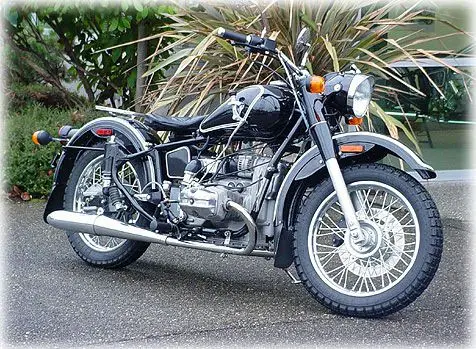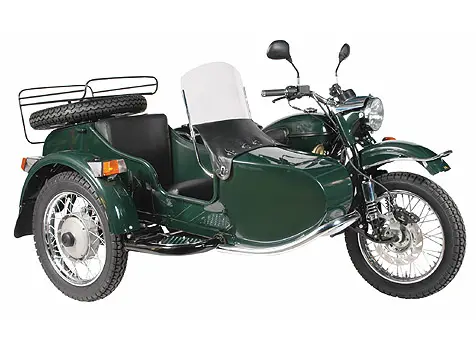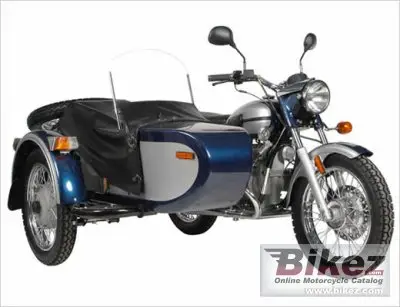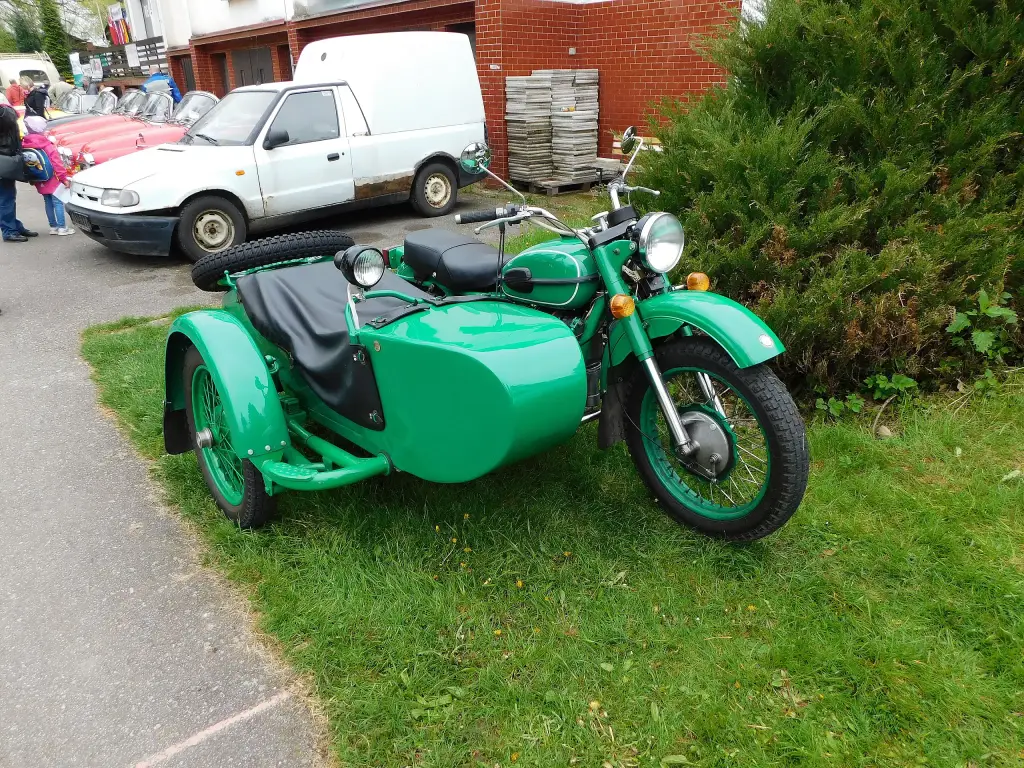
The 650 cc engine defined the Ural sidecar motorcycle for more than thirty years. It appeared in 1957 in the M-61, which kept the chassis of the wartime M-72 but replaced its engine, and it powered every Irbit model up to the IMZ-8.103-10 of the late 1980s.
Ural 650 at a glance
| Maker | Irbit Motorcycle Factory (IMZ), Irbit, Ural region |
|---|---|
| Production | 1957–1995 as the 650 cc generation |
| First model | IMZ M-61, 1957–1963 |
| Engine | 649 cc air-cooled two-cylinder boxer, four-stroke |
| Bore and stroke | 78 × 68 mm |
| Power | 28 hp (M-62) rising to 32 hp (M-66) and 36 hp (M-67-36) |
| Compression | 6.2 on the M-62, raised to 7 on the M-66 |
| Gearbox | four-speed, with reverse from the IMZ-8.103-10 of 1987 |
| Final drive | shaft to the rear wheel |
| Top speed | 95 km/h (M-62), 105 km/h (M-66) |
| Fuel consumption | about 6 litres per 100 km (M-62) |
| Electrical system | 6 V until the M-67 of 1973, then 12 V |
There is no separate Wikipedia article for the 650 cc family; this page uses the model list in the Russian article on Ural motorcycles and the factory history in the English article on IMZ-Ural.
History of the Ural 650
A new engine in an old chassis
The 650 cc engine arrived with the IMZ M-61 of 1957. The factory kept the chassis of the M-72 but fitted a larger, more powerful engine and revised the front fork, and the frame was made lighter. The M-62 followed in 1961 with a new gearbox, longer suspension travel and automatic ignition advance, which lifted output to 28 hp.
The 1970s
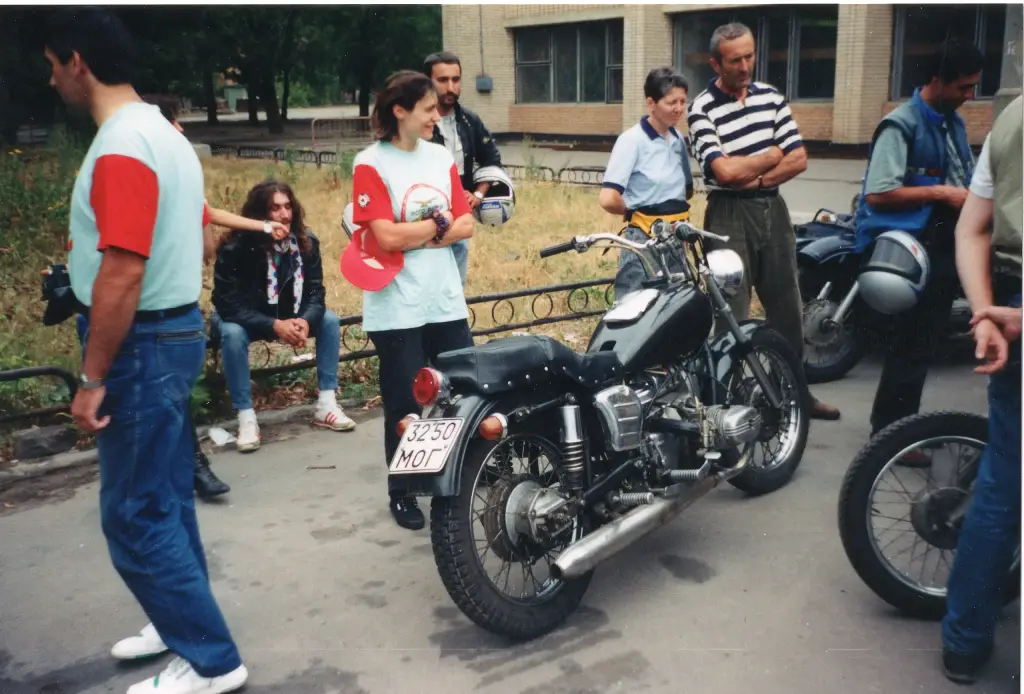
The M-63 of 1963 brought a frame with a swingarm rear suspension on spring-hydraulic shock absorbers and more ground clearance. In 1971 the M-66, sold as the Ural-3, raised compression from 6.2 to 7 and power to 32 hp, strengthened the crankshaft and added a full-flow paper oil filter. The M-67 of 1973 moved the motorcycle to 12-volt electrics; its M-67-36 successor of 1976 reached 36 hp with larger carburettors and a bigger exhaust, and lost the right turn signal mounted on the motorcycle itself.
The end of the line
The 1985 IMZ-8.103-30 brought a new frame and rear suspension, new optics and a brake on the sidecar wheel, with one silencer on the right instead of two. The IMZ-8.103-10 of 1987 added reverse gear and weighed less, with 32 hp. By then the factory was producing around 130,000 motorcycles a year at its peak, mostly for the domestic market as a cheap alternative to a car; the 650 cc engine was later replaced by a 750 cc unit.
Design and features
- 649 cc boxer twin: air-cooled and simple, the engine could be repaired far from a workshop.
- Shaft drive: a cardan shaft to the rear wheel, with the sidecar wheel driven on the two-wheel-drive versions.
- Sidecar as standard: most Urals left Irbit with a sidecar, and the outfit could carry three people.
- Steady development: full-flow oil filtration, 12-volt electrics and a reverse gear arrived over the years without changing the basic design.
Ural 650 versions
- IMZ M-61 (1957–1963): the first 650 cc Ural, on the M-72 chassis.
- Ural M-62 (1961–1965): new gearbox, longer travel, automatic ignition advance, 28 hp.
- Ural-2 M-63 (1963–1971): swingarm rear suspension and more ground clearance.
- Ural-3 M-66 (1971–1975): 32 hp, full-flow oil filter, turn signals.
- Ural M-67 and M-67-36 (1973–1984): 12-volt electrics, then 36 hp.
- IMZ-8.103-10 (1987–1995): reverse gear and 32 hp.
The first 650 cc model grew out of the M-72; the M-62 and M-66 are described separately. More machines are in the Ural collection.
Sources
- IMZ-Ural, English Wikipedia: factory history, exports, production volumes
- Урал (мотоцикл), Russian Wikipedia: model list, dates, technical changes