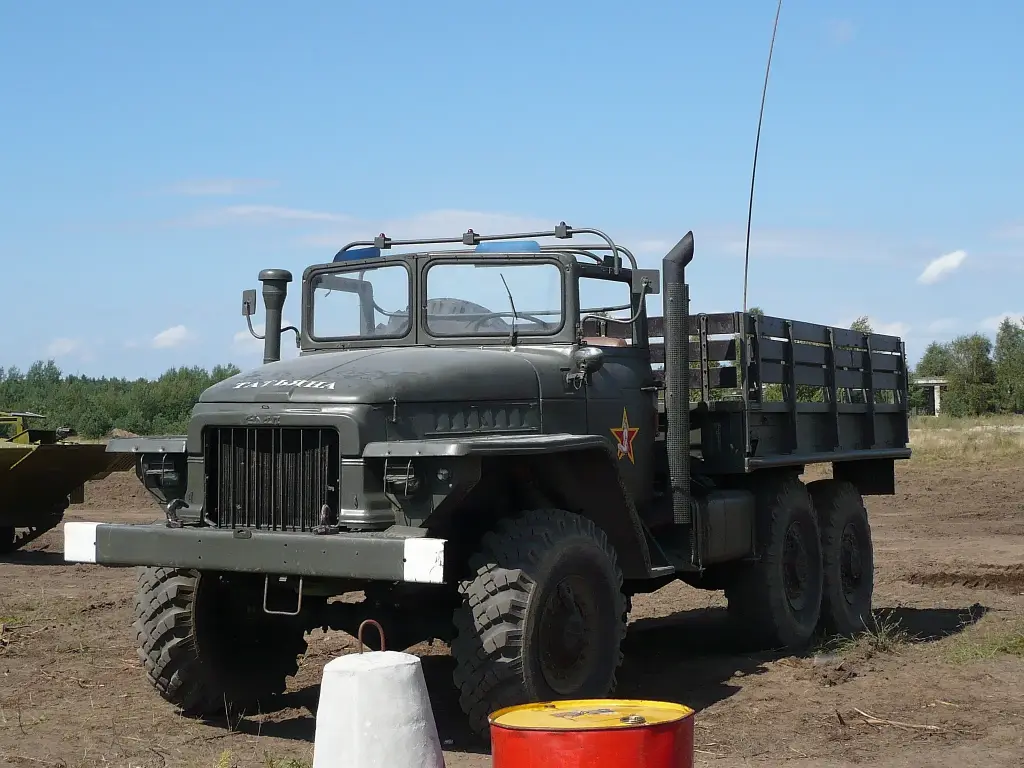
The Ural-375 was the general-purpose 4.5-tonne 6×6 truck of the Soviet Army, built at the Ural Automotive Plant in Miass from 1961 to 1993. It used a 7-litre petrol V8 derived from the ZIL-130 engine, and it became the standard army truck in 1979 before giving way to the diesel Ural-4320.
Ural-375 at a glance
| Maker | Ural Automotive Plant (UralAZ), Miass |
|---|---|
| Production | 1961–1993 |
| Built | 110,000 examples (375D) |
| Layout | 6×6, conventional cab, three seats |
| Engine | 7.0-litre ZIL-375Ya V8 petrol, 180 hp |
| Gearbox | five-speed with a two-speed transfer case |
| Payload | 4,800 kg |
| Max mass | 13,200 kg |
| Top speed | 75 km/h |
| Fording depth | 1,500 mm |
| Tyres | central tyre inflation, 0.5–3.2 kgf/cm² |
| Fuel tanks | 300 + 60 litres |
History of the Ural-375
A petrol V8 for the army
The Ural-375 was developed during the 1950s and 1960s and used many chassis components of the MAZ-200. Its 7.0-litre V8 was based on the 6.0-litre engine of the ZIL-130; the extra capacity came from boring the cylinders out to 108 mm while keeping the 95 mm stroke, so blocks and crankshafts were shared and only the pistons differed. The original 375 had a folding canvas roof and a flat windscreen that folded onto the bonnet.
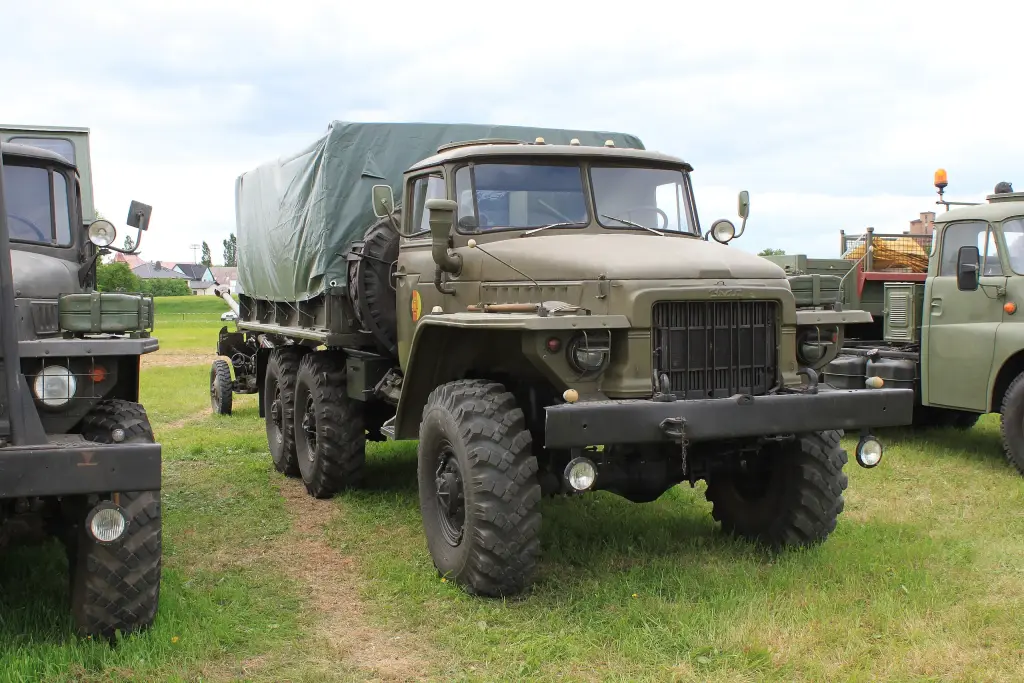
The 375D
In 1964 the truck received an all-steel cab from the Ural-377 and the index Ural-375D. The 375D became the most produced version, with 110,000 built, some with a 7,000 kgf winch behind the cab. Until 1965 the transfer case had a manually engaged front axle with three positions; from 1965 a simpler unit kept the front axle engaged permanently with a lockable inter-axle differential.
Service and replacement
The Ural-375 replaced the ZIL-157 as the standard Soviet Army truck in 1979 and served as a platform for the BM-21 Grad rocket launcher, as a troop carrier and as a supply truck. From 1977 it was gradually replaced by the diesel Ural-4320, though production continued until 1993 and many civilian derivatives remain in use.
Design and features
- Petrol V8: 7 litres, 180 hp, and a fuel consumption of 45–50 litres per 100 km.
- Central tyre inflation: pressure adjustable from 0.5 to 3.2 kgf/cm² while driving.
- Grad chassis: the 375 was the base of the BM-21 Grad rocket launcher.
- Deep fording: 1,500 mm without preparation.
- Steel or canvas cab: the early 375 had a canvas roof, the 375D a steel cab.
Ural-375 versions
- Ural-375 (1961–1964): canvas roof, flat folding windscreen.
- Ural-375D (1964–1993): all-steel cab, the main production version.
- Ural-375A: longer chassis for the K-375 van body.
- Ural-375E: chassis for special equipment.
- Ural-375S: 6×6 tractor unit.
- Ural-375N: civilian version with a wooden platform.
The 375 was replaced by the Ural-4320 and shared its role with the heavier Ural-5323. More trucks are in the Ural collection.
Sources
- Ural-375, English Wikipedia: models, specification, users
- Урал-375Д, Russian Wikipedia: production total, cab history, transfer case