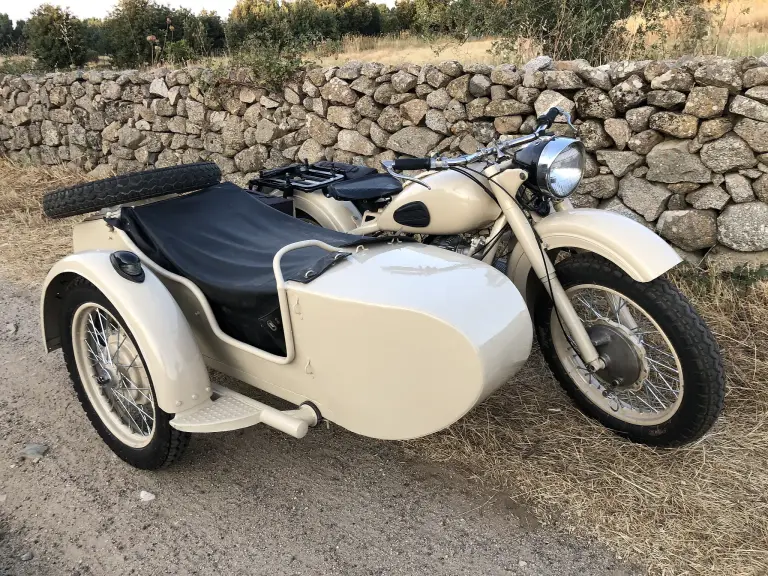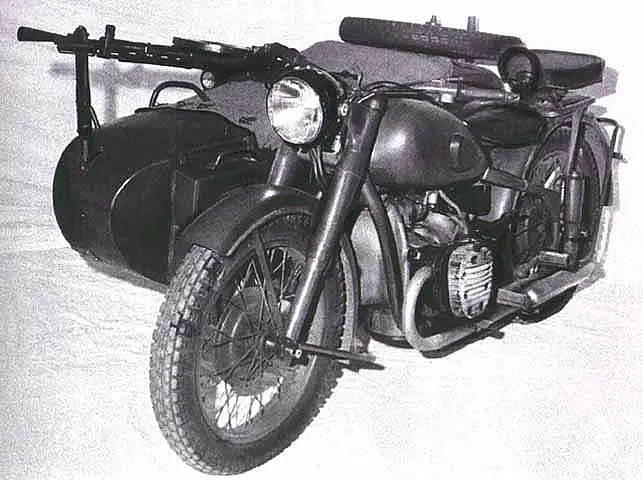
The M-72 is the ancestor of every Ural. The Red Army needed a rugged sidecar motorcycle in the late 1930s, the BMW R71 was judged the closest match, and five machines were bought covertly through Sweden for the Moscow Motorcycle Plant to dismantle and copy. Production began in August 1941 and was moved to Irbit that October.
Ural M-72 at a glance
| Maker | Moscow Motorcycle Plant, then IMZ, Irbit |
|---|---|
| Production | 1941–1961 |
| Based on | BMW R71, bought through Sweden |
| Factory move | Moscow to Irbit, October 1941 |
| First wartime batch | 25 February 1942 |
| Wartime output | 9,799 delivered |
| Role | reconnaissance detachments and mobile troops |
| Last versions | short-lever front fork, aluminium wheel hubs |
| Successor | Ural M-61 |
History of the Ural M-72
The R71 connection
A meeting at the People’s Commissariat of Defence at the end of the 1930s looked for a motorcycle for the Red Army, and the Wehrmacht’s BMW R71 was found to match the requirements. Five were bought covertly through Sweden and handed to the Moscow Motorcycle Plant, recently organised in a retooled bicycle factory. Soviet engineers dismantled them and copied the design in detail, and moulds and dies were made for engines, gearboxes and other parts. Production of the new sidecar motorcycle, designated M-72, started in August 1941.
To the Ural mountains
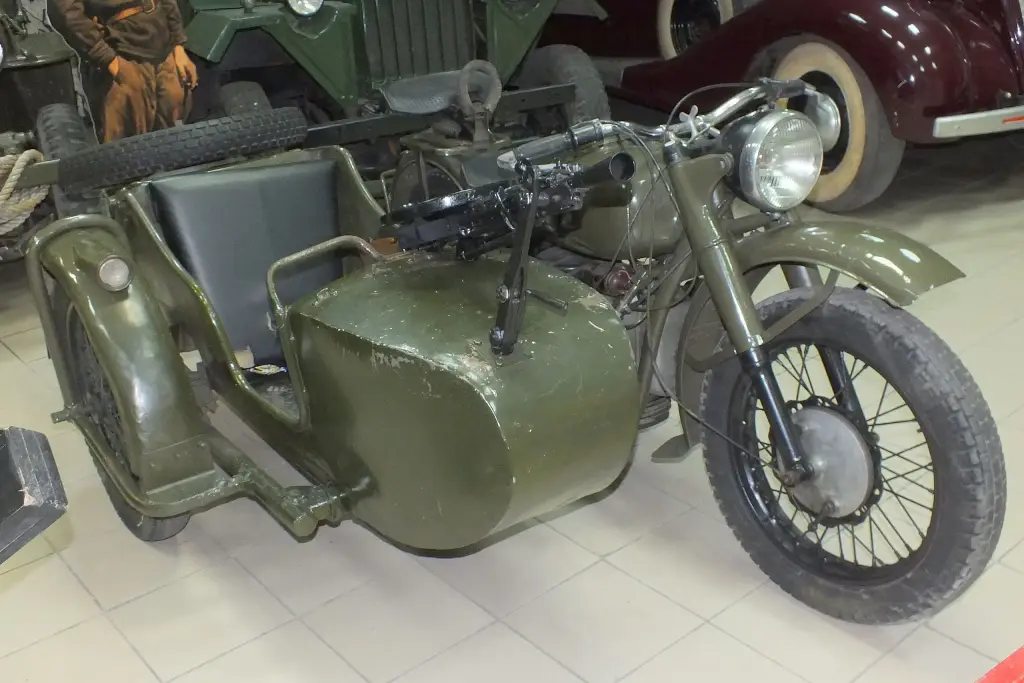
After the German invasion in the summer of 1941 Soviet strategists feared Moscow would soon be within range of the Luftwaffe. On 21 October 1941 the plant was ordered east, to Irbit in the Ural mountains, chosen because it had been a major trade town and its only building large enough was a brewery beyond the railway line. That brewery became the Irbit Motorcycle Factory. On 25 February 1942 the first batch, assembled from parts brought from Moscow, went to the front, and during the war 9,799 M-72s were delivered to reconnaissance units and mobile troops.
After the war
The M-72 stayed in production until 1961 and was modernised throughout its life; the last versions received a short-lever front fork and aluminium wheel hubs. From 1957 it was replaced by the M-61 with a new 650 cc engine, and IMZ began exporting motorcycles in 1953.
Design and features
- Copy of the BMW R71: copied in detail from five machines bought through Sweden.
- Sidecar outfit: built for reconnaissance, with the sidecar as standard.
- Wartime production: 9,799 delivered between 1941 and 1945.
- Constant modernisation: twenty years of development, ending with a short-lever fork and aluminium hubs.
Ural M-72 versions
- M-72 (1941–1961): the standard military sidecar motorcycle.
- Later M-72s: with short-lever front fork and aluminium wheel hubs.
The M-72 was replaced by the M-61, which began the 650 cc generation; the modern machines are covered on the Ural 750 page. More machines are in the Ural collection.
Video: Jazda na motocykli Ural M 72 z roku 1951
Video by Petr Hric on YouTube.
Sources
- IMZ-Ural, English Wikipedia: BMW R71, wartime production, factory move
- М-72 (мотоцикл), Russian Wikipedia: production years and later changes