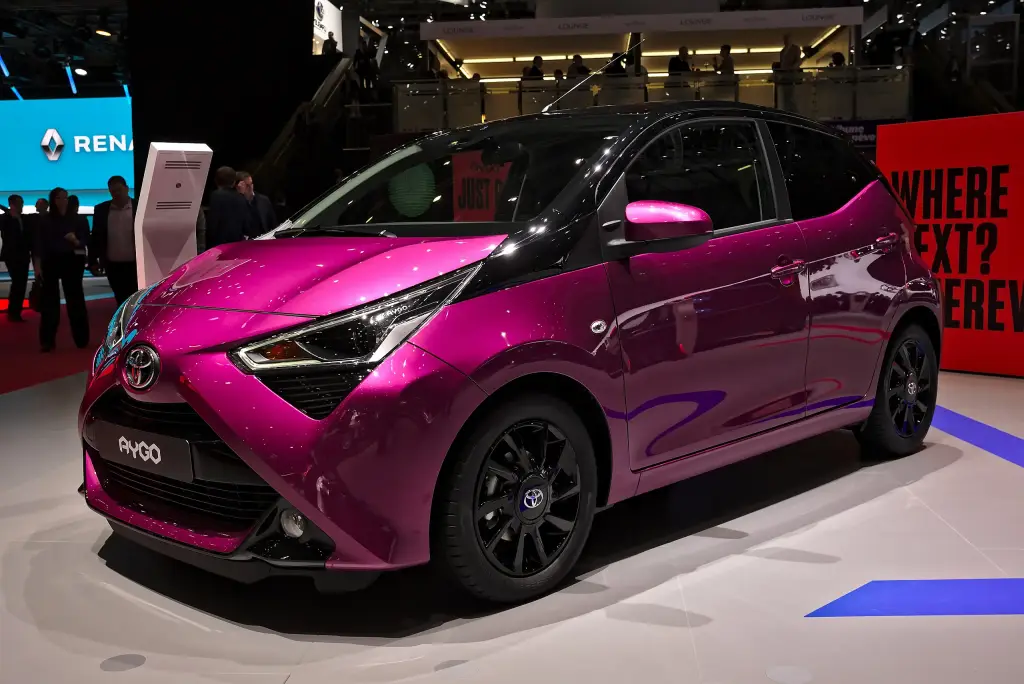
The Toyota Aygo was a city car sold mainly in Europe between 2005 and 2022 across two generations. It was built in Kolín in the Czech Republic by Toyota Peugeot Citroën Automobile, the joint venture that also produced the Citroën C1 and Peugeot 107/108, and the planned output was 300,000 cars a year, 100,000 per brand.
Toyota Aygo at a glance
| Maker | Toyota |
|---|---|
| Production | 2005–2022 |
| Built in | Kolín, Czech Republic (TPCA joint venture) |
| Class | City car (A-segment) |
| Body styles | Three- or five-door hatchback |
| Engines | 1.0-litre three-cylinder petrol, 1.4-litre turbo-diesel |
| Power | 68 PS (petrol), 54 PS (diesel) |
| First shown | Geneva Motor Show, 2005 |
| Sales began | July 2005 |
| Twin models | Citroën C1, Peugeot 107 and 108 |
| Name | From “i-go”, for freedom and mobility |
Based on one source: the English Wikipedia article on the Toyota Aygo.
History of the Toyota Aygo
Origins of the joint venture
The decision to build the car was taken on 12 July 2001 by Toyota president Fujio Cho and PSA Peugeot Citroën president Jean-Martin Folz, who wanted a small car to share development costs. The project was called B-Zero, and the Peugeot 107 and Citroën C1 were rebadged versions of the same car. The main differences between the Aygo and its French siblings were the badging, rear side windows, steering wheel and the front and rear styling. Sales began in July 2005 with three- and five-door bodies and two engines: a 1.0-litre three-cylinder petrol of 68 PS and a 1.4-litre turbo-diesel four of 54 PS.
Fame and recalls
The Aygo’s manoeuvrability was shown on BBC’s Top Gear in a giant game of football, and a modified car performed a twelve-metre-high loop-the-loop on Fifth Gear in May 2009. In January 2010 the Aygo was caught up in Toyota’s worldwide recall for sticking accelerator pedals, affecting cars built between February 2005 and August 2009; Toyota later said only automatic versions were affected. German breakdown statistics for May 2010 put the Aygo, C1 and 107 at the top of the sub-small class for reliability. A 2008 one-off concept, the Aygo Crazy, moved the engine behind the seats and drove the rear wheels through a turbocharged MR2 1.8-litre engine of 197 bhp.
Facelifts and second generation
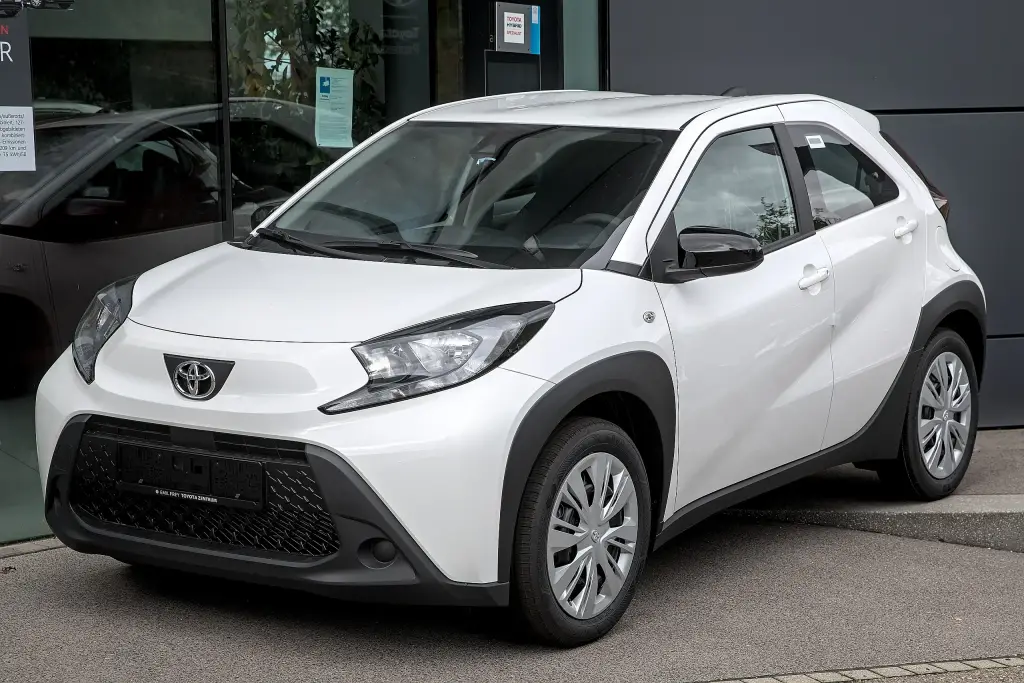
The first generation was updated in 2009 with a new front bumper and clear rear lights, and again in 2012 with a more angular bumper and daytime running lights. Toyota revealed a completely redesigned second-generation Aygo at the Geneva Motor Show in March 2014, with styling drawn from Japanese youth culture. Production of the Aygo ended in 2021 with the second generation, and the model was replaced by the crossover-styled Aygo X. Between 2008 and 2015, and again from 2019 to 2020, the Chinese maker BYD also produced the unlicensed F0 clone of the Aygo.
Design and features
- Shared city car: designed and built with PSA alongside the C1, 107 and 108.
- Three-cylinder engine: the 1.0-litre petrol of 68 PS was the main unit.
- Small footprint: a three- or five-door hatchback aimed at European cities.
- Reliability: top of the German breakdown statistics for small cars in 2010.
Toyota Aygo versions
- AB10 (2005): the original three- and five-door hatchback.
- AB20 (2009): new front bumper and clear rear lights.
- AB30 (2012): angular bumper with daytime running lights.
- Aygo Crazy (2008): mid-engined, rear-drive one-off with a turbocharged 1.8.
- AB40 (2014): second generation, replaced by the Aygo X in 2021.
The Aygo was Toyota’s smallest European model alongside the Yaris, and it used a 1.8-litre engine related to the MR2 in the Crazy concept. More cars are in the Toyota collection.
Sources
- Toyota Aygo, English Wikipedia: joint venture, engines, versions, concept