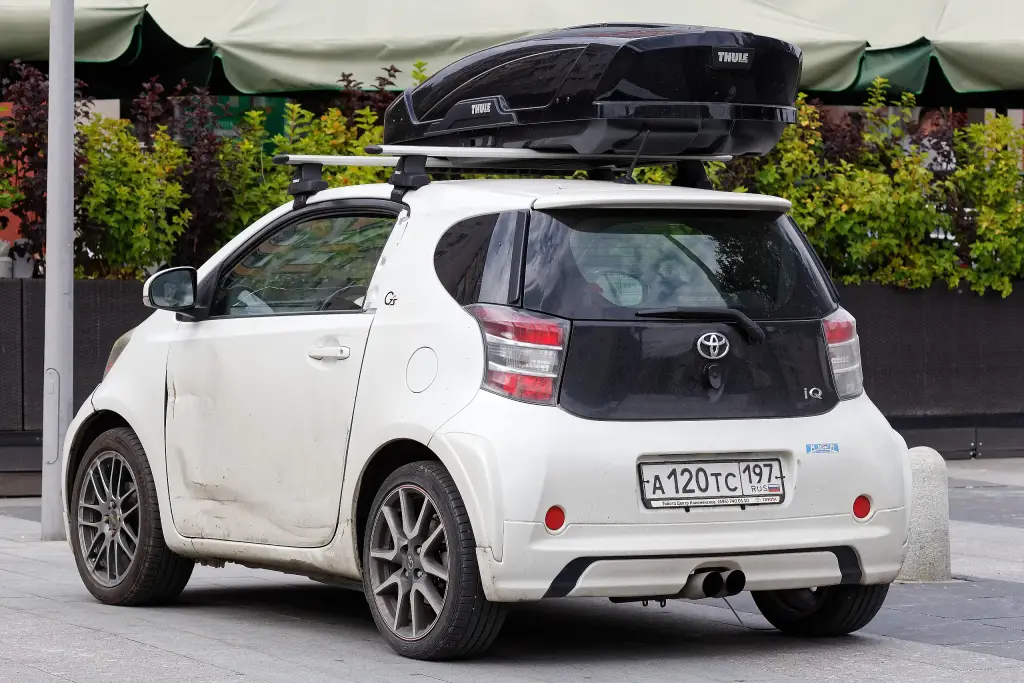
The Toyota iQ is a city car produced in a single generation from 2008 to 2015 in Europe and North America, and until 2016 in Japan. Designed at Toyota’s European design studio in Nice, it used specialised engineering to maximise passenger space in the shortest possible length, accommodating four occupants.
Toyota iQ at a glance
| Maker | Toyota |
|---|---|
| Production | 2008–2015, Japan until 2016 |
| Class | City car |
| Design | Toyota European Design and Development, Nice |
| Concept | Frankfurt Motor Show, 2007 |
| Production debut | Geneva Motor Show, March 2008 |
| Engines | 1.0-litre three-cylinder, 1.33-litre four |
| Airbags | Nine |
| Award | Car of the Year Japan, 2008 |
| Related | Aston Martin Cygnet, Scion iQ, Toyota eQ |
| Name | From intelligence quotient |
Based on one source: the English Wikipedia article on the Toyota iQ.
History of the Toyota iQ
Packaging
The iQ’s design emphasised fuel efficiency, manoeuvrability, low environmental impact and interior space. Six features made its short body possible: a differential mounted further forward than usual, a centre take-off steering gear, a flat fuel tank under the cabin floor, rear-angled shock absorbers that intrude less into rear passenger space, a smaller heater and air conditioning unit mounted centrally behind an asymmetric dashboard, and slimmer seats. The transmission differential sits ahead of, rather than behind, the engine, the starter motor is built into the flywheel, and the steering rack is mounted high. The result allows the front passenger to sit forward of the driver, giving rear passengers more legroom, while the under-floor tank shortens the rear overhang. Because of its width and engine size the car is classed as a supermini in Japan, though its length meets kei-car rules.
Launch and versions
Following a concept at the 2007 Frankfurt Motor Show, the production iQ debuted at the Geneva Motor Show in March 2008, with Japanese sales from November 2008 and European sales from January 2009. It won Car of the Year Japan in 2008. The 1.0-litre engine was related to the Aygo’s and gave 65.69 mpg under European standards, with a 1.33-litre option from 2009 that included stop-start on manual cars. Japanese models used a CVT. In the United States and Canada the car was sold as the Scion iQ from 2012 to 2015, only with the 1.3-litre engine and a CVT. In Europe a rebadged variant was sold as the Aston Martin Cygnet from 2011 to 2013. A limited electric version, the Scion iQ EV or Toyota eQ, had a range of about 80 km and was reserved for fleets and car-sharing schemes.
Safety and the end
The iQ came with nine airbags, including a front passenger seat cushion airbag and a rear curtain airbag to protect back-seat passengers’ heads in a rear impact, with stability control, traction control, ABS, brake assist and electronic brake distribution as standard. In 2013 the UK’s Vehicle and Operator Services Agency named it the three-year-old car most likely to pass its first roadworthiness test. European sales peaked at 44,282 in 2009 and fell below a thousand in 2015, partly because the iQ cost about £10,000, more than the larger Aygo. Production ended in December 2015 and Japanese sales in April 2016.
Design and features
- Clever packaging: a flat under-floor tank and forward-mounted differential shorten the car.
- Nine airbags: including a rear curtain airbag and a seat cushion airbag.
- Asymmetric dashboard: the front passenger sits ahead of the driver.
- Cygnet connection: the same car was sold by Aston Martin as the Cygnet.
Toyota iQ versions
- 1.0 (2008): three-cylinder engine with a CVT in Japan.
- 1.33 (2009): four-cylinder with stop-start on manual cars.
- Scion iQ (2012): North American version with the 1.3 and a CVT.
- Aston Martin Cygnet (2011): rebadged luxury version.
- Toyota eQ (2012): limited electric version for fleets.
The iQ sits below the Aygo in size and shares its city-car thinking with the i-unit concept. More cars are in the Toyota collection.
Sources
- Toyota iQ, English Wikipedia: packaging, versions, safety