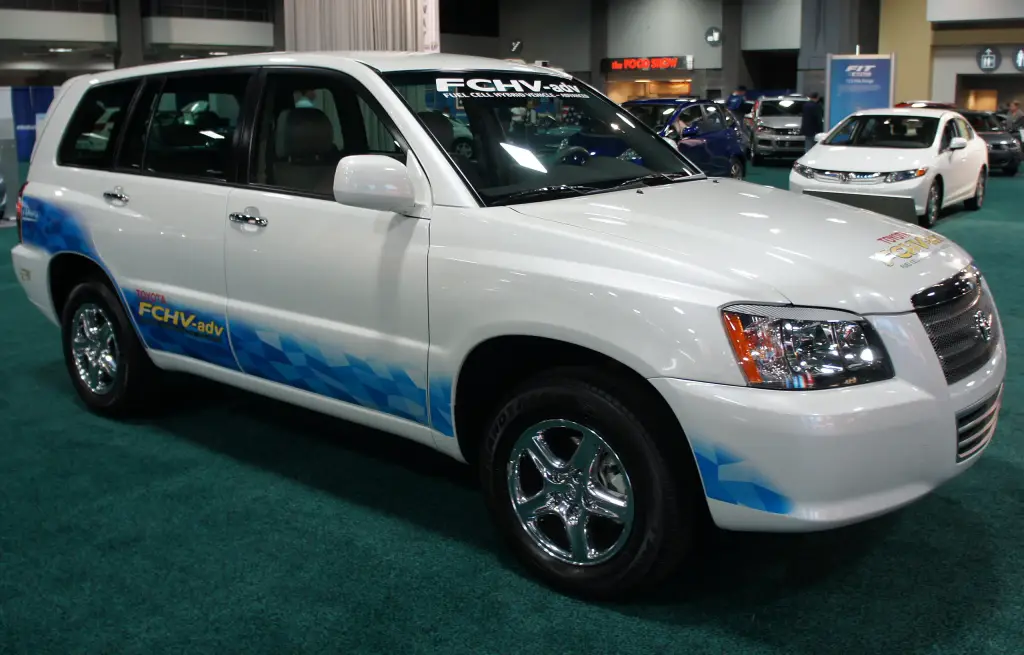
The Toyota FCHV is Toyota’s hydrogen fuel cell vehicle programme, leased to a limited number of drivers in Japan and the United States from 2002. Along with the Honda FCX, it became one of the world’s first government-certified commercial hydrogen fuel cell vehicles.
Toyota FCHV at a glance
| Maker | Toyota |
|---|---|
| Programme | Fuel Cell Hybrid Vehicle, from 1996 |
| First leased | 2002 |
| Basis | First-generation Toyota Highlander |
| Fuel cell | 90 kW, with nickel-metal hydride battery |
| Drive motor | 90 kW |
| Hydrogen storage | Compressed gas at 700 bar, 156 litres |
| Range | 830 km on the Japanese 10-15 cycle |
| Battery-only range | About 50 km |
| Latest version | FCHV-adv, leased in Japan from 2008 |
Based on one source: the English Wikipedia article on the Toyota FCHV.
History of the Toyota FCHV
Six generations of prototypes
Toyota built six generations of FCHV for testing. The FCHV-1 of 1996 was Toyota’s first fuel cell vehicle, based on the RAV4 and fitted with a hydrogen-absorbing alloy storage unit. The FCHV-2 of 1997 carried a reformer to extract hydrogen from methanol. The FCHV-3, FCHV-4 and FCHV-5 of 2001 moved to the Highlander body and could generate four times the power of the FCHV-1; the FCHV-4 was the first fuel cell vehicle tested on public roads in Japan, and driving tests continued until 2004. The FCHV-5’s Clean Hydrocarbon Fuel reformer used a new catalyst and heat exchanger to improve acceleration and fuel economy.
How it works
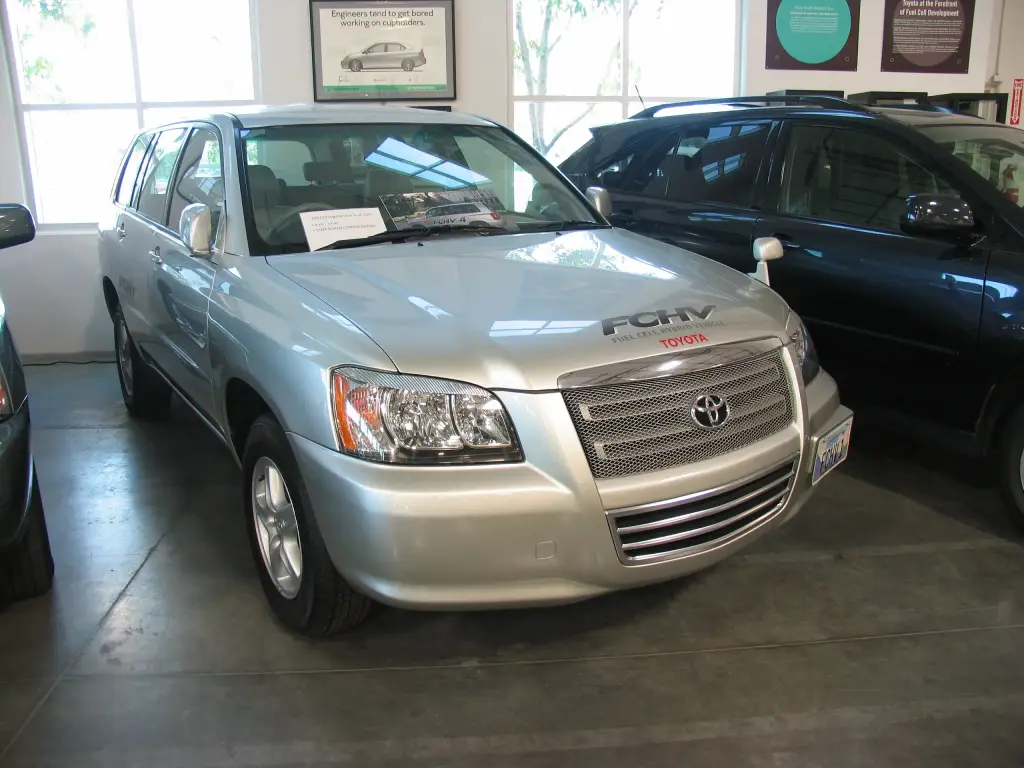
The FCHV’s powertrain combines a 90 kW fuel cell fed from compressed hydrogen tanks with a nickel-metal hydride battery, both able to supply the 90 kW drive motor singly or together. The principle is close to the Hybrid Synergy Drive of the Prius and Auris hybrid, but with the fuel cell replacing the petrol engine, which eliminates greenhouse gas emissions at the point of use. At low speed the car can run on battery alone for about 50 km; under hard acceleration the fuel cell and battery work together, and the battery recovers energy under braking. The 700-bar tanks hold 156 litres of hydrogen, enough for 830 km on the Japanese 10-15 test cycle and 760 km on the JC08 cycle.
Proving the range
In 2007 an FCHV drove 560 km between Osaka and Tokyo on a single tank of hydrogen, showing that a fuel cell car could match a conventional one for range. In August 2009 Toyota USA estimated a range of 690 km for the FCHV-adv from a 6 kg tank, based on a 533 km test run between Torrance and San Diego. Leasing to government ministries and companies gave Toyota detailed feedback under varied conditions. The technology fed into later fuel cell buses, including the SORA, and into the Mirai production car.
Design and features
- Certified for the road: among the first government-certified hydrogen fuel cell vehicles.
- Hybrid layout: a 90 kW fuel cell and a battery feeding a 90 kW motor.
- Long range: 830 km on the Japanese 10-15 cycle from 156 litres of hydrogen at 700 bar.
- FCHV-adv: the final development version, leased in Japan from 2008.
Toyota FCHV versions
- FCHV-1 (1996): RAV4-based, with hydrogen-absorbing alloy storage.
- FCHV-2 (1997): methanol reformer version.
- FCHV-3, 4 and 5 (2001): Highlander-based, four times the power of the first car.
- FCHV-adv (2008): improved range, leased in Japan.
- FCHV-BUS: fuel cell bus based on the Hino Blue Ribbon City.
The FCHV programme led to the Mirai, and its body was based on the Highlander. Its early prototype used the RAV4, and more cars are in the Toyota collection.
Sources
- Toyota FCHV, English Wikipedia: programme, system, versions