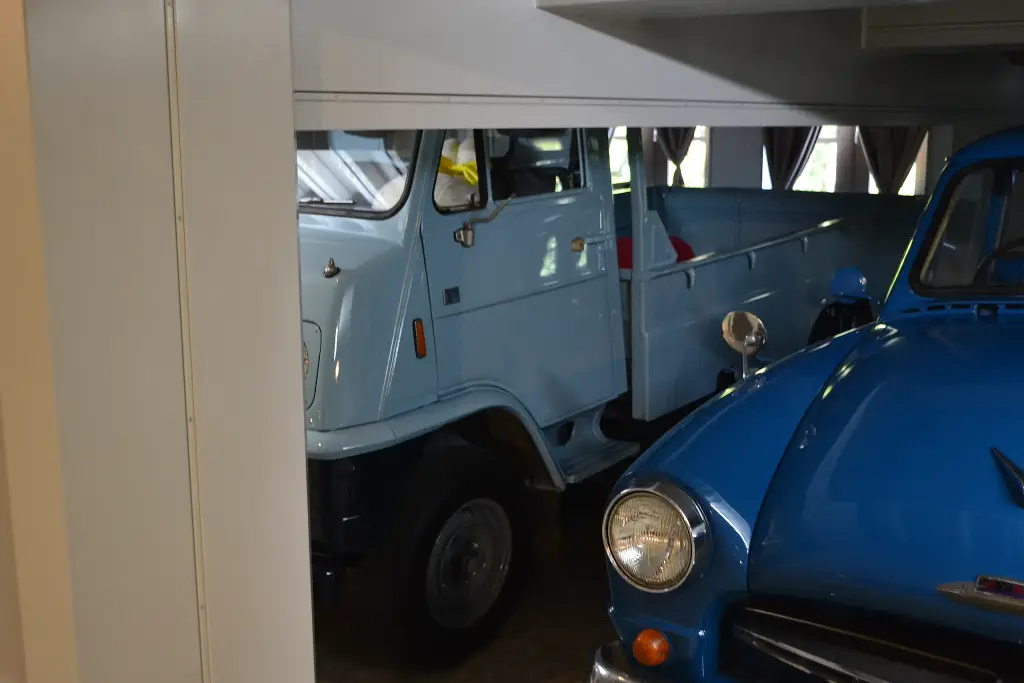
The Toyopet ToyoAce has been built by Toyota since September 1954, originally as the Toyopet Light Truck. Its 1950s generations established Toyota in the one-ton cab-over market, and from 1985 the line has been merged with the Toyota Dyna.
Toyopet ToyoAce at a glance
| Maker | Toyota (Toyopet) |
|---|---|
| Production | since September 1954 |
| Original name | Toyopet Light Truck SKB |
| Renamed | ToyoAce after a public contest in 1956 |
| First engine | 1.0 L sidevalve S, 30 PS |
| Payload | one ton |
| Second generation | SK20, March 1959 |
| New engine | 1.0 L P, 45 PS (October 1959) |
| Later engines | 1.2 L 2P and 1.5 L R |
| 1967 facelift | quad headlights, 1.35 L 3P (PK32) |
| Third generation | August 1971, Y-series codes |
| Diesel | 2.5 L 2J, from July 1972 |
| Merged with Dyna | 1985 |
The English Wikipedia article covers the whole ToyoAce line; this page follows its account of the first generations and the merger with the Dyna. Based on one source.
History of the Toyopet ToyoAce
The Toyopet Light Truck
The first-generation ToyoAce was a one-ton truck of semi-cab-over design with a four-cylinder sidevalve S engine of 995 cc and 30 PS. It was originally sold as the Toyopet Light Truck, a name changed to ToyoAce after a public contest in 1956. The simple interior had hammock-style seats like a Citroën 2CV, and the truck shared its chassis and its K model-code with the Toyopet SK/RK truck, the line that later became the Stout. Sales were initially slow because the price was much higher than that of the three-wheeled trucks it competed with, but after a large price cut the ToyoAce helped turn the Japanese light truck market towards four-wheeled vehicles. Panel van, light van and double-cab bodies were developed with chassis numbers from SK17 to SK19; in 1958 power rose to 33 PS, and Central Motors built the van from June 1956 to July 1960.
Second generation (SK20/PK20)
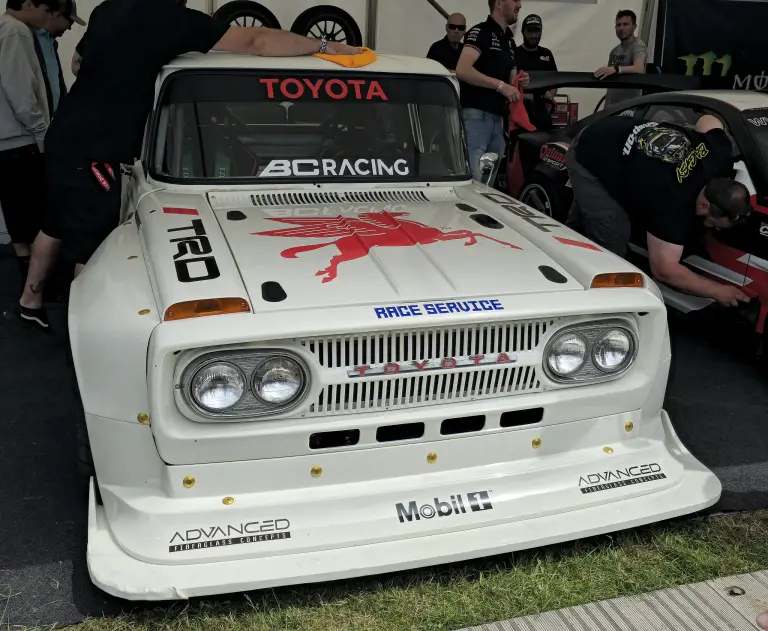
The semi-cab-over layout was retained for the second generation, initially the SK20, also sold as the SK20V panel van and the SK20P double-cab truck. Its 1.0-litre sidevalve engine still gave 33 PS. The model arrived in March 1959 but was facelifted that October with the 1.0-litre P engine of 45 PS, which made it the PK20 series. Australian versions were badged Toyota 25, and later 1.25- and 1.5-ton versions used the 1.2-litre 2P and 1.5-litre R engines. After the first S-engined series the trucks kept PK model codes to distinguish them from the Stout’s RK codes. A May 1967 facelift brought quad headlights and a 1.35-litre 3P version, the PK32. Unlike the front-engined SKB, the engine was moved underneath and behind the seats, which allowed seating for three instead of two; the cabin tilted for access, and the split windshield gave way to a single flat unit. The model stayed on the market until 1971.
Third generation and beyond
The third generation of August 1971 adopted Y-series chassis codes to avoid confusion with the Stout. It offered 3P and 12R petrol engines of 1.35 and 1.6 litres, the latter with 83 PS, and from July 1972 a 2.5-litre 2J diesel with 70 PS. Payloads ranged from 850 to 2,000 kg, and in August 1977 a special “just low” version with small twin rear wheels lowered the cargo floor. From this generation Toyota used the ToyoAce as the basis of a passenger van, the HiAce. The fourth generation was built from March 1979 to August 1985 with a wheelbase 345 mm shorter than before, and in 1982 a walk-in delivery van called the QuickDelivery was added. The fifth generation of August 1985 was based on the Dyna, and the sixth, introduced in May 1995, was merged fully with the Dyna range.
Design and features
- Semi-cab-over layout: a one-ton truck with the cab above the front axle, unusual in Japan in 1954.
- Hammock-style seats: a simple interior borrowed in spirit from the Citroën 2CV.
- Engine under the seats: from 1959 the engine moved behind and below the seats, allowing three abreast and a tilting cabin.
- Shared K-series chassis: the first generation shared its chassis with the SK/RK line that became the Stout.
- HiAce origins: the third generation provided the basis for Toyota’s HiAce van.
Toyopet ToyoAce versions
- SKB (1954): the original Toyopet Light Truck with a 30 PS sidevalve engine.
- SK20 (1959): second-generation truck with the 33 PS S engine.
- SK20V and SK20P: panel van and double-cab versions of the second generation.
- Toyota 25: Australian-badged version of the second generation.
- PK32 (1967): facelifted model with quad headlights and the 1.35-litre 3P engine.
- QuickDelivery (1982): walk-in delivery van based on the fourth generation.
The first ToyoAce shared its K-series chassis with the Toyopet Stout, and the Masterline light trucks are covered with the Toyopet Master. More cars are in the Toyopet collection.
Sources
- Toyota ToyoAce, English Wikipedia: all generations, engines, body styles