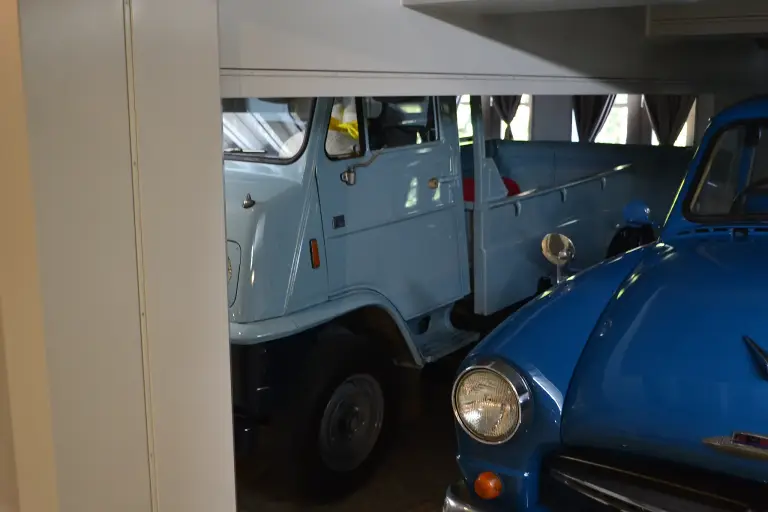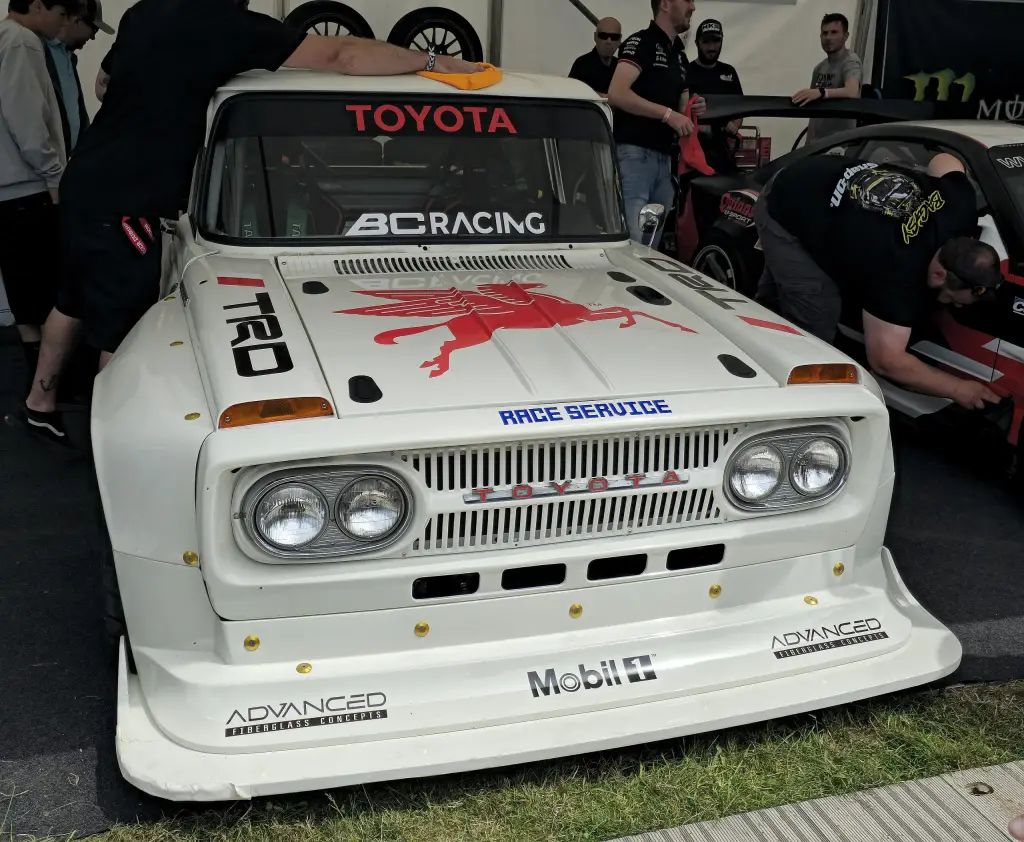
The Toyopet Stout was Toyota’s light truck line from the mid-1950s, launched in April 1956 as the RK23. It used a ladder frame, leaf springs and a 1.5-litre R engine, and the second generation stayed in production well into the late 1970s.
Toyopet Stout at a glance
| Maker | Toyota (Toyopet), Toyota Shatai Honsha plant |
|---|---|
| Production | 1956–2000 as a line, Stout name from June 1959 |
| First generation | RK23 1.5-ton truck, April 1956 |
| First engine | 1.5 L R, 49 PS |
| Power growth | 55 PS (1957), 58 PS (1958), 60 PS (July 1959) |
| Second generation | July 1960, RK45 |
| Second-generation engine | 1,453 cc R |
| 2-ton version | RK100, October 1962, 1,897 cc 3R-B |
| Lite Stout | RK40, September 1963 |
| Stout 1900 | RK41, North America 1964–1967 |
| Bodies | pickup, double cab, box van, station wagon |
| South African sales | 17,500 cars, 1961–1975 |
This page covers the first and second generations of the Stout, the period described in the English Wikipedia article. Based on one source.
History of the Toyopet Stout
First generation (RK23 and RK30, 1956–1960)
The truck arrived in April 1956 as the Toyopet RK23 1.5-ton truck, the successor of the RK. It used the same cabin as the Masterline coupé utility, which itself came from the short-lived Master sedan, but sat on a separate ladder frame and was positioned as a heavy-duty model with twice the payload of the Masterline. Its chassis was shared with the Dyna cab-over until the Dyna received a new generation in 1963. The main competitor was the Nissan Junior, and assembly took place at Toyota Shatai’s Koromo plant, renamed the Honsha plant in August 1960. The 49 PS 1.5-litre R engine was coupled to a three-speed manual gearbox, and the truck had leaf springs, solid axles and four-wheel drum brakes. In 1957 power rose to 55 PS and two-door extended-cab and three-door van or station wagon bodies were added. April 1958 brought the RK30 with a four-speed synchromesh gearbox, a column-mounted shifter for three abreast and a shorter, lighter body; the long-wheelbase RK35 followed with a 1.75-ton payload. In June 1959 a naming competition gave the truck the Toyopet Stout name, and power reached 60 PS a month later.
Second generation (K40/100, 1960–1978)
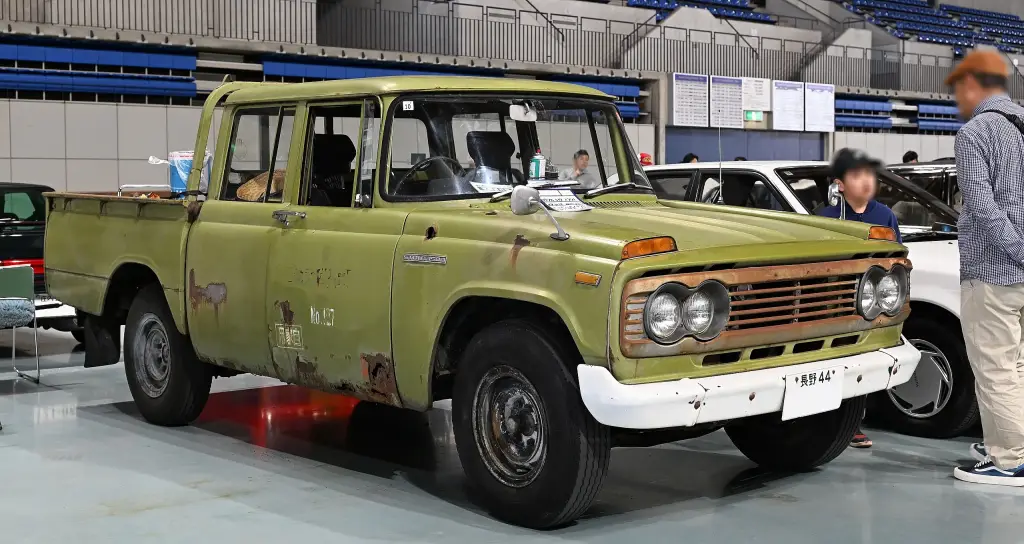
The Stout was completely redesigned in July 1960 and became the most familiar version. The RK45 pickup kept the 1,453 cc R engine and the 1.75-ton payload of the RK35. In October 1962 a 2-ton RK100 joined the range with the 1,897 cc 3R-B engine, introduced to answer the 2-ton Nissan Junior 1900, and the facelift brought twin headlights. Leaf springs, drum brakes and a ladder frame were retained, with pickup, double-cab, box van and five-door station wagon bodies; trucks were built at Honsha and vans by Arakawa Auto Body Industries. The Stout was Toyota’s launch model in South Africa in 1961, where it sold well until 1979; between 1961 and 1975, 17,500 Stouts were sold there, most of them assembled locally. The generation was also assembled in Thailand from February 1964, in Uruguay by Automotora Basso from 1963 to 1972 and in Peru, where 940 units were built between 1967 and 1971.
Lite Stout and exports
In September 1963 Toyota added the Lite Stout (RK40), a shorter and lighter model with the 1.5-litre R engine and independent coil-sprung front suspension for a more car-like ride. It was aimed at Nissan’s Datsun minitrucks but never sold well at home, and it was replaced by the Briska and Hilux after Toyota took over Hino Motors. A version with the 1.9-litre 3R engine was sold in North America as the Stout 1900 (RK41) between 1964 and 1967; only four were sold in its first year. The Lite Stout was also assembled in South Africa from 1965 as the Stallion, to distinguish it from the original solid-axle model. A 1964 facelift added 50 mm to the cabin and shortened the bed of the heavy-duty long-wheelbase Stout from 2,275 to 2,225 mm, while South African trucks kept a longer 2,310 mm bed.
Design and features
- Ladder frame and leaf springs: simple, strong mechanicals shared with Toyota’s commercial range.
- Shared cabin: the RK23 used the cabin of the Masterline coupé utility, derived from the Master.
- K-series codes: the chassis codes were shared with the Dyna and ToyoAce until the ToyoAce moved to Y-series codes in 1971.
- Lite Stout: independent coil front suspension gave the lighter model a more comfortable ride.
- South African production: the Stout was Toyota’s launch model there and was assembled locally from 1962.
Toyopet Stout versions
- RK23 (1956): the original 1.5-ton truck with the 49 PS R engine.
- RK30 (1958): facelifted version with a four-speed synchromesh gearbox and column shift.
- RK35 (1958): long-wheelbase model with a 1.75-ton payload.
- RK100 (1962): 2-ton version with the 1.9-litre 3R-B engine and twin headlights.
- RK40 Lite Stout (1963): lighter, shorter model with independent front suspension.
- RK41 Stout 1900 (1964): North American version with the 1.9-litre engine.
The Stout shared its K-series chassis codes with the Toyopet ToyoAce, and its cabin came from the Toyopet Masterline. More cars are in the Toyopet collection.
Sources
- Toyota Stout, English Wikipedia: first and second generations, exports, Lite Stout