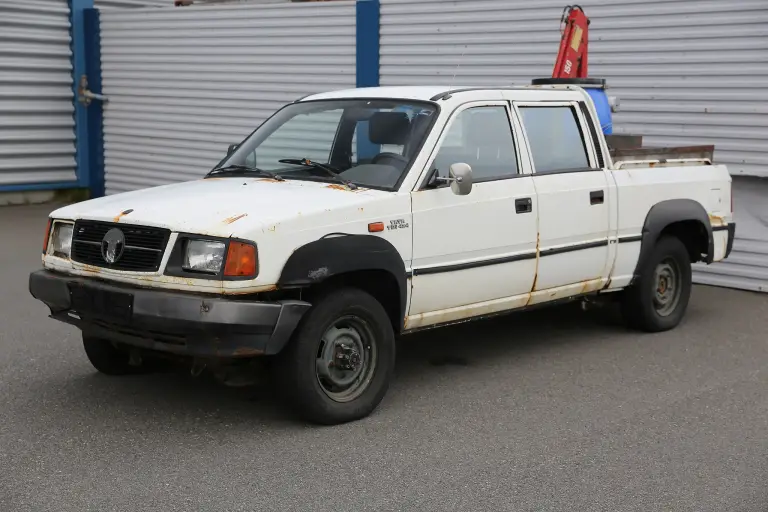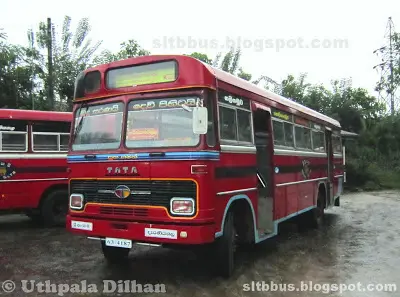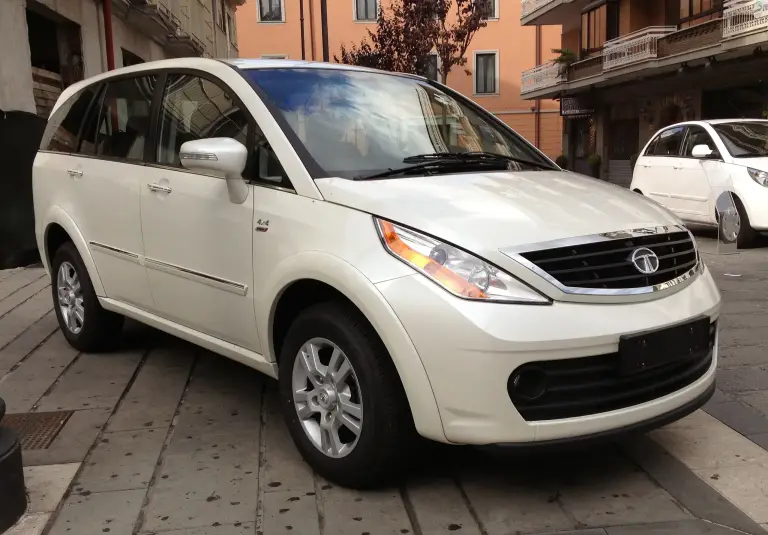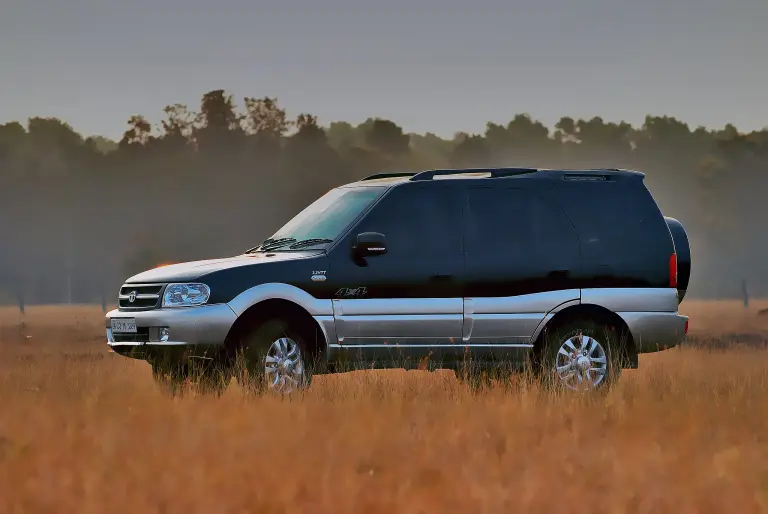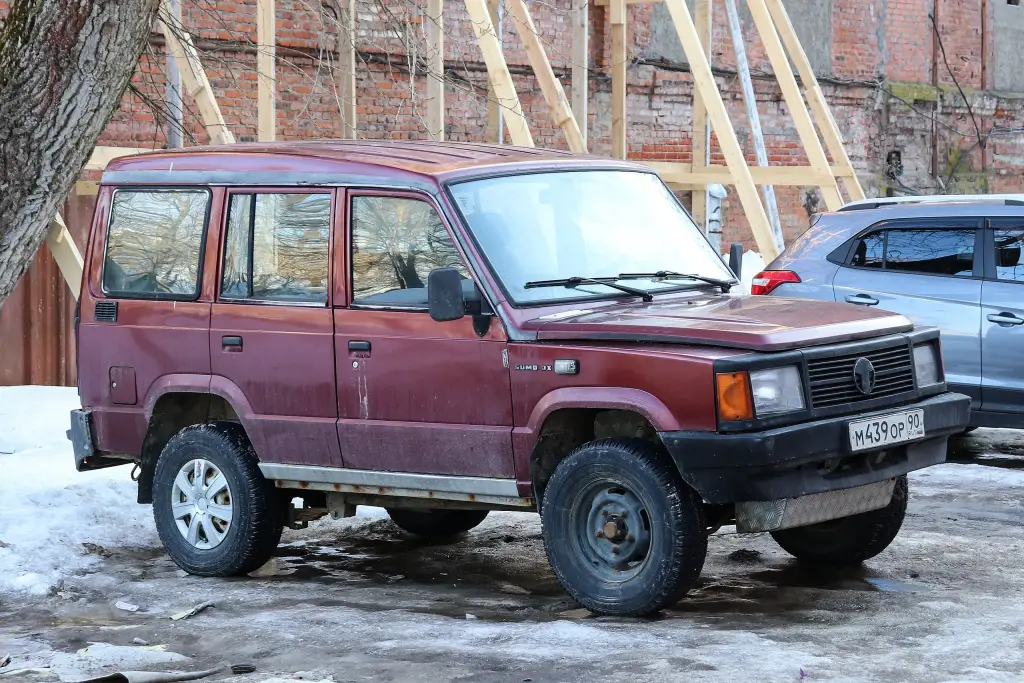
The Tata Sumo is a rear-wheel-drive SUV introduced in 1994 for military use and off-road transport, with ten seats and the ladder frame of the Telcoline. It soon became the best-selling utility vehicle in India, selling more than 100,000 units before 1997. Spacio, Victa and Gold versions followed, and the Sumo remained in production until 2019, when the Harrier replaced it.
Tata Sumo at a glance
| Maker | Tata Motors (Telco), India |
|---|---|
| Launched | 1994 |
| Produced until | April 2019 |
| Class | SUV, up to ten seats |
| Platform | Tata X2, body on frame |
| Length | 4.45 m |
| Engine | 2.0-litre Peugeot XD88 diesel, 63 hp; later 3.0-litre from the 407 |
| Gearbox | G76 five-speed manual |
| Drive | rear-wheel drive; four-wheel drive for fleets and the army |
| Name from | Sumant Moolgaokar, former managing director of Tata Motors |
| Built before 1997 | more than 100,000 |
History of the Tata Sumo
The Sumo was launched in 1994 as a ten-seater rear-wheel-drive SUV designed mainly for military use and off-road transport. The Indian market had stagnated, with the most modern vehicles in the class being Mahindra models derived from the Willys Jeep, and the Sumo quickly took a large part of it. Its name comes from the initials of Sumant Moolgaokar, a former managing director of Tata Motors who died in 1989.
Chassis and engines
The Sumo used the Tata X2 platform of the Telcoline, with a redesigned and strengthened rear axle for off-road work. Four-wheel drive was part-time, with electric selection up to 60 km/h, a low range, a self-locking rear differential and manually locking front hubs, later made automatic. The front suspension was double wishbone with a torsion bar; at the back there was a rigid axle of the Salisbury type on parabolic leaf springs with an anti-roll bar. The engine was the 2.0-litre Peugeot XD88 diesel that Tata built under licence: 1,948 cc, indirect injection with a pre-chamber, 63 hp and a G76 five-speed gearbox. In India the four-wheel-drive version went to fleets and the army, while private buyers had the rear-wheel-drive car; abroad both were sold.
Spacio and Victa
In 1996 the range gained a more refined Deluxe version, and in 1998 a turbocharged 2.0-litre Peugeot diesel of 92 hp to Euro 2 for export; the Sumo Deluxe Turbo with the 2.0 TDi came to India in 2001. The Sumo Spacio appeared in 2000 as the cheaper, no-frills version. It had a longer wheelbase, round headlamps instead of rectangular ones, its own transmission, rear axle and tyres for better economy, and a new 2,956 cc naturally aspirated direct-injection diesel of 65 hp known as the 4SP, taken from the 407. A soft-top Spacio ST was offered for rural markets, also with four-wheel drive, and a Spacio Gold Plus with a 3.0 turbo of 70 hp and 223 Nm followed in early 2007. The Sumo Victa of 7 July 2004 replaced the Spacio with new interiors, a tachometer, a multifunction instrument panel, power steering, electric windows on all four doors and keyless entry; the Victa Turbo DI of 2007 moved the spare wheel under the body and came in seven and nine-seat versions.
Gold and Grande
The Sumo Gold arrived in early 2012 as a facelift of the Victa with the 3.0 CR4 common-rail Dicor engine of 85 hp and 250 Nm, alongside the older 3.0 direct-injection turbo with 70 hp and 225 Nm. New fabrics, air-conditioning controls, instruments, fake wood trim, better brakes and softer shock absorbers came with it, and a last update in October 2013 added a CD and MP3 radio, dual-zone air conditioning and new colours. Production ended in April 2019 because of the new Indian safety standards, and the Harrier took its place. A separate model, the Sumo Grande of January 2008, used a 2.2 DiCor diesel of 120 bhp and completely different bodywork, and sat below the Safari.
Design and features
- Ten seats as standard: a utility vehicle for the army, rural transport and large families.
- Body-on-frame X2 platform: shared with the Telcoline, Sierra and Safari, with a strengthened rear axle.
- Part-time four-wheel drive: low range, a self-locking rear differential and locking front hubs.
- A name that lasted 25 years: Spacio, Victa and Gold versions kept the model on sale until 2019.
Tata Sumo versions
- Sumo (1994): the original ten-seater with the 2.0 Peugeot diesel.
- Sumo Deluxe (1996) and Deluxe Turbo (2001): more equipment and the 2.0 TDi engine.
- Sumo Spacio (2000–2011): cheaper version with round headlamps and the 3.0-litre 4SP diesel from the 407.
- Spacio ST: soft-top version for rural markets, also with four-wheel drive.
- Sumo Victa (2004–2011): new interior and equipment; Victa Turbo DI from 2007.
- Sumo Gold (2012–2019): 3.0 CR4 Dicor with 85 hp and 250 Nm.
- Sumo Grande (2008–2016): a separate model with the 2.2 DiCor engine below the Safari.
The Sumo used the chassis of the Telcoline and its engine came from the 407, while the larger Safari took its place at the top of the range. More Tata cars are in the Tata collection.
Sources
- Tata Sumo, English Wikipedia: launch, chassis, engines, Spacio, Victa, Gold, Grande
- Tata Sumo, Italian Wikipedia: dimensions, army use, updates
- Tata Sumo, German Wikipedia: production years, Victa and Grande