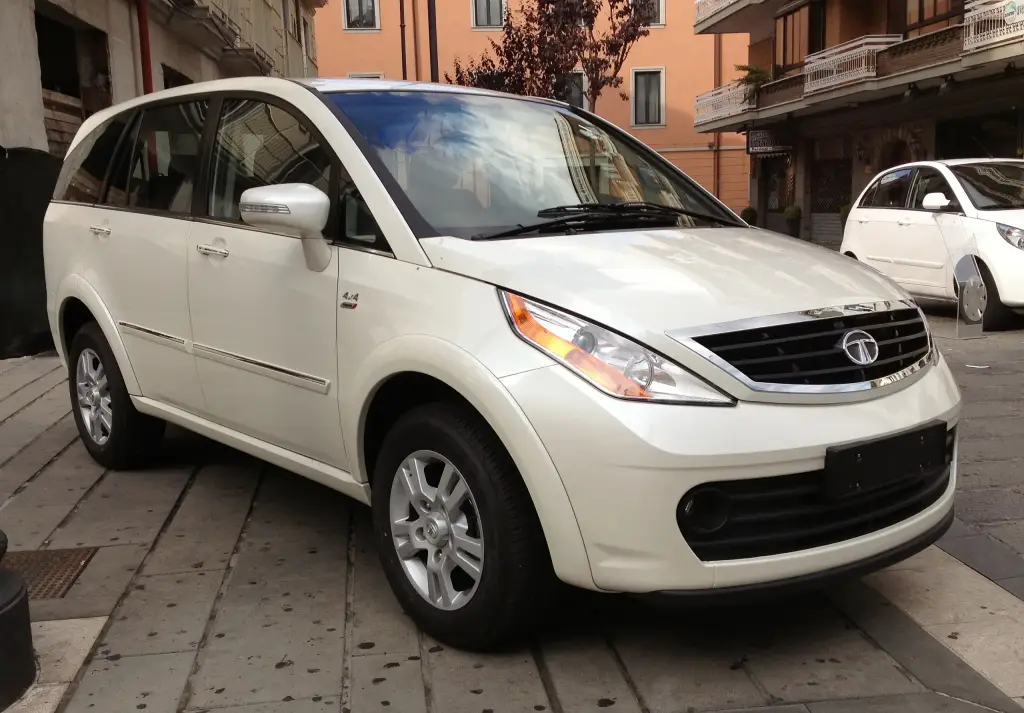
The Tata Aria is a crossover MPV that Tata Motors showed at the Delhi Auto Expo on 5 January 2010 and put on sale later that year. It was based on the Tata Xover concept and combined the body of a large MPV with the frame and running gear of an SUV, a 2.2-litre diesel and, optionally, four-wheel drive. It stayed in production until 2017 and was replaced by the Tata Hexa.
Tata Aria at a glance
| Maker | Tata Motors, India |
|---|---|
| Unveiled | 5 January 2010, Auto Expo, New Delhi |
| On sale | October 2010 |
| Class | crossover MPV |
| Seats | seven (2+2+3) or eight (2+3+3) |
| Engine | 2.2-litre Varicor four-cylinder common-rail diesel |
| Power | 150 PS at 4000 rpm |
| Torque | 320 Nm at 1700 rpm |
| Gearbox | six-speed manual |
| Drive | front-wheel drive or four-wheel drive |
| Production ended | 2017 |
| Successor | Tata Hexa |
History of the Tata Aria
The Aria was first shown on 5 January 2010 at the Auto Expo in Delhi, with prices starting at 10.4 lakh rupees. Tata based it on the Xover concept car exhibited at the Geneva Motor Show, and the company says the model was designed in collaboration with Jaguar Land Rover, its subsidiary, to meet European safety standards as well as Indian ones. Deliveries in India began in October 2010, and the car was also sold in Austria from April 2012.
A body-on-frame crossover
The Aria’s exterior is that of a crossover SUV, but underneath is a body-on-frame chassis of galvanised steel with a front engine, three rows of seats and a 300-litre boot whose third row folds flat. Five doors, a 2+2+3 or 2+3+3 layout and access to the third row either by folding a second-row seat or through the aisle between the two middle seats make it a practical family car rather than a pure off-roader.
Equipment and engines
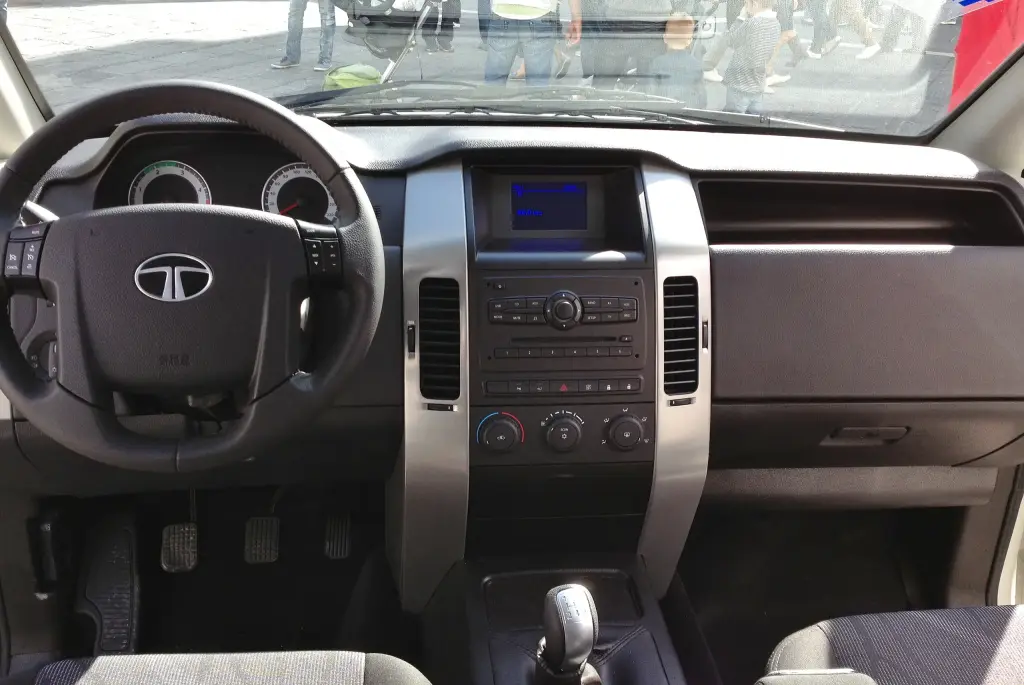
Tata’s own 2.2-litre Varicor four-cylinder common-rail diesel has a variable-geometry turbocharger and an intercooler, 150 PS at 4000 rpm and 320 Nm at 1700 rpm, and drives through a six-speed manual gearbox. Four-wheel-drive versions can switch between 4×4 and 4×2 on the move and have three slip differentials. For its class the Aria was unusual in offering projector xenon headlamps, power-folding mirrors, diamond-cut alloy wheels, a touchscreen navigation system, dual-zone automatic climate control, rain-sensing wipers, automatic headlamps and reverse sensors, together with six airbags, ABS with EBD, ESP with traction control, ventilated front discs and solid rear discs.
The name before the car
Tata had used the name Aria once before. In 2000 the company showed a two-seater coupé convertible called the Tata Aria at the Geneva show, built on the Indica platform and proposed with a 140 hp engine; a later Aria Coupé study was to use a 1.6- to 2.0-litre petrol engine and was styled in Italy. The production Aria of 2010 is a separate car.
Design and features
- Three rows, seven or eight seats: a 300-litre boot and a third row that folds flat.
- 2.2-litre Varicor diesel: 150 PS and 320 Nm through a six-speed manual gearbox.
- Optional four-wheel drive: on-the-fly switching between 4×4 and 4×2, with three slip differentials.
- Unusual equipment for its class: projector xenon lamps, dual-zone climate, touchscreen navigation, six airbags, ESP.
- Developed with Jaguar Land Rover: Tata aimed at European safety standards as well as the Indian market.
Tata Aria versions
- Aria 4×2: rear-wheel drive with the 2.2-litre Varicor diesel.
- Aria 4×4: part-time four-wheel drive with on-the-fly selection.
- Seven-seat 2+2+3: two individual middle-row seats with an aisle to the third row.
- Eight-seat 2+3+3: a middle bench that folds 2:3.
- Hexa: the 2017 successor with the Varicor 400 engine.
The Aria shared its engine family with the Safari and its platform thinking with the Sumo. More Tata cars are in the Tata collection.
Sources
- Tata Aria, English Wikipedia: launch, engines, equipment, chassis
- Tata Aria, German Wikipedia: Indian and Austrian sale dates, Xover concept
- Tata Aria, Russian Wikipedia: end of production, Hexa successor
- Tata Aria, Italian Wikipedia: seating and body description