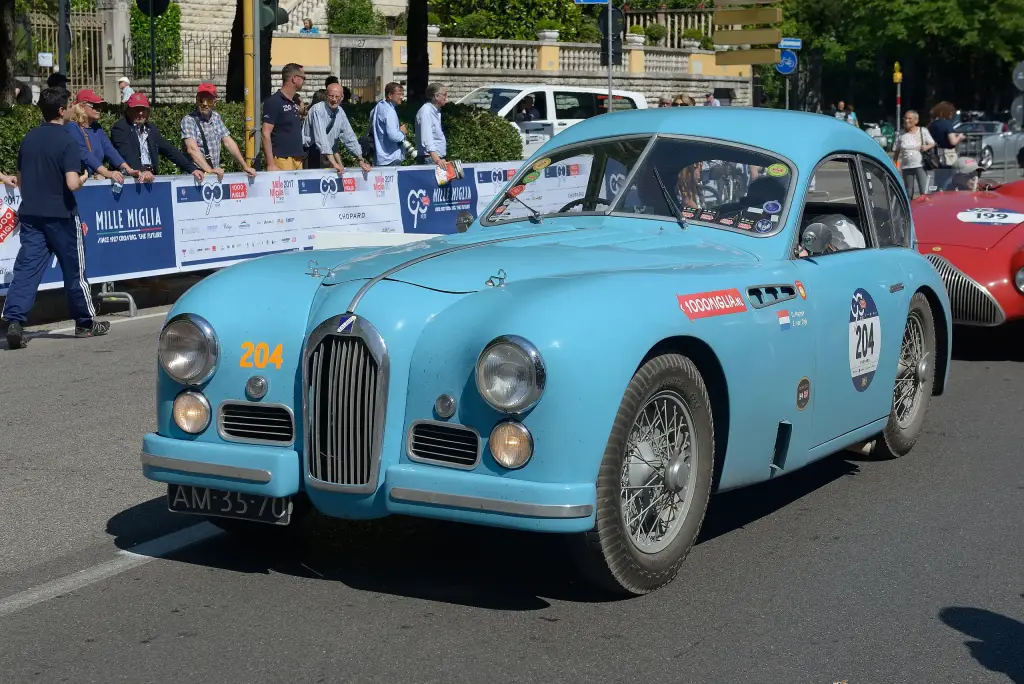
The Talbot-Lago T26 was a luxury car produced from 1947 to 1956 by the Anglo-French manufacturer Talbot-Lago. It was designed in 1942 in the middle of the war, presented to the press in June 1947, and became the basis of successful racing cars, including the T26C single-seater and the T26 GS that won at Le Mans.
Talbot-Lago T26 at a glance
| Maker | Talbot-Lago, Suresnes, France |
|---|---|
| Production | 1947–1956 |
| Designed | 1942, by Antonio Lago and Carlo Marchetti |
| Engine | 4,482 cc six-cylinder |
| Road power | 165 hp with three carburettors |
| Racing power | up to 240–260 hp with twin camshafts |
| Gearbox | four-speed manual with preselector |
| Brakes | drum brakes |
| Top speed | 180–210 km/h depending on version |
| Bodies | coachbuilt by Figoni et Falaschi, Saoutchik and others |
| Built | about 500 in nine years |
| Racing | Le Mans 24 Hours win in 1950 |
There is no English page for the T26: the article uses the French page and the English Talbot-Lago article.
History of the Talbot-Lago T26
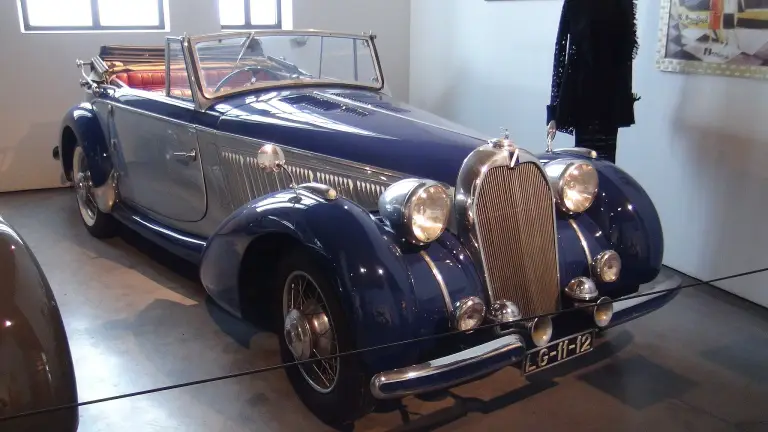
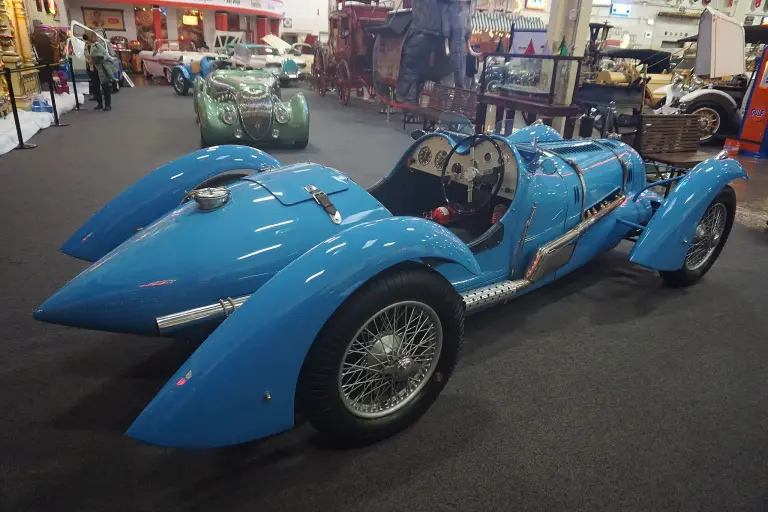
The T26 was among the first Talbot-Lagos built after the Second World War, its design worked out in 1942 while the conflict was still on. It came from Antonio Lago’s new collaboration with the Italian draughtsman Carlo Marchetti, and was presented to the press in June 1947. As with other Talbot-Lago models, the body was ordered by the buyer from prominent coachbuilders, especially Figoni et Falaschi and Saoutchik. The T26 was offered in several versions, all decidedly sporting in character, and some cars received competition “barchetta” bodies in single- and two-seat form.
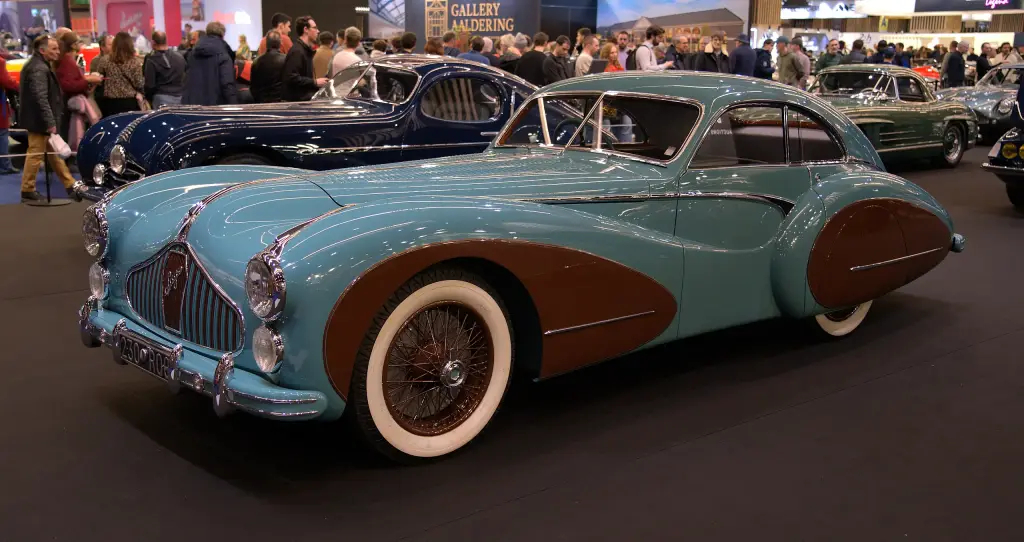
The engine was a six-cylinder, a logical extension of the six-cylinder units used just before the war, developed jointly by Lago and Marchetti. Its capacity was 4,482 cc, it was fed by three carburettors and in the first versions its maximum power was limited to 165 hp. Intended also for competition, the engine was not competitive enough in that form, so those early cars were reserved for road production in more comfortable T26 specification. To improve their racing ability a twin side camshaft was adopted: engines so modified developed up to 240 hp and, with later refinements, 260 hp. From this evolution came the T26C, a single-seater racing car able to take on Maserati and Ferrari; it won several Grands Prix and also the 24 Hours of Le Mans in 1950, with L. Rosier and J.-L. Rosier driving a T26 GS. The 240 hp sporting engine also powered the T26 GS (Grand Sport), while some cars used an intermediate engine of about 200 hp.
T26s were rear-wheel drive with a four-speed manual gearbox operated through a preselector, and they used drum brakes. Top speed was between 180 and 210 km/h depending on the version and engine. The prohibitive price limited sales: in nine years production was restricted to some 500 units. The English Wikipedia describes the Talbot Lago Record T26 as a large car with a fiscal rating of 26 CV, a claimed 170 hp, rear-wheel drive through a four-speed manual or an optional Wilson preselector, and a claimed top speed of 170 km/h (105 mph).
Design and features
- Post-war six: a 4,482 cc engine designed by Lago and Marchetti from 1942.
- Coachbuilt bodies: Figoni et Falaschi, Saoutchik and other houses.
- Racing pedigree: the T26C and T26 GS won Grands Prix and Le Mans.
- Preselector gearbox: a four-speed transmission with preselection.
- Rare and expensive: about 500 cars in nine years.
Talbot-Lago T26 versions
- T26 Record: the comfortable road car with 165–170 hp.
- T26 GS (Grand Sport): the sporting version with up to 240 hp.
- T26C: the single-seater racing car with a twin-camshaft engine.
- Barchetta: open competition bodies in single- and two-seat form.
The T26 followed the pre-war Talbot Baby and Talbot T120, and the marque itself is covered in the Talbot-Lago article. More cars are in the Talbot collection.
Sources
- Talbot-Lago T26, French Wikipedia: design, engines, racing, production
- Talbot-Lago, English Wikipedia: T26 Record specification, company background