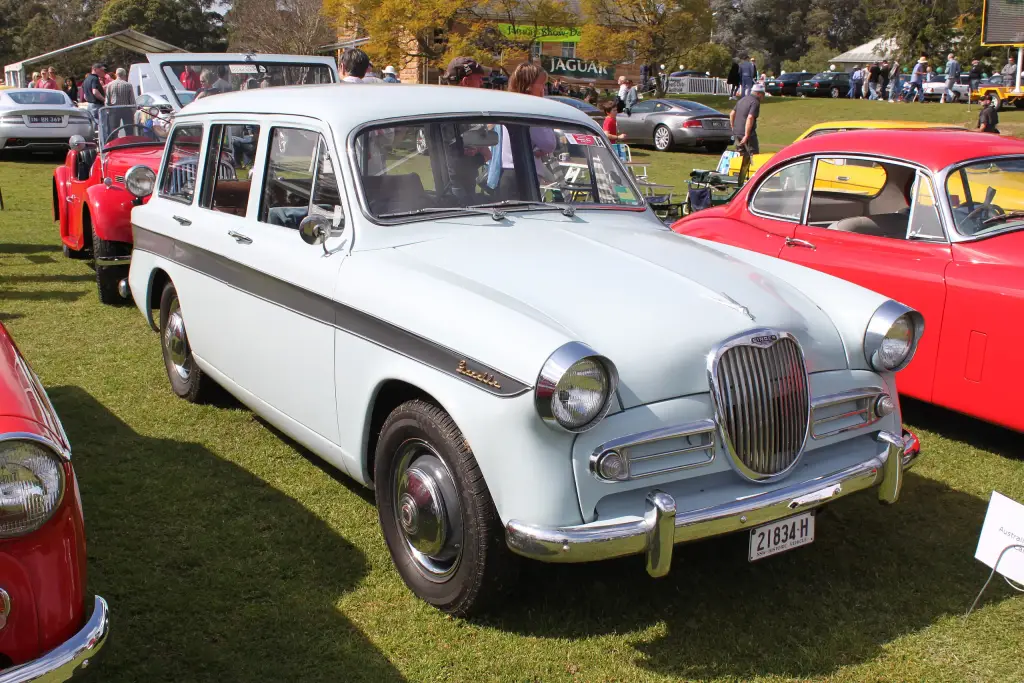
The Singer Gazelle was the first Singer produced after the Rootes Group took over the company in 1956. Essentially a Hillman Minx with a restyled Singer nose and the Singer overhead-camshaft engine, it spanned six series on the “Audax” body before a final Arrow-based Gazelle VII ended Singer production in 1970.
Singer Gazelle at a glance
| Maker | Singer Motors, under Rootes Group |
|---|---|
| Production | 1956–1970 |
| Based on | Hillman Minx / Rootes Audax |
| Body styles | saloon, convertible, estate from Series II |
| Engine, Series I | 1,494 cc Singer overhead cam, 49 hp |
| Engine, IIA on | Hillman pushrod, 56 hp |
| Engine, IIIC | 1,592 cc, 53 hp |
| Engine, VI | 1,725 cc, 65 bhp |
| Top speed, 1957 overdrive car | 78 mph (125.5 km/h) |
| Top speed, 1959 convertible | 83.4 mph (134.2 km/h) |
| Suspension | independent front, live axle rear |
| Last built | 1970, the last Singer |
based on one source
History of the Singer Gazelle
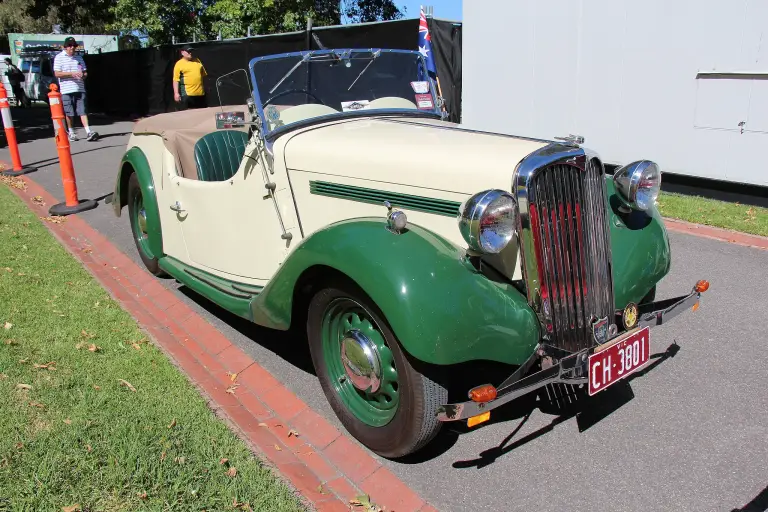
The Gazelle was announced in late September 1956 and was the first Singer produced after the Rootes takeover. It was a version of the mainstream Hillman Minx that kept the Singer overhead-camshaft engine, with a restyled nose built around a traditional Singer grille as the main external difference. The body, known as the “Audax” and developed with input from Raymond Loewy’s design organisation, was offered as a saloon and a convertible; the Series II of autumn 1957 added an estate car, optional overdrive and a larger fuel tank, along with horizontal chrome vents and sidelights either side of the oval grille.
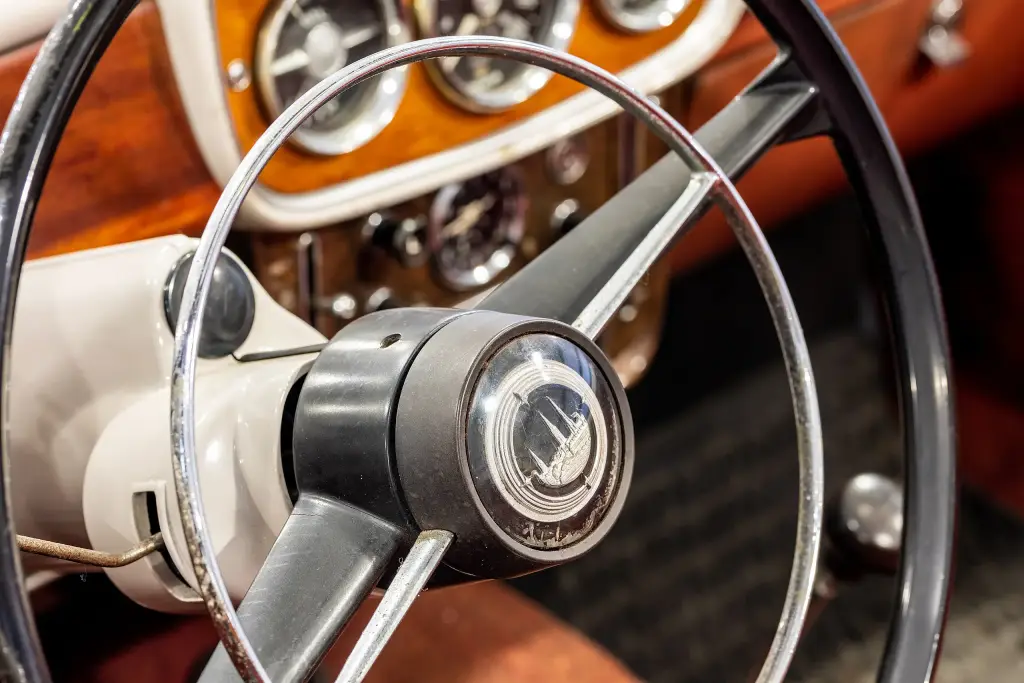
The suspension was independent at the front on coil springs, with a live axle and half-elliptic leaf springs at the rear, and steering used a worm-and-nut system. A bench front seat was standard, with individual seats optional, and the handbrake was mounted between the seat and the door to suit it. The convertible had a two-position hood that could be lowered fully or rolled back to just behind the front seats in the “coupé de ville” position, extra cross bracing under the floor compensating for the loss of roof rigidity. A 1957 overdrive car tested by The Motor reached 78 mph and 0–60 mph in 24.8 seconds at 33.5 mpg, costing £1,016 including tax.
The Gazelle II became the IIA in 1958, when the Hillman pushrod overhead-valve engine replaced the Singer overhead-cam unit, raising output from 49 to 56 bhp. Rootes policy of small annual upgrades produced the III in September 1958 with better seats and a folding central armrest, two-tone paint becoming available; the IIIA of September 1959 gained small tail fins, a larger windscreen and twin Solex carburettors lifting output to 60 bhp, with a floor gearchange and Smith’s Easidrive automatic as options. The IIIB of September 1960 went back to a single carburettor for better economy and a new hypoid-bevel rear axle, and the IIIC of July 1961 used a larger 1,592 cc engine of 53 bhp; the convertible and estate were dropped in 1962.
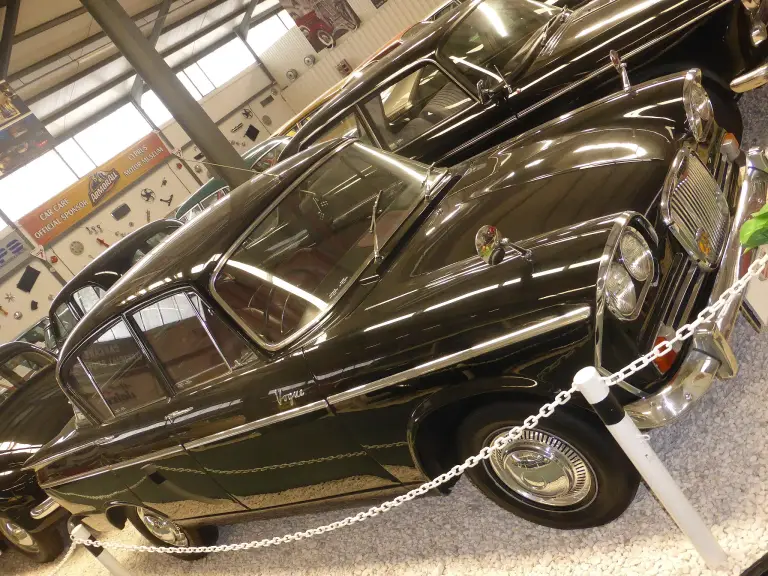
The Gazelle IV designation was never used, because in July 1961 Rootes released the new Singer Vogue on the body intended for it. The Gazelle V of August 1963 followed the updated Minx with longer rear doors, no wrap-around rear window, front disc brakes and, from 1964, synchromesh on first gear. The Gazelle VI of 1965 was the last Audax car, with an all-new five-bearing 1,725 cc engine of 65 bhp later reduced to 59 bhp and a rectangular grille no longer fixed to the opening bonnet. The Gazelle VII of 1967 moved to the Rootes Arrow body as a four-door saloon only, at first automatic and 1,725 cc, later with a 1,496 cc manual; production ended in 1970 with the last Singer ever built.
Design and features
- Singer identity under Rootes: a Minx with a traditional Singer grille and, at first, Singer’s own engine.
- Audax body: saloon, convertible and estate developed with Loewy’s organisation.
- Annual upgrades: six series in fourteen years, each with detail changes and new designations.
- Coupé de ville hood: the convertible could be lowered fully or rolled back behind the front seats.
Singer Gazelle versions
- Gazelle I (1956–1957): saloon and convertible with Singer overhead-cam engine.
- Gazelle II (1957–1958): estate added, overdrive and larger tank optional.
- Gazelle IIA (1958): Hillman pushrod engine, 56 bhp.
- Gazelle III and IIIA (1958–1960): better trim, tail fins, twin carburettors.
- Gazelle IIIB and IIIC (1960–1962): single carburettor, then 1,592 cc engine.
- Gazelle V and VI (1963–1967): facelifted Audax, disc brakes, 1,725 cc engine.
- Gazelle VII (1967–1970): Arrow-based four-door saloon, the last Singer.
The Gazelle sat below the Singer Vogue, and its last series shared the Rootes Arrow body with it. More cars are in the Singer collection.
Video: 1958 SINGER GAZELLE
Video on YouTube.
Sources
- Singer Gazelle, English Wikipedia: series I to VII, engines, bodies, road tests