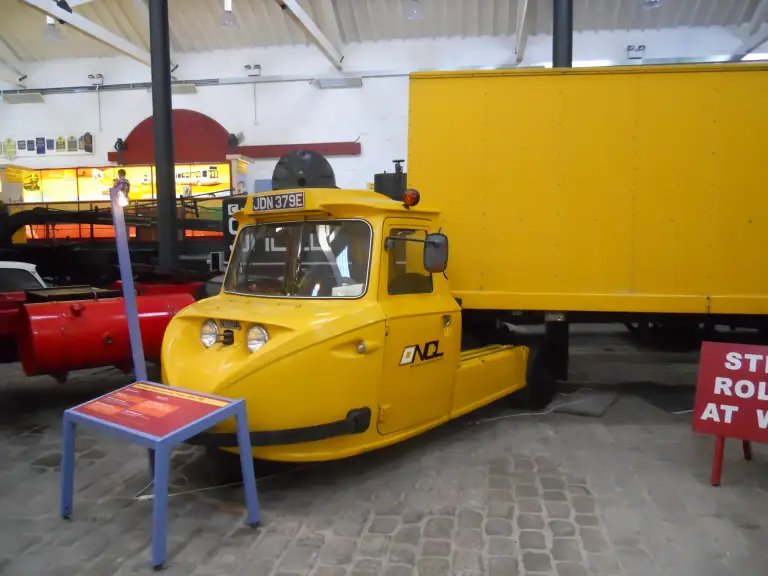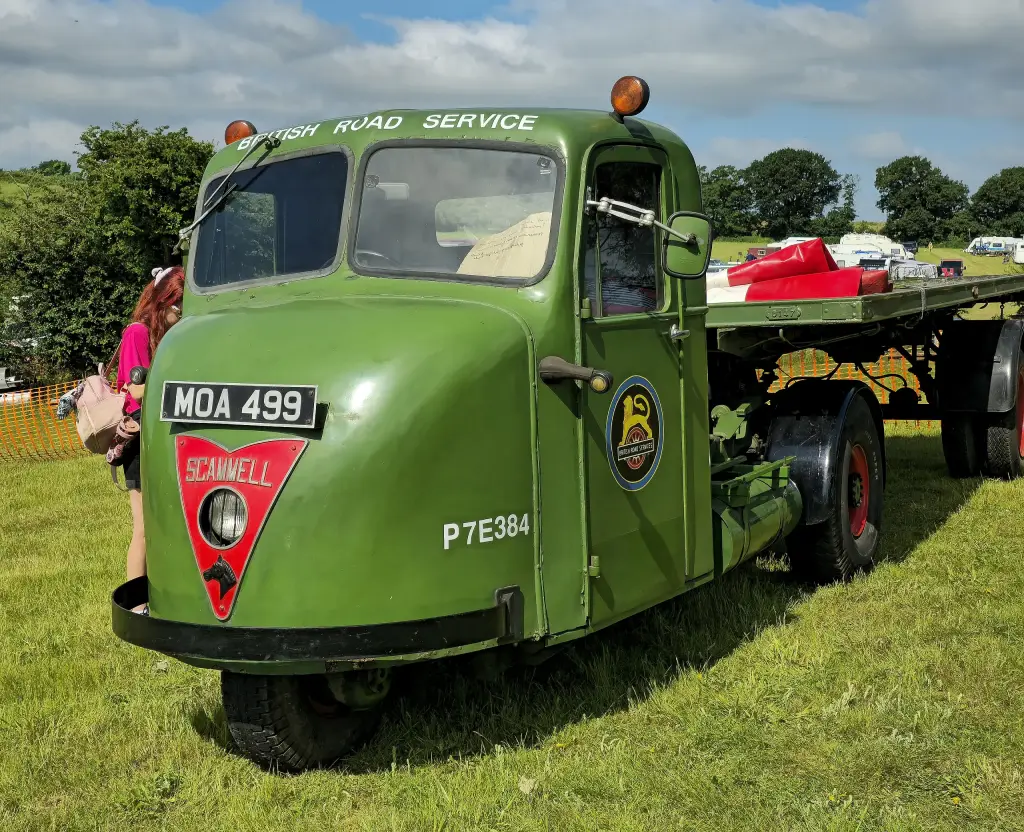
The Scammell Scarab was the three-wheeled tractor unit that Scammell built from 1948 to 1967 as the successor to its Mechanical Horse. With a 360-degree steering front wheel and an automatic trailer coupling, it was a familiar sight on British Railways parcels work and in town deliveries.
Scammell Scarab at a glance
| Maker | Scammell Lorries Ltd, Watford |
|---|---|
| Production | 1948–1967 |
| Type | three-wheeled tractor unit |
| Payloads | 3 and 6 tons |
| Petrol engine | Scammell 2,090 cc side-valve, both payloads |
| Diesel engines | Perkins 4.99 (3-ton) and 4.203 (6-ton) |
| Steering | single front wheel, 360 degrees |
| Coupling | automatic, as on the Mechanical Horse |
| Predecessor | Scammell Mechanical Horse of 1934 |
| Surviving examples | about 60 known |
History of the Scammell Scarab
From horse to Scarab
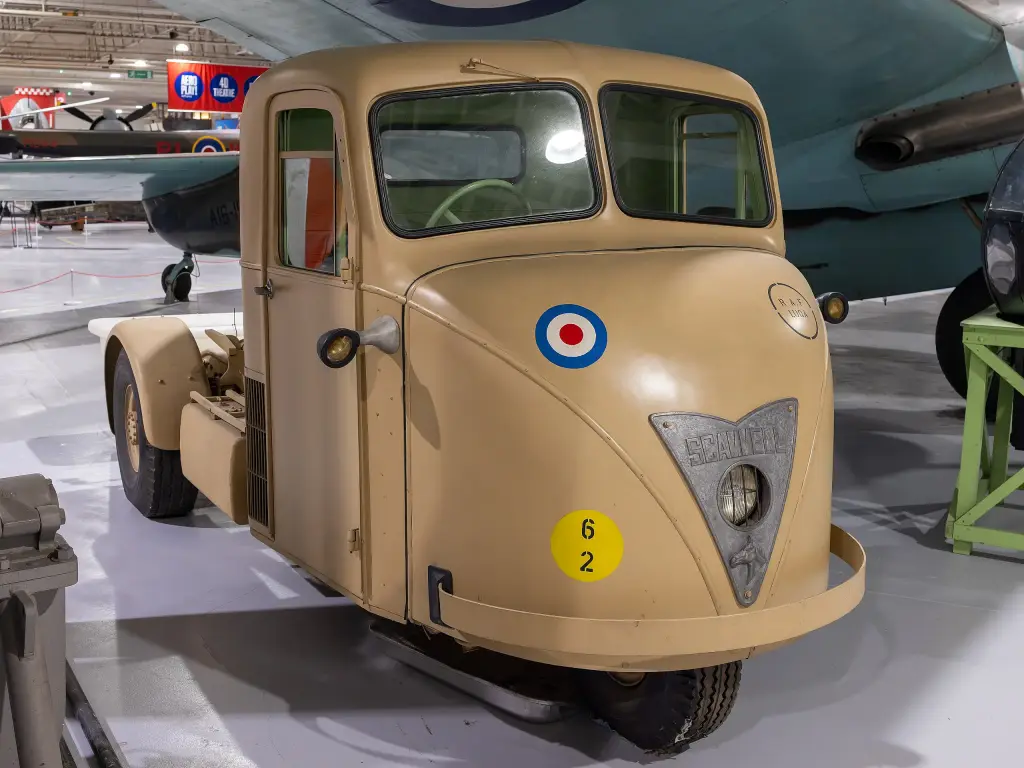
In the late 1920s the railway companies were looking for a vehicle for town parcels traffic, which was still mostly horse-drawn. The London Midland & Scottish Railway announced the Karrier Cob in 1930; the London & North Eastern Railway went to Napier, which produced some ideas but did not want to develop them and sold the project to Scammell Lorries of Watford. Scammell’s designer, O. D. North, refined the concept of a three-wheeled tractor unit that coupled and uncoupled trailers automatically, and in 1934 the Mechanical Horse went into production. In the late 1940s the tractor section was redesigned as the Scarab, which kept the successful automatic coupling.
Engineering
The Scarab used the Scammell 2,090 cc side-valve petrol engine in both the three- and six-ton versions, and a diesel version with a Perkins engine was also offered, the 4.99 for the three-tonner and the 4.203 for the six-tonner. The chassis frame was cranked downwards to lower the centre of gravity, and the engine, gearbox and rear axle were built as one unit, fitted low in the chassis behind the cab; the radiator stood in the back wall of the cab and drew cooling air through a duct behind the right-hand cab door. Because the engine sat lower and more centrally than in the Mechanical Horse, the Scarab was much more stable. The rounded all-steel cab had doors as standard and used roof and windscreen panels pressed on tools obtained from Bedford, and in place of the Mechanical Horse’s square wooden cab it made the little lorry considerably more comfortable for its driver.
Railways, services and the Scarab Four
The railways remained the primary customer, and the Scarab was also popular with companies delivering in built-up areas, while the Ministry of Defence used Scarabs and trailers for internal transport on large bases. Production ended in 1967 and the Townsman, with a fibreglass cab, took over the three-ton role. Scammell built about 30,000 Mechanical Horses of all types, of which around 30 original Mechanical Horses, 60 Scarabs and 30 Townsmen are known to survive. A four-wheel version, the Scarab Four, was built on the Standard Atlas van chassis, later the Leyland 20; it was not a great success, only a handful were sold in Britain and 60 were exported to South Africa and Macau, and no example is known to survive in the UK. The Scarab also reached a wider public as the model for Madge in Thomas & Friends, and the restoration of one to working order was filmed for the third series of Salvage Squad, the vehicle being handed back in British Railways carmine and cream livery in November 2003.
Design and features
- 360-degree steering: the single front wheel and the fully rotating coupling let the outfit turn in less space than its own length.
- Automatic coupling: the driver could pick up a trailer without leaving the cab.
- Low centre of gravity: the cranked frame and low-mounted power unit made it more stable than the Mechanical Horse.
- Steel cab: rounded bodywork with doors as standard, pressed from Bedford tooling.
Scammell Scarab versions
- Three-ton Scarab: 2,090 cc petrol or Perkins 4.99 diesel.
- Six-ton Scarab: the larger payload with the Perkins 4.203 diesel option.
- Scarab Four: a four-wheel version on the Standard Atlas chassis, exported to South Africa and Macau.
- Preserved Scarabs: about 60 known, in museums and heritage railways.
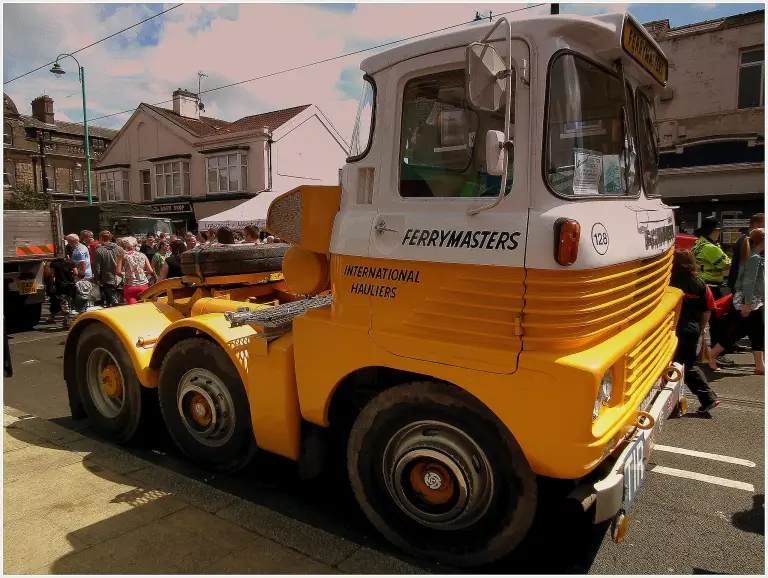
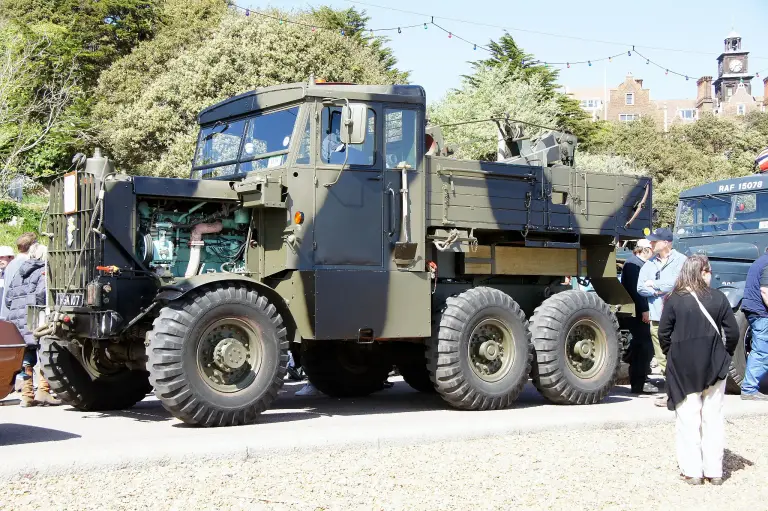
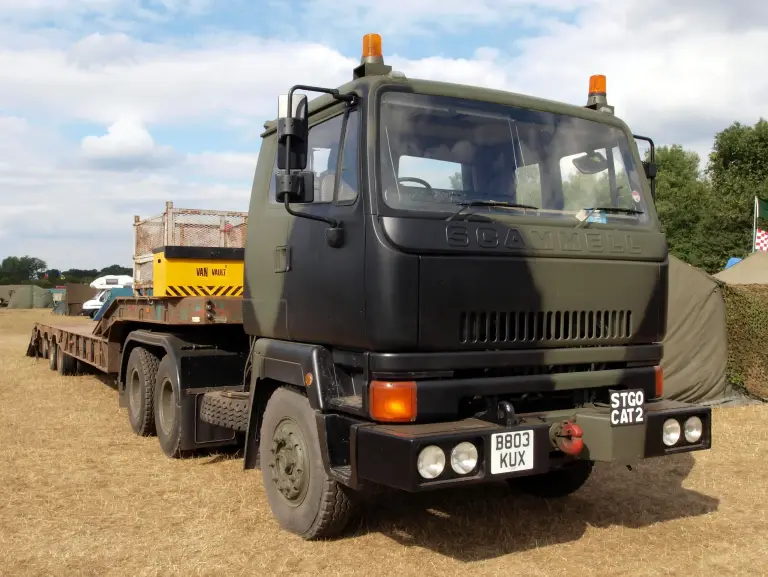
The Scarab replaced Scammell’s Mechanical Horse and was itself replaced by the Townsman with its fibreglass cab. Its bigger stablemates were the Highwayman and Routeman. More lorries are in the Scammell collection.
Sources
- Scammell Scarab, English Wikipedia: development, engineering, production, preservation, Scarab Four
- Mechanical Horse, German Wikipedia: background of the three-wheeled tractor and its coupling
- Scammell Mechanical Horse, English Wikipedia: predecessor and production totals