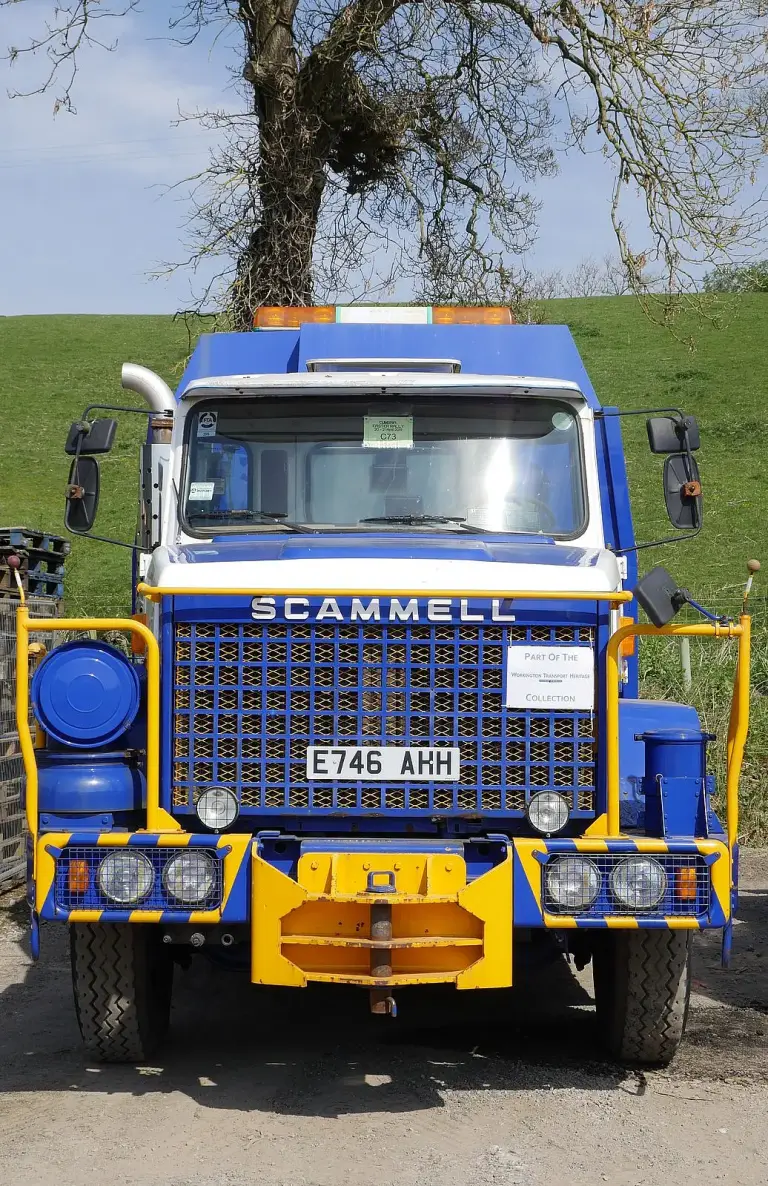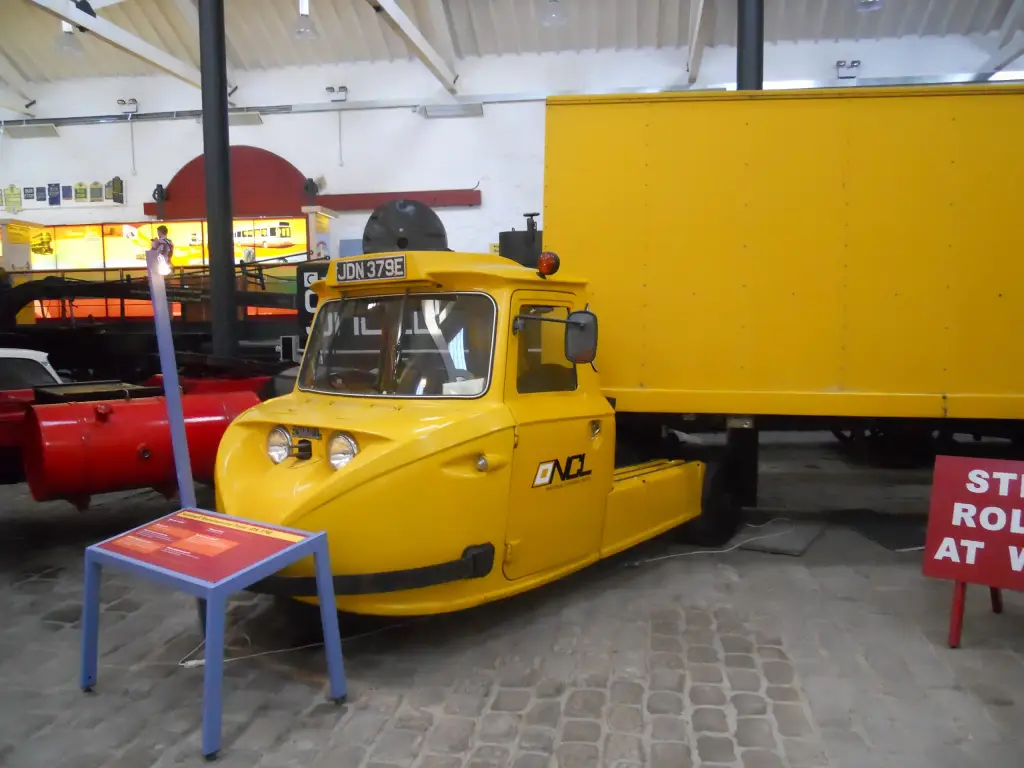
The Scammell Townsman was the last of the Watford works’ three-wheeled tractor units. Introduced in 1967 to replace the three-ton Scarab, it kept the automatic coupling and the 360-degree steering wheel but wrapped them in a futuristic fibreglass cab with vacuum-assisted brakes. Production ended in 1968.
Scammell Townsman at a glance
| Maker | Scammell Lorries Ltd, Watford |
|---|---|
| Production | 1967–1968 |
| Type | three-wheeled tractor unit |
| Payload | 3 tons |
| Predecessor | Scammell Scarab |
| Cab | glass-reinforced plastic by Giovanni Michelotti |
| Coupling | Mechanical Horse automatic coupling, vacuum release |
| Brakes | vacuum-assisted hydraulic, rear axle only |
| Later engine | Leyland OE160 |
| Top speed | 50 mph |
| Surviving examples | about 30 known |
History of the Scammell Townsman
The successor to the three-ton Scarab
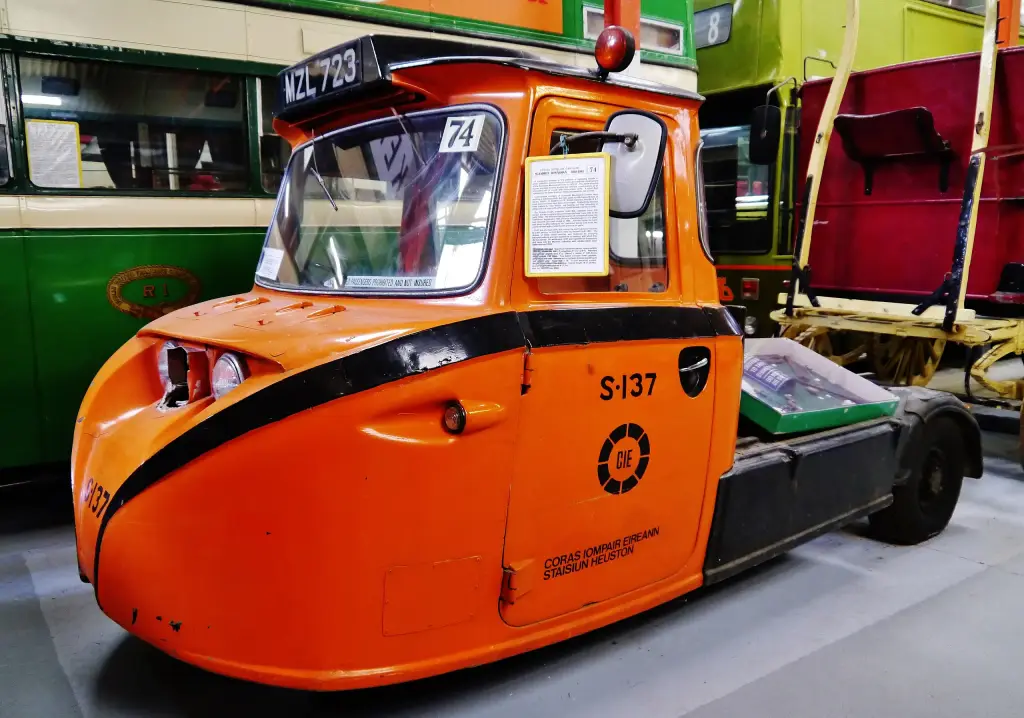
The Townsman replaced the three-ton Scarab; there was no provision for a six-ton model, because more conventional vehicles took on the heavier role. In its basic design it closely followed the Scarab. The frame was of welded construction, with integral coupling ramps and the Scammell Mechanical Horse automatic coupling, while a vacuum-operated release mechanism replaced the hand lever used on the Scarab.
A fibreglass cab and new running gear
The futuristic lines of the fibreglass cab were a novelty, and the use of glass-reinforced plastic allowed a more complex shape than pressed steel. Scammell already had experience of GRP cabs on heavy lorries such as the Routeman, Trunker and Handyman, whose cabs were designed by Giovanni Michelotti, and the Townsman’s cab belongs to the same school. The new cab brought vacuum-assisted hydraulic brakes, a heater-demister, two rear-view mirrors, interior sun visors, totally enclosed oil-immersed coil-spring front suspension and dual-rate mounting of the semi-elliptic leaf springs at the rear. Later a larger engine was fitted, the Leyland OE160, an in-house product now that Standard-Triumph and Scammell were both part of the Leyland Group; the same engine was used in the Leyland Twenty and Leyland 90 commercials built under Leyland badges by Standard-Triumph.
The end of the three-wheelers
The Townsman had better driver controls and a faster road speed of 50 mph, but it still lacked brakes on all wheels: only the rear axle had them. Legislation in the late 1960s on the braking of goods vehicles meant that the working days of these innovative Scammells were coming to an end, and production finished in 1968. About 30,000 Mechanical Horses of all types were built over the 35 years of production, and around 30 Townsmen are known to survive.
Design and features
- Fibreglass cab: a complex, futuristic shape that pressed steel could not have produced cheaply.
- Vacuum-assisted brakes: better than the Scarab’s, though still only on the rear axle.
- Better controls: heater-demister, two mirrors and sun visors made the driver’s job easier.
- 50 mph: a much faster road speed than the Mechanical Horse’s 20 mph.
Scammell Townsman versions
- Early Townsman: the 1967 lorry with its original engine.
- Later Townsman: with the Leyland OE160 fitted after the Leyland Group consolidation.
- Preserved Townsmen: about 30 known, including a CIE tractor at Howth.
The Townsman replaced the Scarab and used the cab technology of the Routeman and Handyman. More lorries are in the Scammell collection.
Sources
- Scammell Mechanical Horse, English Wikipedia: Townsman design, equipment, engine, braking and production
- Scammell Scarab, English Wikipedia: Townsman as Scarab replacement, Michelotti cabs, preservation figures
- Scammell, English Wikipedia: GRP cabs and Leyland group background