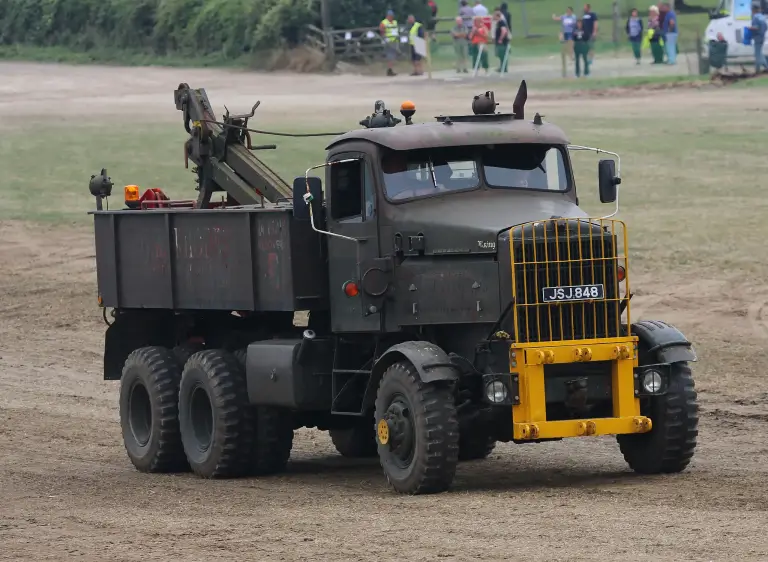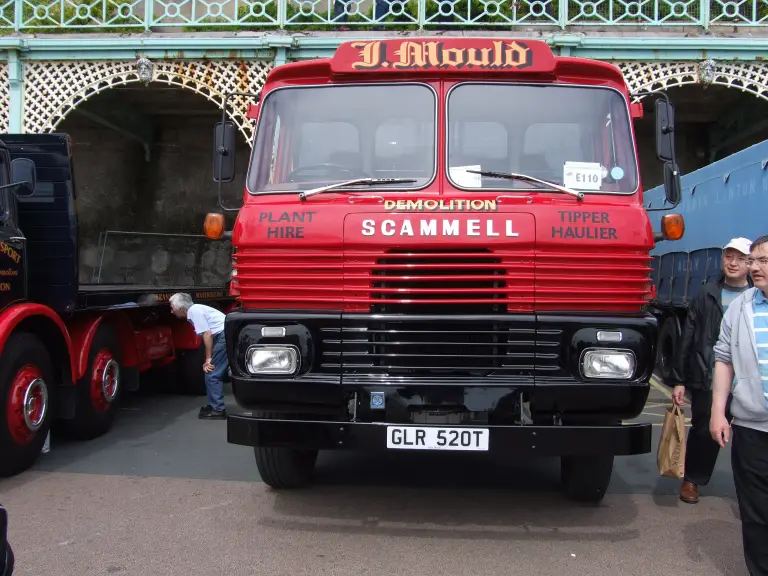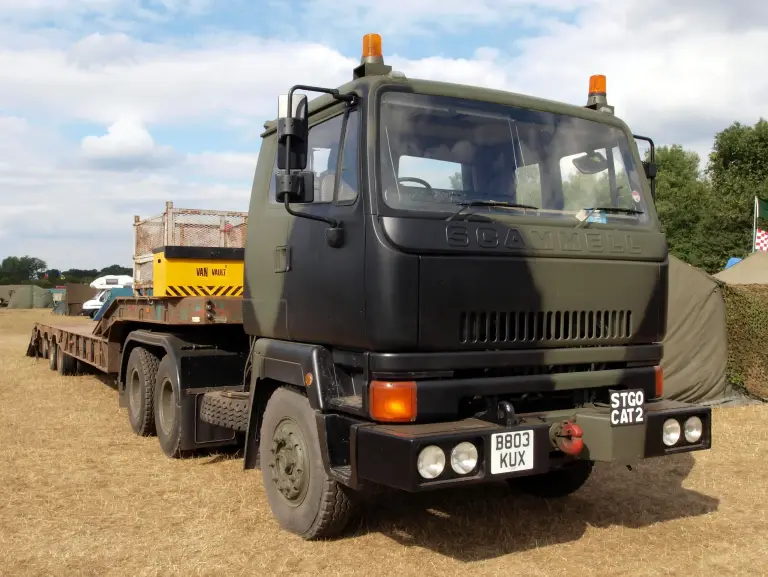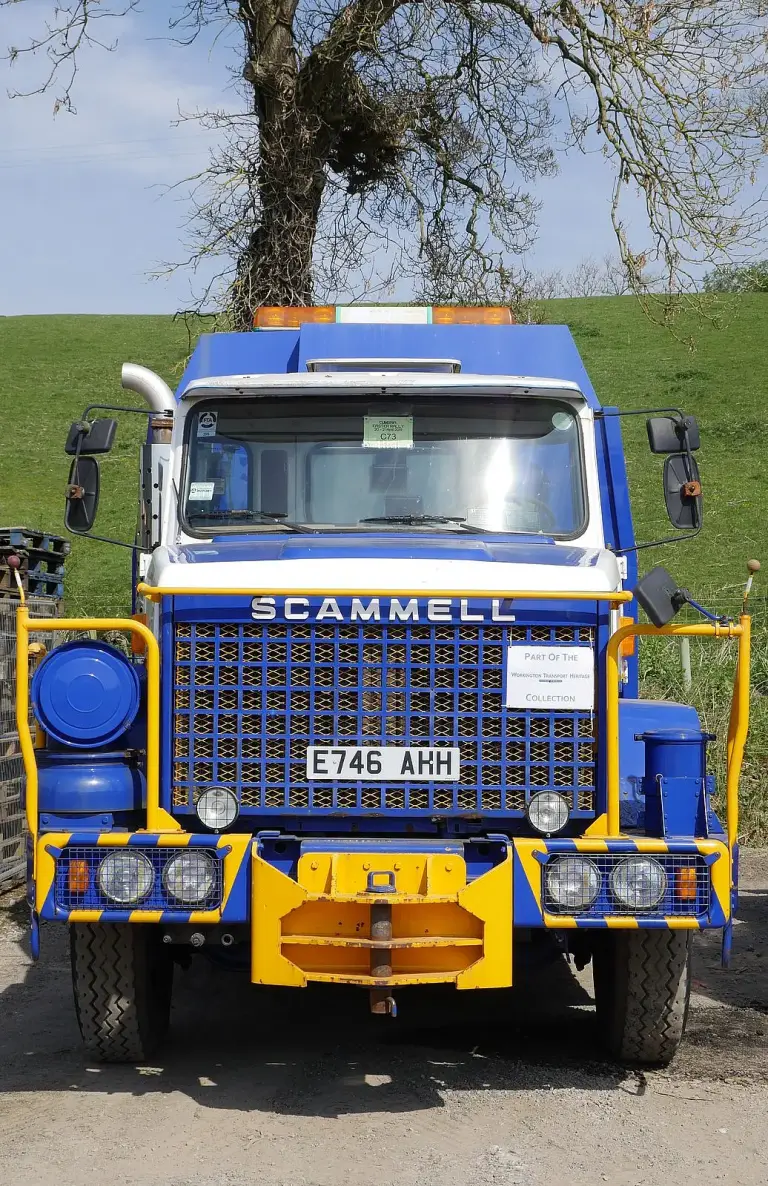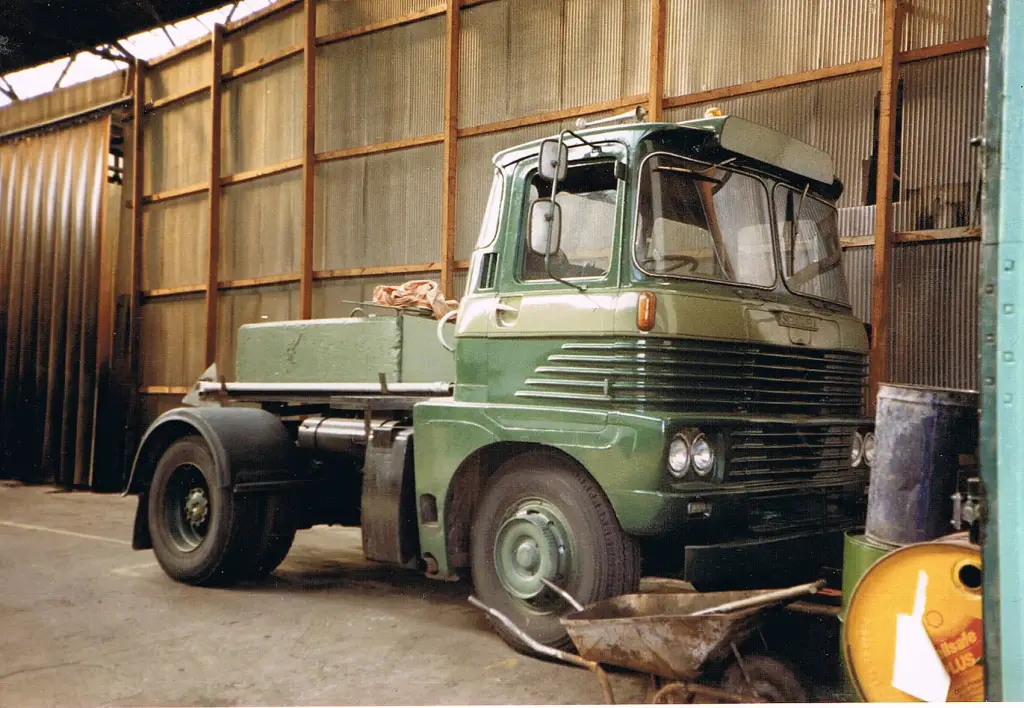
The Scammell Handyman was the forward-control 4×2 of the range that Scammell built after joining Leyland Motors in 1955. Coupled to Scammell trailers it was rated at up to 50 tonnes, and in its later form it carried a glass-fibre cab designed by Giovanni Michelotti.
Scammell Handyman at a glance
| Maker | Scammell Lorries Ltd, Watford |
|---|---|
| Type | forward-control 4×2 tractor unit |
| Introduced | with the post-1955 Leyland-era range |
| Gross train weight | up to 50 tonnes |
| Trailers | Scammell, built at the Moor Park works |
| Cab, early cars | fibreglass cab designed by Scammell |
| Cab, Marks 2 and 3 | fibreglass cab by Giovanni Michelotti |
| Gearboxes | Scammell “gate” type early, AEC and David Brown later |
| Engines | Leyland 680, Gardner 150, Rolls-Royce 220 |
| Derivative | Trunker, a three-axle version |
There is no separate Wikipedia article on the Handyman; this page uses the company articles on Scammell.
History of the Scammell Handyman
A forward-control tractor
After the Second World War, foreign competition and the rationalisation of British manufacturers brought Scammell into Leyland Motors in 1955. Membership of the group gave the Watford works access to ready-made components and allowed it to replace its “lightweight” range with three new models: the Highwayman, a bonneted 4×2; the Routeman, a forward-control eight-wheeler; and the Handyman, a forward-control 4×2. Both tractor units could be set up for trains of up to 50 tonnes and, with the full range of Scammell trailers made at the Moor Park works, they let the company keep selling into specialist and military markets.
Cabs by Michelotti
In the 1960s Scammell commissioned Giovanni Michelotti to design its cabs, which produced a series of glass-reinforced plastic designs; the first to be redesigned was the Routeman, followed by the Handyman. The Handyman began with a fibreglass cab designed in-house by Scammell, and the Mark 2 and Mark 3 versions received the new Michelotti glass-fibre cab, as used on the second and third versions of the Routeman rigid.
Mechanical detail and the Trunker
The early Handymans had a Scammell “gate” gearbox, but later versions were fitted with AEC and David Brown gearboxes. Engines were the Leyland 680, the Gardner 150 and the Rolls-Royce 220. The design was also stretched into a three-axle tractor unit, the Trunker, which was derived from the Handyman Mark III.
Design and features
- Forward control: the cab sat over the engine, unlike the bonneted Highwayman.
- 50-tonne trains: with Scammell trailers the Handyman could haul up to 50 tonnes.
- Michelotti cab: glass-reinforced plastic bodywork on the Mark 2 and Mark 3.
- Engine choice: Leyland 680, Gardner 150 or Rolls-Royce 220.
Scammell Handyman versions
- Early Handyman: Scammell-designed fibreglass cab and Scammell gate gearbox.
- Handyman Mark 2: Michelotti glass-fibre cab and later AEC or David Brown gearbox.
- Handyman Mark 3: the final version, also the basis of the Trunker.
- Trunker: three-axle tractor unit derived from the Handyman Mark III.
The Handyman was the forward-control stablemate of the bonneted Highwayman and of the eight-wheel Routeman. Scammell tractor units in general are described in the Scammell tractor article; more lorries are in the Scammell collection.
Sources
- Scammell, English Wikipedia: post-1955 range, 50-tonne rating, Moor Park trailers, Michelotti cabs
- Scammell, French Wikipedia: Handyman cabs, gearboxes, engines, Trunker derivative
- Scammell, German Wikipedia: Trunker as a three-axle Handyman Mark III