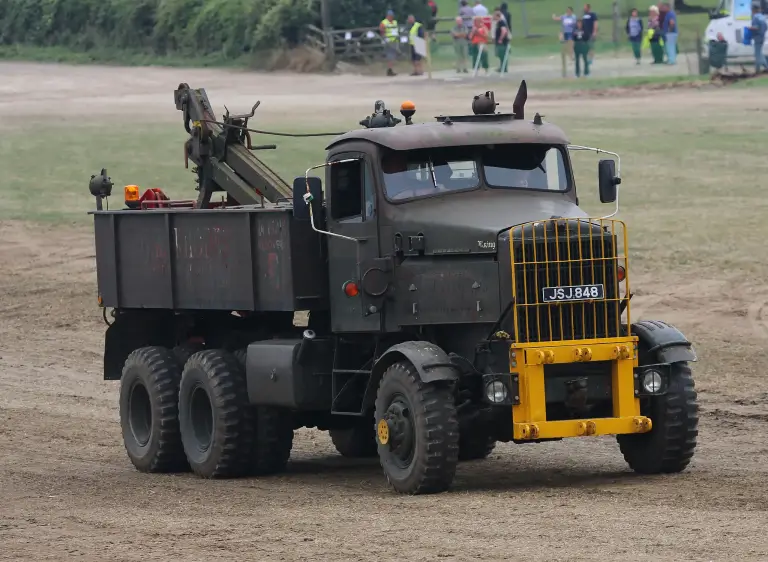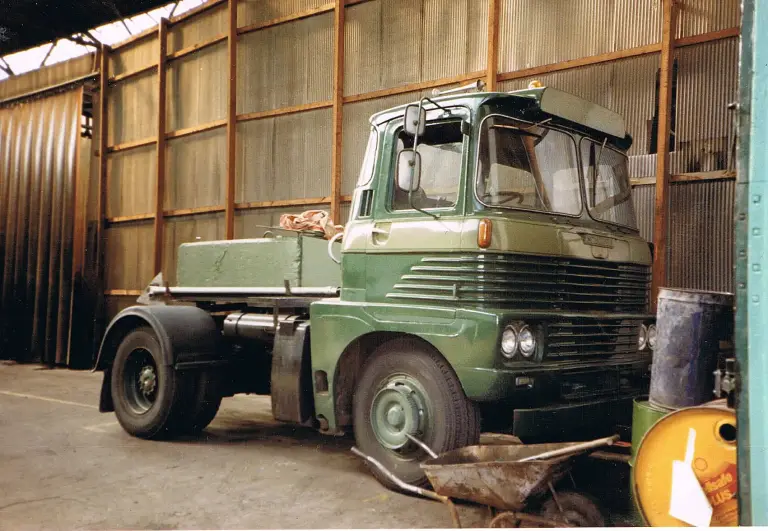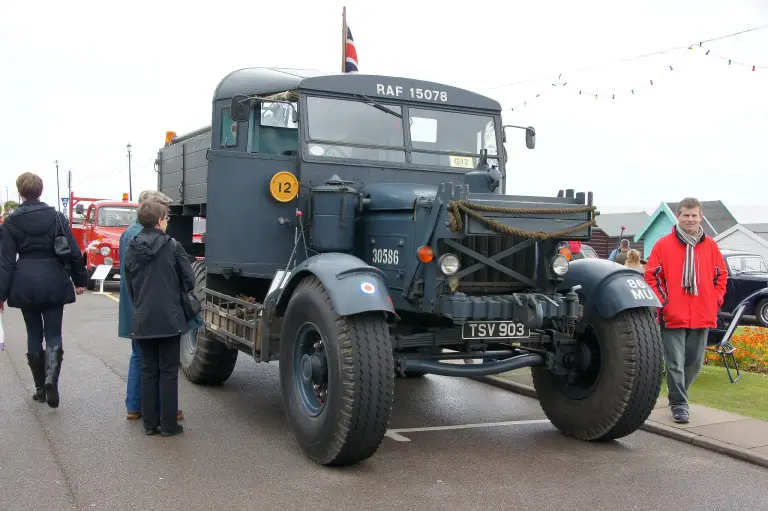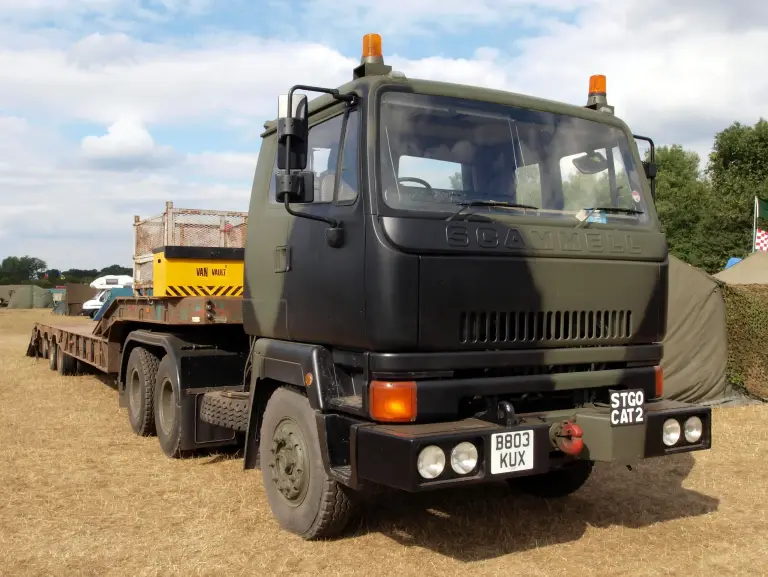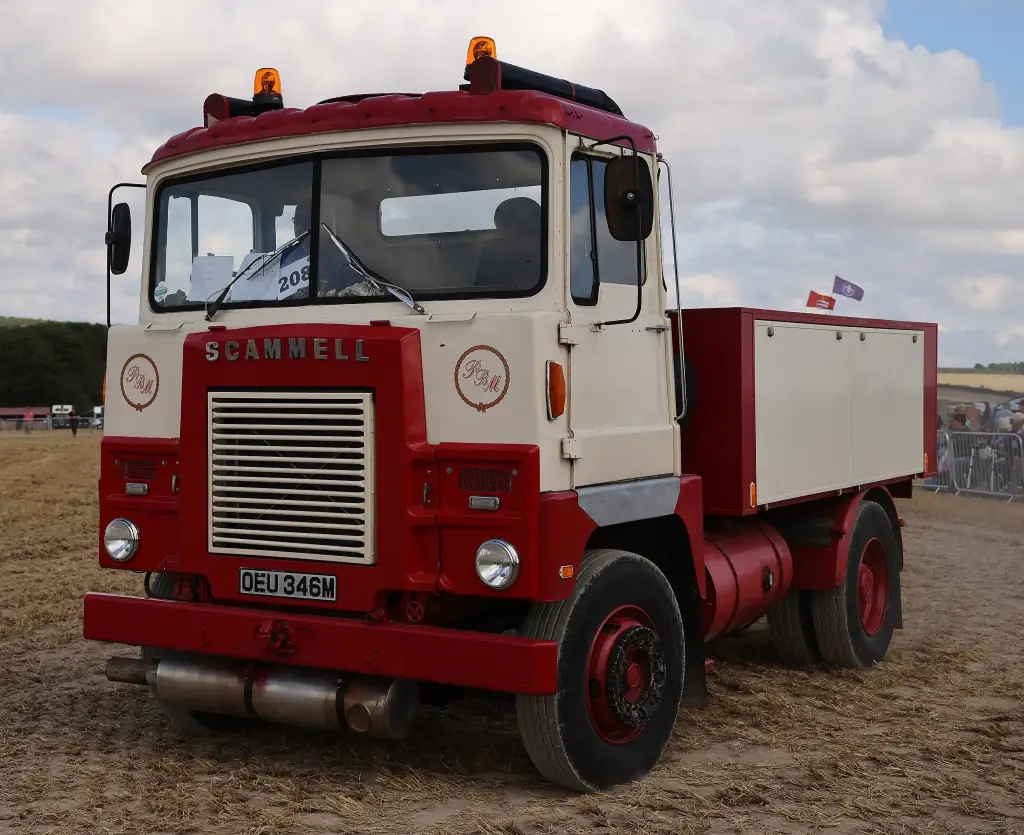
The Scammell Crusader was the Watford works’ heavy lorry of the motorway age. Introduced in 1968, it came as a 4×2, 6×4 and 8×4, offered engines from Detroit Diesel, Cummins, Rolls-Royce and Leyland, and was bought by the British Army in numbers for use as a heavy tractor and recovery vehicle.
Scammell Crusader at a glance
| Maker | Scammell Lorries Ltd, Watford |
|---|---|
| Launched | 1968, Earls Court commercial vehicle show |
| First example built | August 1968 |
| Types | 4×2, 6×4 and 8×4 |
| Early engine | Detroit Diesel 8V71N two-stroke, 273 hp |
| Later engines | Rolls-Royce Eagle 220 and 280 |
| Gearbox of the early 6×4 | Fuller RoadRanger, 16 speeds |
| Military engine | Rolls-Royce six-cylinder turbo diesel, 305 hp, 12.2 litres |
| Military gearboxes | 9 speeds (20-tonne tractor), 15 speeds (35-tonne tractor) |
| Military top speed | 85 km/h (20-tonne); 66 km/h (35-tonne) |
| Fuel | 318 litres; 455 litres on the heavy military tractor |
| Winch | 8 tonnes, heavy military tractor only |
English Wikipedia has no separate article on the Crusader; the Dutch article is the fullest account, with further detail from the French company article.
History of the Scammell Crusader
Leyland’s new heavy lorry
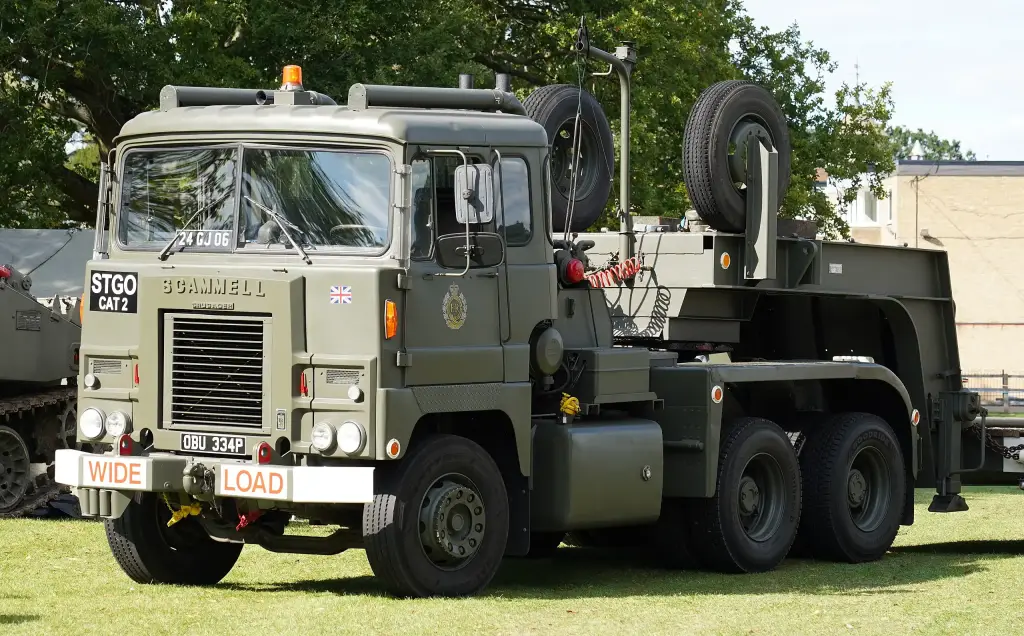
In 1964 British lorry legislation was changed, allowing heavier vehicles on the road and giving manufacturers the chance to design to the new limits. Scammell, by then part of the Leyland group, began work on a heavier model, which was sold both under its own name and as the Leyland Crusader. The first Crusader left the factory in August 1968, and the type was shown in London at the Earls Court commercial vehicle exhibition that year. It was available as a 4×2, 6×4 and 8×4; the 6×4 came first and was used as a tractor unit but also as the basis for concrete mixers, tippers and recovery vehicles.
Power for long-distance work
The Crusader was designed for high-speed long-distance haulage, typically covering 250,000 km a year, and on a repair-by-replacement philosophy intended to cut downtime. The early 6×4 used the General Motors Detroit Diesel 8V71N two-stroke of 273 hp, driving through a Fuller RoadRanger 16-speed constant-mesh gearbox and an Albion double-disc axle with double reduction and lockable cross shafts; the final drive sat in the hubs so that the differential housing did not reduce ground clearance. Scammell used the same rear bogie on the Routeman 24-tonne double-drive 8×4 tipper shown at the same exhibition. Most British 32-tonners of the day had between 150 and 220 hp, so 273 hp drew attention, much of it unfavourable from conservative operators. With the active encouragement of Walter Batstone, then head of engineering at British Road Services, Scammell quickly developed one- and two-axle models powered first by Rolls-Royce Eagle six-cylinder diesels of 220 or 280 hp; the new model appeared at the Scottish motor show at Glasgow’s Kelvin Hall in November 1969. A four-axle 8×4, the Samson, was sold in limited numbers.
With the British Army
The army ordered more than 500 Crusaders. There were three versions: a light tractor for loads up to 20 tonnes with a two-seat cab, a heavy tractor for loads up to 35 tonnes with a cab for four, and a recovery vehicle on the heavy chassis. All had six wheels, four of them driven, and the same Rolls-Royce six-cylinder turbo diesel of 305 hp at 2,100 rpm and 12.2 litres. The difference lay mainly in the gearbox, with nine forward speeds in the light version and fifteen in the heavy, which gave 85 km/h and 66 km/h respectively; fuel capacity was 318 litres, or 455 litres on the heavy tractor, for a range of about 500 km. Only the heavy version had a winch, rated at eight tonnes. In 1977 the army ordered 130 Crusaders as recovery vehicles and the RAF two more; with the same cab, engine and gearbox as the heavy tractor, they could recover vehicles of up to 16 tonnes. Military Crusaders were usually fitted with a 15-speed Fuller gearbox and an eight-tonne winch, and the type was also used as a 6×4 wrecker with an EKA underlift or as a tractor for 35-tonne trailers and 30-tonne tank bridge transporters. The army replaced its Crusaders at the end of the 1990s with Seddon Atkinson tractors.
Design and features
- Steel cab: offered as a day cab or a sleeper cab.
- Engine choice: Detroit Diesel, Cummins, Rolls-Royce or Leyland, according to the customer.
- Strong chassis: its robust frame made the Crusader a favourite of heavy haulage operators.
- Military equipment: 15-speed Fuller gearbox and eight-tonne winch on army vehicles.
- Power for its day: 273 hp when most 32-tonners had 150 to 220 hp.
Scammell Crusader versions
- 4×2 tractor: the two-axle unit developed after the first 6x4s.
- 6×4: the original form, used as a tractor and as the basis for mixers, tippers and recovery vehicles.
- 8×4 Samson: a four-axle version sold in small numbers.
- Military 20-tonne tractor: nine-speed gearbox, two-seat cab, 85 km/h.
- Military 35-tonne tractor: fifteen-speed gearbox, four-seat cab, eight-tonne winch, 66 km/h.
- Military recovery vehicle: ordered in 1977, able to recover loads of up to 16 tonnes.
The Crusader shared its rear bogie with the Routeman tipper. Later heavy Scammells were the S24 and the S26; more lorries are in the Scammell collection.
Sources
- Scammell Crusader, Dutch Wikipedia: launch, versions, engines, military specifications and orders
- Scammell, French Wikipedia: 1964 legislation, Earls Court show, Detroit Diesel and Fuller details, Samson, army use
- Scammell, English Wikipedia: company history and Leyland group background