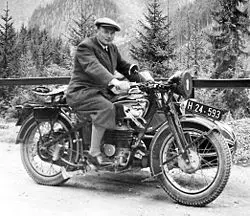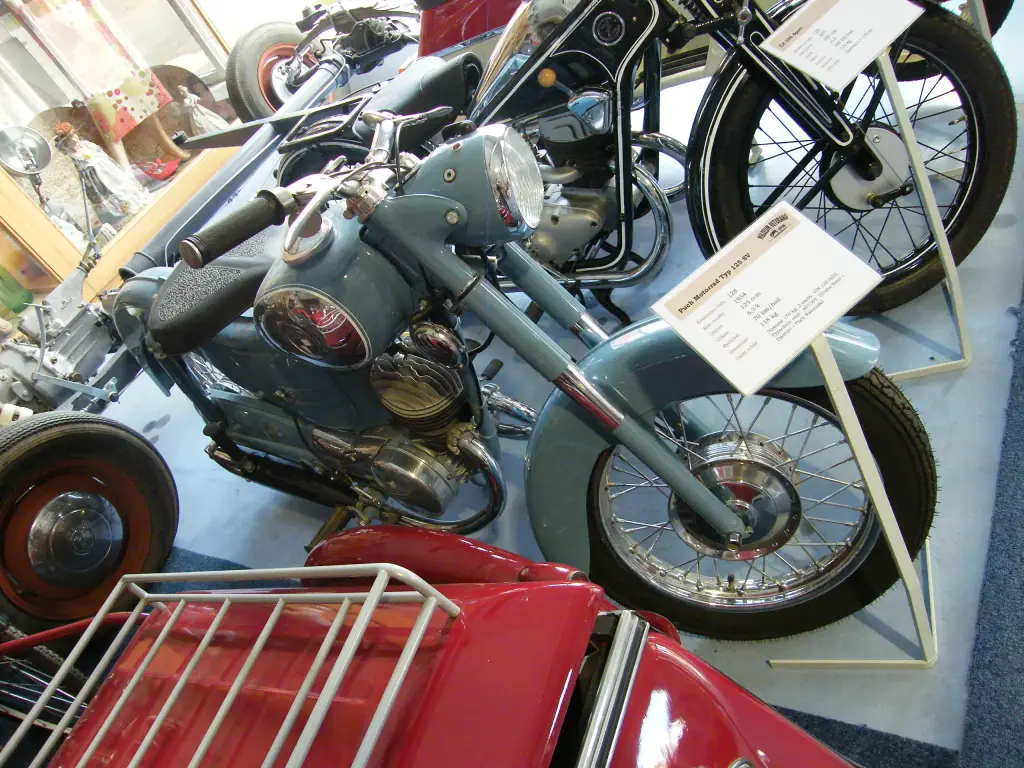
The Puch 125 SV and Puch 175 SV are two motorcycle models that Steyr Daimler Puch AG built between 1953 and 1967. The letters SV stand for Schwingarm-Vollnabenbremsen — swing arm and full-hub brakes — and both used Puch’s split-single two-stroke engine with two pistons sharing a single combustion chamber.
Puch 125 and 175 SV at a glance
| Maker | Steyr Daimler Puch AG, Graz, Austria |
|---|---|
| Production | 1953–1967 |
| Models | 125 SV and 175 SV; sport versions 125 SVS and 175 SVS |
| Engine | split-single two-stroke, two pistons in line, one combustion chamber |
| Rear piston | driven through a linkage rod from a common crank throw |
| Frame | pressed sheet-steel shell frame, closed torsionally stiff profile |
| Suspension | swing arm, full-hub brakes (SV) |
| Final drive | secondary chain fully enclosed in sheet steel |
| Paint | blue to 1956, green in 1957, black afterwards; SVS red |
| Military use | 175 SV engine in the Puch 175 MCH |
The 125 and 175 SV are described only in the German Wikipedia, and this page is based on that article, with the launch date from the English article on Puch.
History of the Puch 125 and 175 SV
Puch launched the 125 and 175 SV in 1953, the same year in which the larger 250 SGS appeared. Both models were built until 1967. They shared the same technical idea: a split-single two-stroke in which two pistons lie one behind the other in the direction of travel and share a single combustion chamber. The rear piston is driven through a linkage rod from a common crank throw, a design developed and patented by Arnold Zoller. With its asymmetric port timing the layout gave lower fuel consumption than similar engines with symmetric timing, and Puch used it across its larger motorcycles of the period.
The shell frame
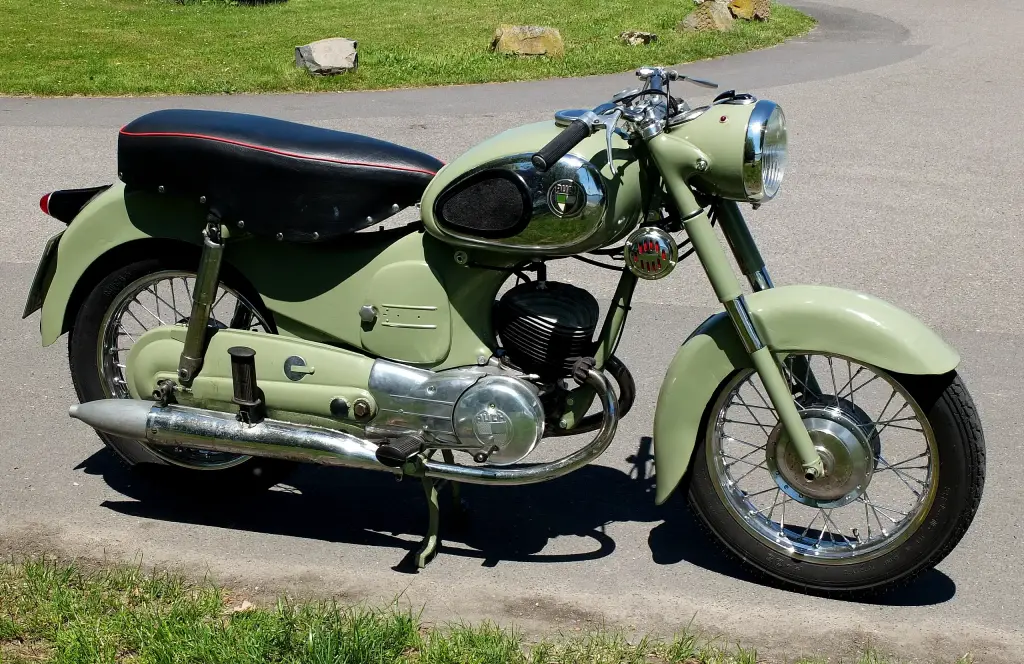
The frame is a shell frame pressed from steel sheet, with a closed and torsionally stiff profile. The rear mudguard, the battery and tool box and the upper mounts of the rear suspension form an organic unit with the shell frame. The secondary chain to the rear wheel is fully enclosed in sheet-metal parts, and every model had a drive shock absorber in the rear hub and an adjustable steering damper as standard. The result was a motorcycle built for weather and long use rather than for light weight.
Colours and the SVS
Until 1956 the frame and fittings of the 125 SV and 175 SV were painted blue, briefly green in 1957 and black from then until the end of production. The sport versions were painted red throughout their production. Both capacities were also offered as the more powerful 125 SVS and 175 SVS, with two carburettors — the second mounted on the right-hand side of the machine.
Military use
The engine of the 175 SV was used for the military motorcycle Puch 175 MCH (Moto-Cross-Heer), which carried the split-single layout into military service. The SV models themselves remained civilian machines, sold as solid middleweight motorcycles in a market that was moving towards smaller mopeds and scooters.
Design and features
- Split-single engine: two pistons in line with one combustion chamber and asymmetric port timing.
- Zoller linkage: the rear piston is driven through a linkage rod from a common crank throw.
- Shell frame: steel sheet pressed into a closed, torsionally stiff profile.
- Enclosed drive: the secondary chain runs fully enclosed in sheet steel.
- Standard fittings: a drive shock absorber in the rear hub and an adjustable steering damper on every model.
Puch 125 and 175 SV versions
- 125 SV: the smaller capacity model, 1953–1967.
- 175 SV: the larger capacity model, 1953–1967.
- 125 SVS: sport version with two carburettors, painted red.
- 175 SVS: the same treatment for the 175, red throughout.
- 175 MCH: military motorcycle using the 175 SV engine.
The bigger Puch 250 SGS used the same split-single idea, and the Puch MS 50 was the moped that followed in 1954. More Puch models are in the Puch collection.
Sources
- Puch 125/175 SV, German Wikipedia: engine, frame, colours, versions, military use
- Puch, English Wikipedia: launch of the 125 and 175 SV in 1953