The Praga Mignon was a passenger car built by the automobile department of the First Czech-Moravian Engineering Works in Prague-Libeň from 1911 to 1929. It was the first model entirely designed and built by Praga, the work of a young engineer named František Kec, and by the custom of the day it was marketed as the Praga 16 HP.
Praga Mignon at a glance
| Maker | Praga, Prague-Libeň |
|---|---|
| Production | 1911–1929, eighteen series |
| Designer | František Kec |
| Marketing name | Praga 16 HP |
| First-series engine | 1,100 cc side-valve four |
| Later engine | 1,848 cc four |
| Six-cylinder from 1927 | 2,498 cc, then 2,638 cc |
| Wheelbase | 3,000 mm |
| Weight | 1,300 kg |
| Top speed | 70 km/h |
| Gearbox | four-speed |
| Built in total | 5,000–6,000 |
Built on the Czech and German Wikipedia articles; both describe the same car and the German page gives the series-by-series production figures.
History of the Praga Mignon
The Mignon was designed by František Kec, an engineer who had come from Laurin & Klement and who drew the versatile middle-class car in six months. It was conceived as a people’s car that would put the engineering firm Praga on to the passenger-car market, and it replaced the licence-built Praga Charon as the firm’s first own model. The original body was a five-seat, three-door torpedo phaeton with a water-cooled side-valve four and rear-wheel drive through a four-speed gearbox.
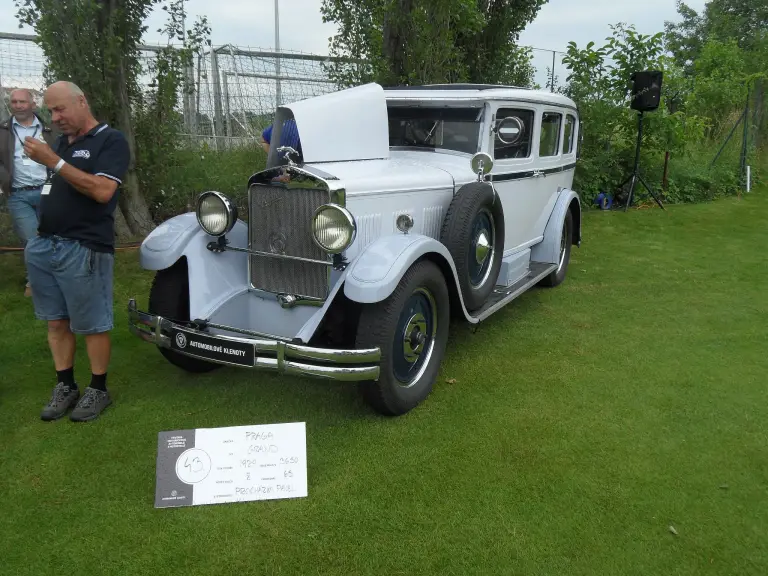
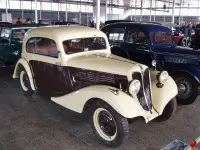
The first series used a 1,100 cc engine, enlarged from the third series to 1,848 cc. The car was an elegant saloon of 3 m wheelbase and 1,300 kg with a top speed of 70 km/h. From 1925 the Prague coachbuilder Josef Sodomka began to contribute bodies, and to satisfy wealthier customers the Mignon was also built as a closed town coupé or sedan, the most popular versions, while other bodies were made to order as was then customary.
In 1927 the four was replaced by a 2,498 cc six, enlarged to 2,638 cc two years later. In its later versions the Mignon had rigid axle suspension, hydraulic brake assistance, twin Zenith carburettors with triple diffusers, Bosch ignition, a removable Ricardo cylinder head and a four-bearing crankshaft. A hydraulic device prevented the driver from pressing the accelerator when oil pressure was insufficient, and, as on all Pragas, the indicators returned to neutral when the steering straightened. The interior was trimmed in leather and plush, with pull-down blinds, interior lamps, a telephone to the driver, a cigar lighter and, for gentlemen, walking-stick holders. The Depression ended production after eighteen series, with total output variously given as 5,000 to 6,000 cars.
Design and features
- Praga’s first own design: the Mignon ended the licence-built Charon era and established the firm as a car maker.
- Long engine evolution: from a 1,100 cc four to an 1,848 cc four and finally a 2,638 cc six.
- Coachbuilt bodies: Sodomka of Prague joined in 1925, and customers could order bodies to their own taste.
- Luxury details: leather and plush trim, blinds, a telephone to the driver and oil-pressure protection for the engine.
Praga Mignon versions
- Mignon series 1–3: 1,100 cc four, torpedo phaeton body.
- Mignon series 4–15: 1,848 cc four, later with brake assistance and Ricardo head.
- Mignon series 12: a batch of 100 cars with the bore reduced to 69 mm.
- Mignon series 16–17: the new 2,498 cc six, 202 cars in 1927–1928.
- Mignon series 18: 2,638 cc six with 50 PS, 200 cars in 1929.
- Body styles: torpedo phaeton, town coupé, sedan and coachbuilt bodies to order.
The Mignon was the smaller companion of the luxury Praga Grand, and its place in the range was later taken by the Praga Alfa. More cars are in the Praga collection.
Sources
- Praga Mignon, Czech Wikipedia: origin, design, engines, equipment, production
- Praga Mignon, German Wikipedia: series, engine sizes, power outputs, prices, production numbers