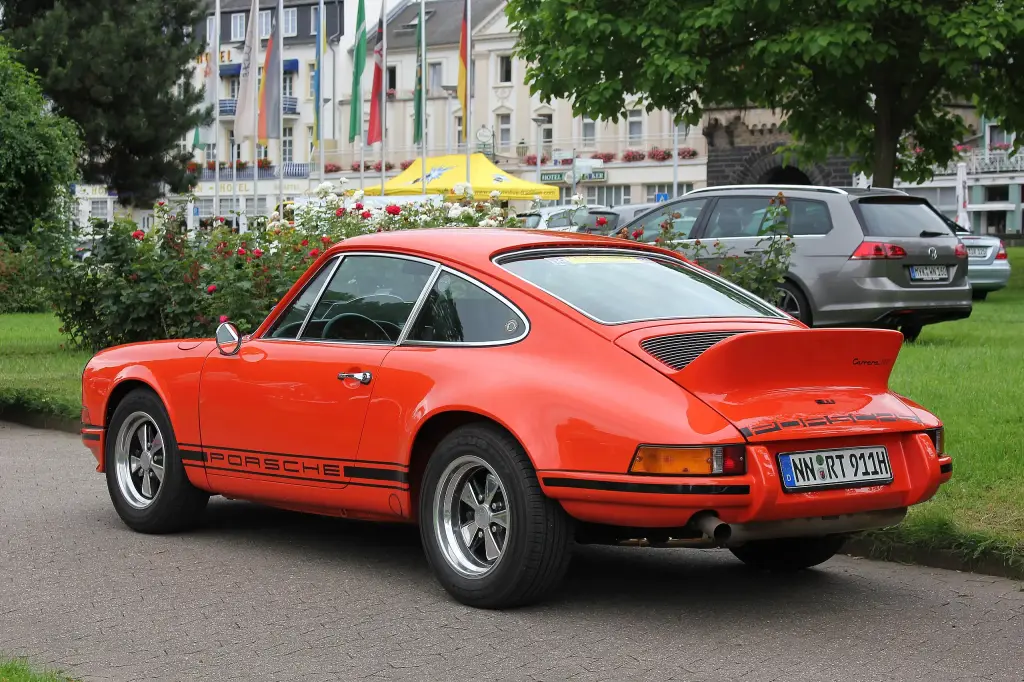
The original Porsche 911, known in Germany as the Neunelfer, is the sports car that replaced the 356. A prototype was shown to the public in autumn 1963, production began in September 1964 and continued through 1989, when a heavily modified car still sold as the 911 took over.
Porsche 911 at a glance
| Maker | Porsche, Stuttgart-Zuffenhausen |
|---|---|
| Shown | Frankfurt Motor Show, 12 September 1963, as the 901 |
| Production | September 1964 – 1989 |
| Design | Ferdinand Alexander “Butzi” Porsche, body by Erwin Komenda |
| Engine | 1,991 cc air-cooled flat-six, 130 PS |
| Engine type | Typ 901, single overhead camshaft, dry sump |
| Gearbox | five-speed Type 901 transaxle |
| Front suspension | MacPherson struts |
| Rear suspension | semi-trailing arms |
| Steering | rack and pinion |
| Body | 2+2 coupé, small rear seats |
| Successor | 964 of 1989, still sold as the 911 |
History of the Porsche 911
The 911 began as a styling and engineering exercise meant to modernise the 356. A T7 body project led by Butzi Porsche applied a modified style and a 100 mm longer wheelbase to a 356B Karmann hardtop in 1959–1960, while Erwin Komenda worked on the T6 body that became the 1962 356B facelift. The longer body was used first for a rear “+2” seat, not for a six-cylinder engine.
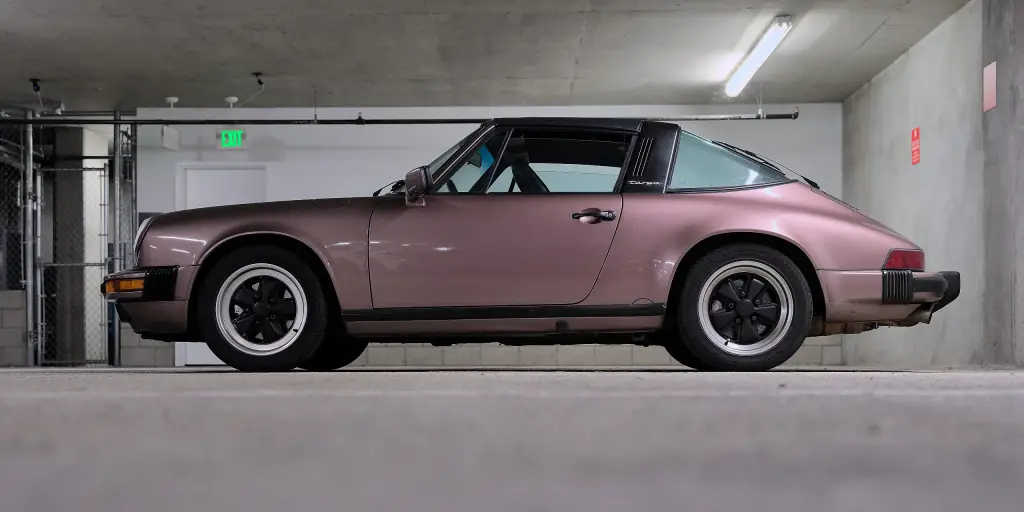
Engines were tried in parallel. A T7 prototype ran with a pushrod 1600 Super engine as the Typ 695, then with the 2-litre four-cam four of the 356B Carrera as the Typ 754, which served as a benchmark against the Typ 901 prototypes. The new six was first drawn as the Typ 745 with an unusual horizontal pushrod layout; Ferry Porsche rejected it, and the air-cooled 2-litre Typ 821 with a single vertical fan was drafted instead. Ferdinand Piéch argued for a dry-sump engine with a lower centre of gravity, and the dry-sump Typ 901 engine was adopted, with an intermediate shaft below the crankshaft driving two chains and a camshaft in each cylinder head.
The final 1,991 cc engine had an 80 mm bore and a 66 mm stroke and used Solex 40PI carburettors. Butzi Porsche then merged the front and rear styling of the T7 body with the space needed for the six, the Typ 901 four- or five-speed transaxle, rack-and-pinion steering, MacPherson struts at the front and semi-trailing arms at the rear. The result was 70 mm narrower and 120 mm longer than the 356B body, with a wheelbase 111 mm longer.
The car was revealed as the Porsche 901 at the Frankfurt Motor Show on 12 September 1963. Peugeot protested, because it held rights in France to car names formed of three numbers with a zero in the middle. Rather than use a different name in France, Porsche renamed the model 911 for every market, although the engine designation and parts prefix stayed 901. A total of 82 cars were built as the 901 before the badge on the engine lid changed and the car went on sale as the Porsche 911 in 1964.
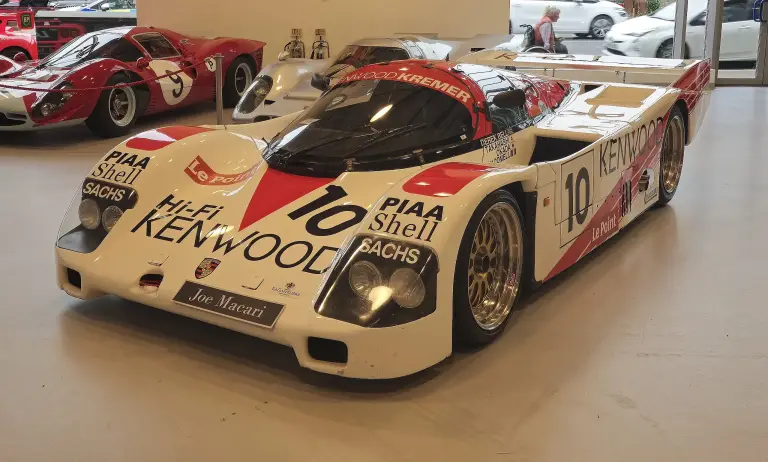
The first series was the O series, built until July 1967; it was followed by the 1968 A series and the 1969 B series. These early cars used the Typ 901/01 all-aluminium air-cooled flat-six of 1,991 cc and 130 PS, with a five-speed manual gearbox. The 2+2 layout gave a small rear seat, much as in the 356. From the start the 911 was modified by private teams and by the factory for racing and rallying, and the original series is often called the most successful competition car ever built once its derivatives are counted, above all the 935 that won at Le Mans outright against prototypes.
Design and features
- Rear-engine layout: the layout Porsche had used since the 356, kept against fashion and made to handle.
- Air-cooled flat-six: dry-sump Typ 901 engine with a single vertical fan.
- Modern chassis: MacPherson struts, semi-trailing arms, rack-and-pinion steering and a five-speed transaxle.
- Racing pedigree: developed for competition from the first year, ending in Le Mans-winning derivatives.
Porsche 911 versions
- 901 (1963–1964): the first 82 cars, badged 901 before the Peugeot protest.
- O series (1964–1967): the original 2.0-litre 911, 130 PS.
- A series (model year 1968): the first update of the range.
- B series (model year 1969): the last of the early 2.0-litre cars.
- Racing derivatives: factory and privateer cars, including the 935.
The 911 was joined by the cheaper four-cylinder Porsche 912, and in 1989 it was replaced by the Porsche 964. More cars are in the Porsche collection.
Sources
- Porsche 911 (classic), English Wikipedia: prototypes, engine, naming, series