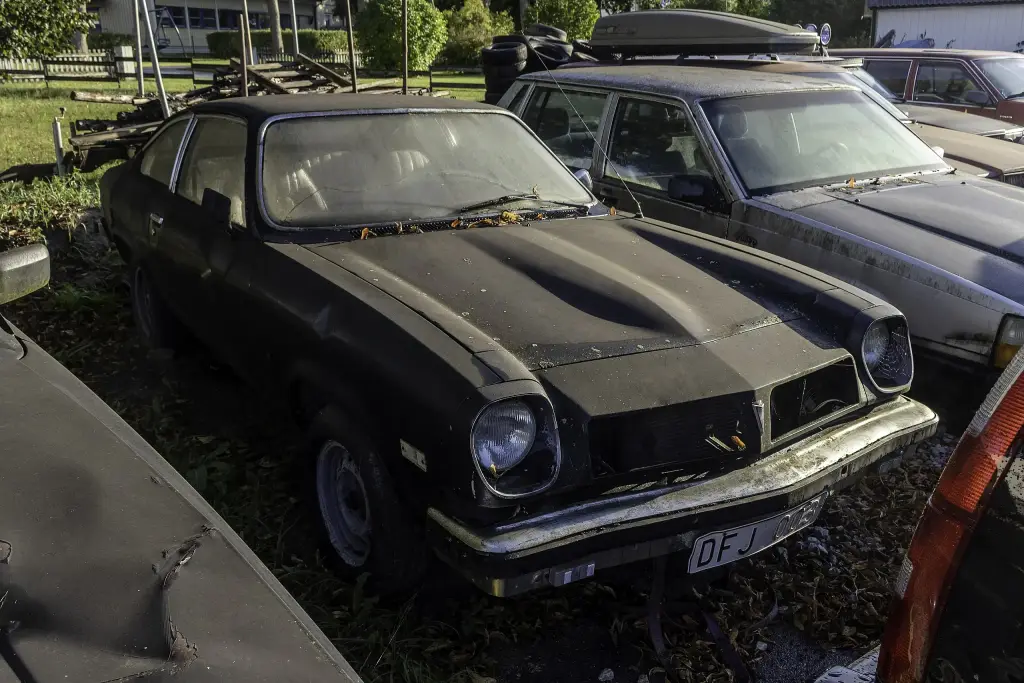
The Pontiac Astre is a subcompact car marketed by Pontiac as a rebadged variant of the Chevrolet Vega. It went on sale in Canada for 1973 and 1974 and reached the United States for 1975, competing with cars such as the Mercury Bobcat, Volkswagen Rabbit and Toyota Corolla.
Pontiac Astre at a glance
| Maker | Pontiac, General Motors |
|---|---|
| Production | 1973–1977, Canada first |
| Basis | Chevrolet Vega |
| Platform | GM H-body |
| Bodies | hatchback coupe, notchback sedan, Safari wagon, panel delivery |
| Wheelbase | 97.0 in (2,460 mm) |
| Engine | 2.3 L aluminium four, single overhead cam |
| 1977 option | Pontiac 2.5 L iron four, overhead valves |
| Gearboxes | three- and four-speed manual, five-speed overdrive, three-speed automatic |
| Name | “astre” is Catalan for star |
History of the Pontiac Astre
In 1968 GM chairman James Roche announced that General Motors would build a new small car in the United States within two years. Pontiac’s own small-car programme had been rejected, and the car was developed as a corporate project rather than a divisional one: Ed Cole formed a GM design team for the Chevrolet Vega under William Munser, who had worked on the Camaro. Pontiac received its own version for the Canadian market, named Astre for 1973, and American Pontiac dealers finally got a subcompact when it arrived there for 1975.
The name follows the Vega convention, “astre” being Catalan for star. The car was built on the H-body with a 97-inch wheelbase and a 65.4-inch width, with short-and-long arm front suspension with coil springs and a four-link coil-sprung rear axle, replaced from 1976 by a torque-arm design. Steering was recirculating ball with optional power assistance, and the brakes were front discs and rear drums.
What made it a Pontiac
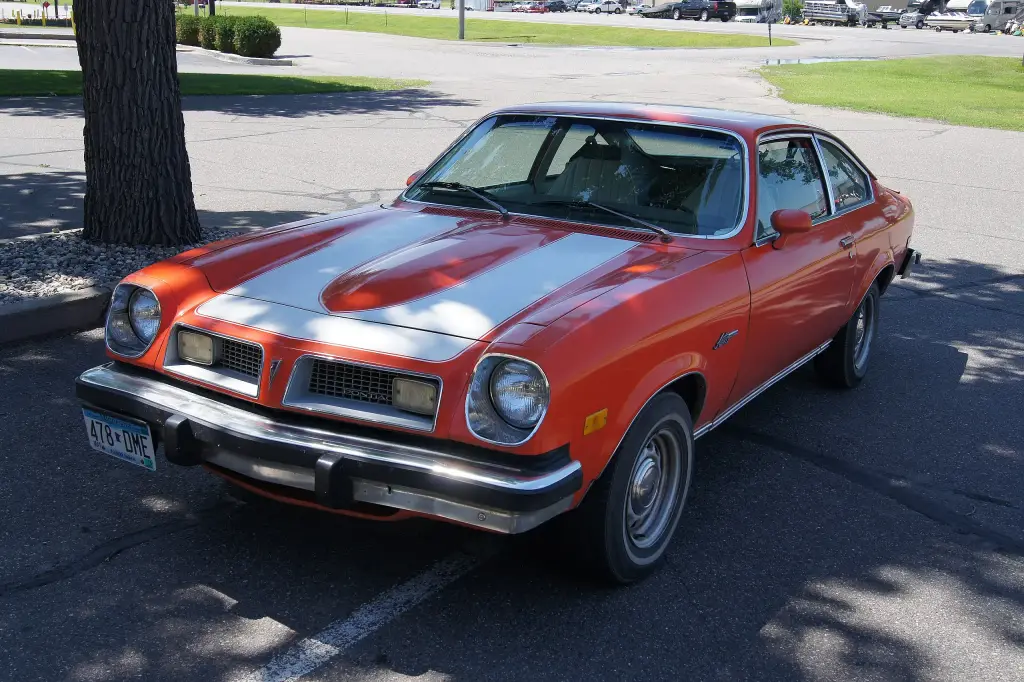
The Astre carried Pontiac’s split grille, emblems and steering wheel, with an upgraded interior. The 1973 cars had a black grille, clear parking lamp lenses and chrome headlamp bezels on non-GT models, and the 1974–1977 cars used Firebird-style tail lights on the notchback and hatchback. The hatchback coupe had a lower roofline and a fold-down rear seat; the notchback was the cheapest and the only version with an enclosed boot; the Safari wagon had fixed rear side glass and a lift-up tailgate. A panel delivery with steel panels instead of the rear side glass was sold through 1975.
The SJ hatchback and SJ Safari wagon brought soft nylon upholstery, cut-pile carpet, rally instruments and radial tyres, and a GT package combined the cheaper interior with the SJ’s chassis and engine. The 1974 cars were the only ones with major body changes, made to meet the new 5 mph bumper rules, with a slanted header panel, a new split grille and larger aluminium bumpers front and rear.
1975 and the end
The 1975 Astre, launched in the United States in September 1974, brought more than 267 changes including high-energy electronic ignition and a catalytic converter, with power brakes and a tilt wheel as new options; the panel delivery was dropped at the end of that year. A budget S series was added during 1975, and a dealer special called the “Lil Wide Track” added a front air dam, rear spoiler, window louvres and stripe decals for a little over $400. The Astre was cancelled with the Vega after 1977, though the wagon continued for 1978 and 1979 as part of the Sunbird line.
Design and features
- Vega underneath: the same H-body, 2.3 L aluminium engine and suspension as the Chevrolet.
- Pontiac face: split grille, Firebird-style tail lights and a better-trimmed interior.
- Four body styles: hatchback, notchback, Safari wagon and a rare panel delivery.
- Canadian origin: two years on sale in Canada before American dealers got the car.
Pontiac Astre versions
- Astre (1973–1977): the standard car in all body styles.
- S series (1975): the budget model added during the year.
- SJ hatchback and SJ Safari: the better-equipped versions with rally instruments.
- GT package: SJ running gear with the cheaper interior.
- Lil Wide Track (1975): a dealer-installed appearance package.
The Astre shared its body with the Sunbird, which absorbed its wagon in 1978, and it sat below the Ventura. More models are in the Pontiac collection.
Video: 1976 Pontiac Astre Two Door Coupe Yel Eust092912
Video by Jack R on YouTube.
Sources
- Pontiac Astre, English Wikipedia: history, engines, body styles, yearly changes