The Pontiac 6 was a six-cylinder automobile built by Pontiac, a division of General Motors, from 1926 to 1932 and again from 1935 to 1940. It was a cheaper companion to the Oakland Six and was sold through GM’s Oakland dealerships.
Pontiac 6 at a glance
| Maker | Pontiac, General Motors |
|---|---|
| Production | 1926–1932 and 1935–1940 |
| First series | Series 6-27 |
| Launched | 3 January 1926 |
| Built at | Oakland factory, Pontiac, Michigan |
| Engine | split-flathead straight-six by Henry M. Crane |
| First-year price | $825 for the coupe or coach |
| First-year output | 76,742 cars |
| Last first-generation series | 402 Six of 1932, 114 in wheelbase |
| 1932 companion | Series 302 V8, renamed from the Oakland Model 301 |
The English article covers the first generation in detail and only begins the second; this page follows it and says no more about 1935–1940.
History of the Pontiac 6
Pontiac was the first of GM’s companion makes, introduced to fill the price gap between Cadillac, Buick, Oldsmobile, Oakland and Chevrolet. It was presented as an affordable Oakland, in the same programme that brought LaSalle for Cadillac, Marquette for Buick and Viking for Oldsmobile. Customers bought the cheaper Pontiac and avoided the more expensive Oakland, and after the Wall Street crash of 1929 GM considered cancelling both before deciding to keep Pontiac.
First generation, 1926–1932
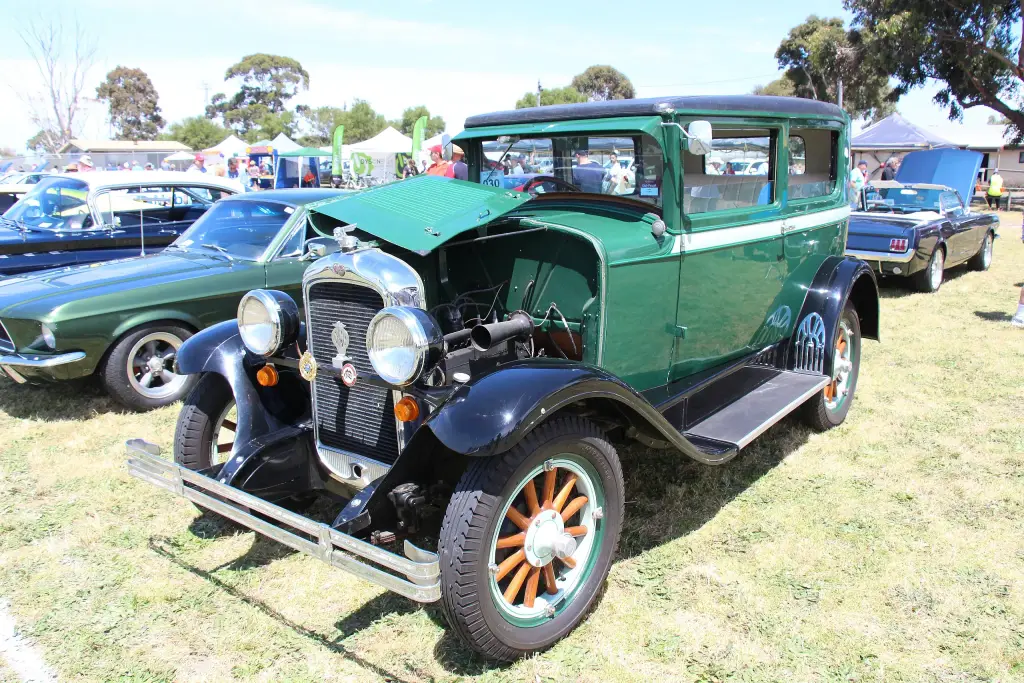
The first car, the Series 6-27, used Fisher Body coachwork and came only as a two-door two-passenger coupe or a five-passenger coach, at $825. Manufacture began at the Oakland factory in Pontiac, Michigan, on 28 December 1925 and the car was introduced on 3 January 1926. It used a split-flathead straight-six designed by Henry M. Crane. Options were limited to bumpers, a rear-mounted spare tyre and a heater; the coach was painted sage green with red striping and the coupe Arizona grey with landau bars on the roof, both on black fenders. In August three more body styles were added, and the Deluxe models could be recognised by having the body and fenders in one colour.
For 1927 the car was renamed the New Finer Series 6-27 and gained a Sport Roadster and Sport Coupe, with an optional rumble seat. Prices ran from $775 to $975 for the Deluxe Landau Sedan. The 1928 New Series 6-28 brought higher-crowned front fenders and renamed the Deluxe models “Sport”; the Indian head mascot lost its headdress, now representing an Indian brave. Every body style stayed under $1,000.
In January 1929 came the New Big 6, Series 6-29, with displacement up to 200 cu in and styling influenced by the Vauxhall 20-60 that GM had bought in 1925. Cars built between August and October 1929 were marked 6-29A. The January 1930 Big 6 Series 6-30B brought a rearward-sloping windscreen, a beltline moulding and exterior sun visors, and model-year production fell to 62,888.
The 1931 Fine 6 Series 401 had a 112-inch wheelbase and seven body styles, priced from $675 to $785; production rose to 84,708. It was the last year for Oakland. For 1932 Pontiac offered two products for the first time: the Series 302 V8, renamed from the Oakland Model 301 V8, and the Series 402 Six with a 114-inch wheelbase, 18-inch Kelsey-Hayes wire wheels as an option and four-wheel mechanical drum brakes.
Second generation
Pontiac management decided to reintroduce a six-cylinder engine for 1935, and the model continued in the range until 1940.
Design and features
- Affordable entry: priced below Oakland, from $675 by 1931, close to Chevrolet money.
- Crane straight-six: a split-flathead engine designed by Henry M. Crane and built in Pontiac, Michigan.
- Annual restyling: new series nearly every year, in the planned-obsolescence tradition of Harley Earl’s Art and Color Section.
- Survival value: the six outsold Oakland and kept the Pontiac name alive through the Depression.
Pontiac 6 versions
- Series 6-27 (1926–1927): coupe, coach, then roadster and sport coupe.
- Series 6-28 (1928): higher fenders, Deluxe renamed Sport.
- Series 6-29 (1929): the New Big 6 with a 200 cu in engine.
- Series 6-30B (1930): sloping windscreen and 62,888 cars built.
- Series 401 (1931): 112-inch wheelbase, seven body styles.
- Series 402 (1932): 114-inch wheelbase, the last of the first generation.
The six-cylinder Pontiac sat at the bottom of the range, below the eight-cylinder Deluxe and the later Torpedo. More models are in the Pontiac collection.
Sources
- Pontiac 6, English Wikipedia: series, prices, production, engines